
Scam of the Day
Scam of the day – February 2, 2020 – Fraudulent Social Security Phone Calls
Last week the Senate Aging Committee released its annual report in which it indicated that fraudulent phone calls where scammers pose as Social Security Administration employees asking for personal information were the number one phone scam last year. Phony calls purporting to be from the IRS were the top scam phone calls for the previous five years. Scammers call on the phone under a variety of pretexts and ask for the Social Security numbers of the people they call. In the hands of an identity thief, it is very simple matter for a criminal to take a person’s Social Security number and use it to make the person a victim of identity theft. Some of the excuses given by the scammers calling are that criminal activity has been linked to the particular number and they need to confirm that you are not a criminal or that there has been a computer problem at the Social Security Administration and they need to confirm your Social Security number. Making the problem worse is that through a technique called “spoofing” scammers are able to manipulate your Caller ID so that the call you receive appears to come from the Social Security Administration.
TIPS
An easy way to avoid becoming a victim of this scam is to remember that the Social Security Administration will never initiate any contact with you by telephone call, email or text message. Any communication you receive in this manner that is not in response to your own telephone call or email is a scam. On a larger scale, it is important to remember that you can never be sure whenever you get an email, text message or phone call as to who is really contacting you so you should never provide personal information to anyone in response to an email, text message or phone call unless you have independently confirmed that the communication was legitimate and that information from you is absolutely required.
Many of these fraudulent calls come as robocalls. It is important to remember that the Social Security Administration will never contact you through a robocall. Seniors are particularly vulnerable to robocalls and should install anti-robocall programs on their phones. Here are some ways to stop robocalls:
Verizon has implemented new services to help its customers avoid illegal robocalls. The new Call Filter service offers spam alerts and new protections from robocalls for its wireless customers. Customers will receive alerts when a call is most likely a scam. The new Call Filter service will also automatically block robocalls based of the customer’s preferred risk level. The Call Filter service is offered in a free version and an enhanced version that among other things will enable customers to create a personal robocall block list. For more information about the Call Filter Services and how to sign up go to https://www.verizonwireless.com/solutions-and-services/call-filter/
There are a number of other options for preventing robocalls including a number of apps that for free or a small fee will reduce and in some instances prevent robocalls.
Samsung’s SmartCall informs you if the call you are receiving is from a known robocaller. This feature is available with newer Samsung Galaxy phones. Here is a link to information about SmartCall and instructions as to how to activate this app.
http://www.samsung.com/levant/apps/smart-call/
Google also has a spam blocker that will warn you when you are receiving a robocall and your screen will turn red. Here is a link to information about the app and how to install it.
https://play.google.com/store/apps/details?id=com.google.android.dialer&hl=en
AT&T also offers free apps to block robocalls on iPhones and Android phones. Here is a link to information about these apps.
https://www.att.com/features/security-apps.html?partner=LinkShare&siteId=TnL5HPStwNw-yrUS1uDw9WGvN._xt67yew&source=ECay0000000CEL00O
Verizon’s CallerName ID is a free service for iPhones and Android phones that will alert you to suspected robocallers. Here is a link to Verizon’s app.
https://www.verizonwireless.com/solutions-and-services/caller-name-id/
T-Mobile offers a free scam blocker of known robocallers for Android phones which you can activate by merely dialing #662#
Sprint offers a paid service to protect your iPhone or Android phone from robocalls. For more information, use this link
http://explore.t-mobile.com/callprotection
For landlines as well as smartphones there are a number of apps such as Nomorobo, Truecaller, Hiya, RoboKiller and YouMail that offer robocall blocking for free or for small monthly charges. Here is a link to those apps. I have used Nomorobo for years and find it to be tremendously useful
https://www.nomorobo.com/
https://www.truecaller.com/
https://hiya.com/
https://www.robokiller.com/
https://play.google.com/store/apps/details?id=com.youmail.android.vvm&hl=en_US https://www.youmail.com/home/apps
If you are not a subscriber to Scamicide.com and would like to receive daily emails with the Scam of the day, all you need to do is to go to the bottom of the initial page of http://www.scamicide.com and click on the tab that states “Sign up for this blog.”
Scam of the day – February 1, 2020 – Super Bowl Merchandise Scams
The Super Bowl, which will be played tomorrow in Miami between the Kansas City Chiefs and the San Francisco 49ers promises to be a hugely popular event with an estimated viewing audience of well more than a hundred million people. Following the game, many people will be be purchasing official Super Bowl merchandise, such as jerseys and caps. While it is relatively easy to examine merchandise when you purchase it at a brick and mortar store for the substandard quality of counterfeit merchandise as shown by low quality fabrics, loose stitching and off-center logos, you can never be sure when you buy Super Bowl merchandise online as to whether it is legitimate or not. Official NFL merchandise will have a hologram tag attached to the item, which is readily apparent in a store, but not when purchasing online.
TIPS
When buying Super Bowl merchandise online, the same rules for purchasing anything online apply. If the price looks too good to be true it generally is. Also, you are better off buying from established companies with good reputations and always pay with a credit card rather than a debit card because if it is a scam, it is simpler and easier to cancel the order with your credit card at less risk than if your debit card is used for such a purchase.
If you are not a subscriber to Scamicide.com and would like to receive daily emails with the Scam of the day, all you need to do is to go to the bottom of the initial page of http://www.scamicide.com and click on the tab that states “Sign up for this blog.”
Scam of the day – January 31, 2020 – Critical New Apple Security Updates
As was made abundantly clear by 2017’s massive Wannacry ransomware attack that exploited a vulnerability in the Microsoft Windows operating system for which Microsoft had already issued a security update and the massive Equifax data breach that also occurred as a result of Equifax not installing security updates to one of its software programs, constant updating of the software we all use with the latest security patches and updates is a critical part of avoiding scams and identity theft threats. Whenever important new security updates and patches are issued, we provide access to these so that you can update your software to provide better security on your computers, smartphones, laptops and other electronic devices. Updating your software with the latest security patches and updates as soon as possible is important because identity thieves and scammers are always finding and exploiting vulnerabilities in the software that we all use. Delay in updating your software could lead to disastrous results. However, it is also important to be sure that you are downloading legitimate patches and updates rather than being tricked by an identity thief or scammer into downloading malware under the guise of downloading a security patch or update. Today’s security update involves serious vulnerabilities in a number of Apple devices and programs.
TIPS
Here is a link to this recent security update: https://www.us-cert.gov/ncas/current-activity/2020/01/28/apple-releases-multiple-security-updates
If you are not a subscriber to Scamicide.com and would like to receive daily emails with the Scam of the day, all you need to do is to go to the bottom of the initial page of http://www.scamicide.com and click on the tab that states “Sign up for this blog.”
Scam of the day – January 30, 2020 – Tax Identity Theft Awareness Week
February third is the start of Tax Identity Theft Awareness Week. Income tax identity theft, by which identity thieves file phony income tax returns with counterfeit W-2s using the Social Security number and name of their victims is still a major problem for the IRS and taxpayers costing us all billions of dollars each year. However, when someone has stolen your Social Security number and filed an income tax return using your name, the problem becomes particularly personal. In addition, there are numerous other tax related scams including most significantly IRS impersonation phone call scams in which the scammer calls his or her victim posing as the IRS demanding an immediate payment of allegedly overdue taxes, often by gift cards and threaten dire consequences unless the payment is made immediately.
TIPS
The most important thing to remember is that the IRS will not initiate any communications with you by email, text message or phone. Their logo is easy to counterfeit and any personal information in the phishing email was probably gathered through data breaches in which the information about you was stolen. Never provide personal information in response to an email, text message or phone call that purports to be from the IRS. If you have any thought that the communication may be legitimate, call the IRS a the numbers indicated here which also let you know what information you will need to confirm your identity. https://www.irs.gov/help/telephone-assistance
Below is a short video produced by the Federal Trade Commission that explains a number of different tax scams, how they work and how to avoid them.
If you are not a subscriber to Scamicide.com and would like to receive daily emails with the Scam of the day, all you need to do is to go to the bottom of the initial page of http://www.scamicide.com and click on the tab that states “Sign up for this blog.”
Scam of the day – January 29, 2020 – Utility Scam
Scams involving utility bills for electric, water or gas services have long been popular with scammers. I recently received an email from a Florida Scamicide reader who received a phone call on her answering machine that indicated it was from Florida Power & Light threatening to terminate her electricity unless she called back in a half an hour and paid over the phone her overdue balance. The truth is that there was no outstanding balance and the Scamicide reader smartly called Florida Power & Electric at a telephone number that she got from her bill and was told that there was no problem and the call was a scam. Unfortunately, however, many people fall for scams such as this. This is a common scam where targeted victims are called on the phone and told that their utility service will be terminated for non-payment unless they pay by credit card or prepaid cards such as iTunes cards over the phone. In another utility scam, potential victims receive an email that has a link to take them to their bill where they are prompted to provide personal information or make a payment through a phony website. In another utility scam, people are called and told that they are eligible for a special promotion that will save them money. They just need to provide personal information.
All of these are scams. In the first, the targeted victim is coerced into giving their credit card or prepaid card information to a scammer. In the second, merely by clicking on the link to go to the phony bill, the victim ends up downloading keystroke logging malware or ransomware that can lead to identity theft or worse and in the third, there is no special promotion and the victim ends up providing personal information that leads to identity theft.
TIPS
You can never be sure when you get an email or a telephone call if it is really from a legitimate source. Email addresses can be hacked to appear legitimate and even if you have Caller ID, a scammer can use a technique called “spoofing” to make it appear that the call is from a legitimate caller. Trust me, you can’t trust anyone. Never provide personal or financial information to anyone in response to a telephone call, text message or email until you have independently confirmed that the communication was legitimate. In the case of a utility bill, merely call the number on the back of your bill and you will be able to confirm whether or not the communication was legitimate. Also, never click on links unless you have confirmed that they are legitimate. The risk is too great. It is also important to remember that no legitimate utility company will require you to immediately pay your bill over the phone with a prepaid card such as an iTunes card or a gift card.
If you are not a subscriber to Scamicide.com and would like to receive daily emails with the Scam of the day, all you need to do is to go to the bottom of the initial page of http://www.scamicide.com and click on the tab that states “Sign up for this blog.”
Scam of the day – January 28, 2020 – Census Job Opportunity Scams
Anything that is currently in the news or popular with the public is fodder for scam artists, the only criminals we refer to as artists. As I mentioned in the January 22, 2020 Scam of the day, the United States Census Bureau is conducting a national census as it is required by law to do every ten years and scammers are already attempting to exploit this fact. In the January 22, 2020 Scam of the day, I warned you in detail about how scammers are and will be attempting to get you to provide personal information that they will use for identity theft purposes under the guise of being official census workers. By the way, Scamicide.com archives all of the Scams of the day and is a good place to go to find information about any scam about which you may have concerns. Scamicide has more than 3,000 Scams of the day contained in our archives, which you can access at Scamicide.com
Today’s census related scam is about scammers posting job applications for people interested in temporary positions with the Census Bureau. As with so many scams, this scam exploits a kernel of truth, which is that the Census Bureau is seeking people to fill thousands of temporary positions. However, the scammers are using this as an opportunity to make you a victim of identity theft or steal your money. In one version of these census job scams, you are asked to pay an application fee in order to apply for a job. The truth is that no federal agency including the Census Bureau that charges an application fee. In another census job scams they ask you for your bank account information in order to set up a direct deposit of your wages, however, the scammers use that information to steal directly from your bank account. In yet another census job scam, the scammer asks for your Social Security number for purposes of tax withholding. Although legitimate employers need this information, the scammer will just use your Social Security number to make you a victim of identity theft. Finally, in another census job related scam, they actually send you a check, however the check is made out for an amount more than what they indicate is actually owed to you and ask you to wire them back the difference. Of course, the check that they send you is counterfeit, however, the funds that you wire back to the scammers comes right out of your bank account and is all but impossible to get back.
TIPS
In order to make sure that you are actually applying for a real job with the Census Bureau you should exclusively to the Census Bureau’s official website and job application page which is https://2020census.gov/en/jobs.html
An indication that you are involved with a scam is when you receive a check for more than what is owed you and you are asked to wire the difference back to the sender. This is the basis of many scams. Whenever you receive a check, wait for your bank to tell you that the check has fully cleared before you consider the funds as actually being in your account. Don’t rely on provisional credit which is given after a few days, but which will be rescinded once a check bounces and never accept a check for more than what is owed with the intention to send back the rest. That is always a scam. Also be wary whenever you are asked to wire funds because this is a common theme in many scams because it is difficult to trace and impossible to stop.
If you are not a subscriber to Scamicide.com and would like to receive daily emails with the Scam of the day, all you need to do is to go to the bottom of the initial page of http://www.scamicide.com and click on the tab that states “Sign up for this blog.”
Scam of the day – January 27, 2020 – Grandparent Scam Claims More Victims
Many of you are familiar with the grandparent scam where a grandparent receives a telephone call from someone purporting to be their grandchild who has gotten into some trouble, either a traffic accident, legal trouble or medical problems in a far away place. The caller pleads for the grandparent to wire some money immediately to help alleviate the problem. However the caller also begs the grandparent not to tell mom and dad. One would think that no one would be gullible enough to fall for this scam, but don’t be so hard on the victims of this scam. Scam artists, the only criminals we refer to as artists, have a knowledge of psychology of which Freud would have been envious and are able to use that knowledge to persuade their victims to send money right away. According to the Federal Trade Commission, the grandparent scam has increased dramatically in the last few years. New York police are looking for a scammer who stole more than $100,000 from three New Yorkers aged 77, 81 and 83 using this scam. In these cases, the scammer actually came to their homes to collect the cash after making initial contact with his victims by phone calls claiming to be a lawyer representing their grandsons. New York police have release a photo and a sketch of the alleged scammer as shown below.

TIPS
Sometimes the scammers do not know the name of their victim’s grandchildren, but often they do. Sometimes they get this information from perusing obituaries which may name grandchildren by name so merely because the correct name is used in the call is no reason to believe the call. Don’t respond immediately to such a call without calling the real grandchild on his or her cell phone or call the parents and confirm the whereabouts of the grandchild. If a medical problem is the ruse used, you can call the real hospital. If legal problems are the ruse, you can call the real police. You can also test the caller with a question that could be answered only by the real grandchild, but make sure that it really is a question that only the real grandchild could answer and not just anyone who might read the real grandchild’ s Facebook page or other social media. Also social media such as Facebook is perused by scammers looking for information they can harvest to make their scams more convincing. A grandchild’s apparent innocuous photo on social media that refers to “nana” can give information to a scammer to exploit.
Never wire money unless you are absolutely sure about to whom you are wiring the money and it is not a scam. Once you have wired money, it is gone forever. Providing gift card information over the phone also is a quick way to lose money that you can never get back. Generally anytime someone asks for a payment by way of a gift card it is a scam. Also, students traveling abroad should register with the State Department’s Smart Traveler Enrollment Program at https://travelregistration.state.gov/ibrs/ui/. This program can help with communications in an emergency situation.
If you are not a subscriber to Scamicide.com and would like to receive daily emails with the Scam of the day, all you need to do is to go to the bottom of the initial page of http://www.scamicide.com and click on the tab that states “Sign up for this blog.”
Scam of the day – January 26, 2020 – Fake ID Scam
Young people have been using fake IDs in order to buy liquor or to get into clubs for many, many years, however, now in the Internet age, obtaining a fake ID carries tremendous risks of being scammed or becoming a victim of identity theft. It has been estimated that as many as 80% of college students have used fake IDs. In 2015 I told you about New York Governor Andrew Cuomo’s warning that buying a fake ID is a risky enterprise that can lead to the purchaser becoming a victim of identity theft after providing sensitive information to the maker of the fake ID. Now we have the unusual story of a Canadian teenager who actually called the Ontario Provincial Police to complain that he never received the fake ID he paid for and ordered online. In many instances, the companies offering fake IDs online are based in foreign countries and merely take the money, generally a hundred dollars or more, of unwary victims and never send anything in return. As for the cheated young consumers, they are left without recourse because with the obvious exception of the Canadian teenager, most do not go to the police complaining that the company selling them an illegal fake ID didn’t provide the product and even if they did report the scam to the police, there is nothing that can be done to get the money back from the companies located overseas. The most common form of fake ID sold on the internet is a phony driver’s license and some of them are actually well copied counterfeits, but they certainly are not worth the risk.
TIPS
Buying a fake ID online is just too risky a venture. Providing personal information that is often requested for these fake IDs is just an invitation to becoming a victim of identity theft. In addition, when buying illegal goods, you can’t be sure that you will ever get anything in return for the money or Bitcoins you pay before you ever receive anything. Finally, using a fake ID is a crime and if you are caught, you are in serious trouble. The bottom line is that young students would be smart to avoid buying fake IDs. Parents should warn their children of the consequences of fake IDs.
If you are not a subscriber to Scamicide.com and would like to receive daily emails with the Scam of the day, all you need to do is to go to the bottom of the initial page of http://www.scamicide.com and click on the tab that states “Sign up for this blog.”
Scam of the day – January 25, 2020 – FTC Report on Fraud During 2019
The Federal Trade Commission (FTC) has just released its annual report detailing the most common types of scams in 2019. The report also provides information about the FTC’s refund programs to consumers victimized by scams in 2019. Starting with the good news, the FTC returned more than 232 million dollars to 1.9 million people victimized by scams in 2019. The refunds come from money obtained by the government through legal actions against scammers. It sometimes can be difficult to find out if you are eligible for such a refund and what you need to do to claim your refund which is why on the http://www.scamicide.com website we have a section on FTC Refunds where you can find information about all of the FTC’s refund programs and what you need to do to claim any money to which you may be entitled. In addition, when a refund program is instituted for a particular scam, we will include that information in a Scam of the day here at Scamicide.com.
As for the amount of money people lost to scams in 2019, according to the FTC, consumers reported losses of more than 1.9 billion dollars to fraud in 2019 and that figure is undoubtedly less than the actual number because many people do not report being scammed to the FTC. The most common scams were identity theft, impostor scams, phone scams and online shopping scams. Here at Scamicide.com we have reported to you about all of these types of scams and how to avoid them. We will continue to do so. Impostor scams, in particular have increased by 50% in just the last year. Impostor scams often involve a phone call, email or text message from someone posing as the IRS, the Social Security Administration or some other governmental agency. The scammers threaten the targeted victim unless a payment is made. It is important to note that neither the IRS nor the Social Security Administration will ever phone, email or text you demanding the payment of money. They will always initiate contact through regular mail. It is also important to remember that clever scammers can manipulate your Caller ID through a technique called spoofing to make it appear that the call from the scammer is coming from the IRS or some other legitimate entity.
TIPS
You can never be sure when you get an email or a telephone call if it is really from a legitimate source. Even if you have Caller ID, a scammer can use a technique called “spoofing” to make it appear that the call is from a legitimate caller. Emails and text messages may also appear legitimate, but can be merely made to appear as if they are coming from a government agency or a legitimate company, such as your utility company when, in fact, they are coming from a scammer. Trust me, you can’t trust anyone. Never provide personal or financial information to anyone in response to a telephone call, text message or email until you have independently confirmed that the communication was legitimate.
If you are not a subscriber to Scamicide.com and would like to receive daily emails with the Scam of the day, all you need to do is to go to the bottom of the initial page of http://www.scamicide.com and click on the tab that states “Sign up for this blog.”
Scam of the day – January 24, 2020 – Federal Express Delivery Scam
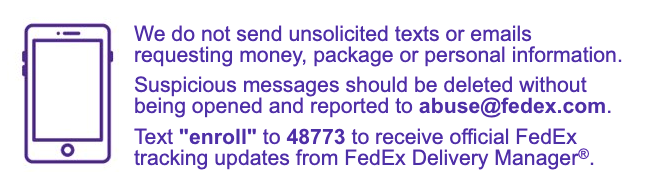
People are receiving phony text messages and emails that appear to come from Federal Express informing them of a pending delivery. Some of the messages contain your name, while others are oddly addressed to “mate.” The email or text message contains a phony tracking code and a link to indicate your delivery preferences. However, if you click on the link you are taken to what appears to be an Amazon satisfaction survey. Once you complete the survey you are asked to provide credit card information in order to claim a free prize. It is all a scam and if you provide your credit card number, you will end up becoming a victim of identity theft.
If you are not a subscriber to Scamicide.com and would like to receive daily emails with the Scam of the day, all you need to do is to go to the bottom of the initial page of http://www.scamicide.com and click on the tab that states “Sign up for this blog.”