
Scam of the Day
Scam of the day – April 10, 2020 – FTC Sending Checks to Victims of Sellers Playbook Scam
In the Scam of the day for August 12, 2018 I reported to you that the Federal Trade Commission (FTC) and the Minnesota Attorney General had filed a lawsuit and obtained a temporary restraining order against Sellers Playbook and its principals in regard to a business opportunity scam in which they sold their “secret” system for earning thousands of dollars each month by selling goods on Amazon. The program in no way was affiliated with or approved by Amazon and although Sellers Playbook claimed that by following the system its customers could earn $20,000 a month and potential net profits of millions of dollars, the promises were phony and there was no secret system. According to the lawsuit filed by the FTC and the State of Minnesota, the defendants cheated their customers out of more than 15 million dollars between April of 2017 and May of 2018 with most of their victims paying them more than $32,000. The case was settled in early 2019 with Sellers Playbook Inc. and its principals, Jessie Conners Tieva, Matthew R. Tieva and their other company Exposure Marketing Company being banned from selling or assisting others to sell any business opportunity or business coaching program. A judgment of 20.8 million dollars was also ordered by the Federal District Court of Minnesota, however the judgment will be suspended once the defendants surrender all corporate assets as well as substantial assets owned by Matthew and Jessie Tieva.
Now the FTC is mailing check totaling more than a million dollars obtained from the defendants to victims of the scam. For more information about this particular refund program check out the “FTC Scam Refunds” tab in the middle of the first page of http://www.scamicide.com. You can find information there about the mailing of the refund checks. There is no cost or fee to file a claim or get a refund. Anyone who tells you differently is trying to scam you.
TIPS
The sale of business opportunities is regulated by the FTC’s Business Opportunity Rule which requires the sellers of business opportunities to provide a one-page disclosure document outlining important facts about the offering including informing you about any legal actions in which the sellers have been involved. In this particular case some of the defendants had previously been sued by the FTC for operating a similar scam. The disclosure also has to provide you with details as to any refund policy and provide a list of references. Additionally, as is always the case with these types of scams, if they make claims about how much money you can earn through their scheme, they must provide you with an Earnings Claim Statement that indicates in detail the specifics of those claims and the opportunity to see written proof of the claims.
Before considering any kind of business opportunity, you should have a lawyer review these required disclosures and if the person offering you the business opportunity does not provide these documents, you should consider that a red flag that this is a scam. You also should investigate the people behind the offering as well as the particular type of business opportunity.
For those of you receiving the Scam of the day through an email, I just want to remind you that if you want to see the ever increasing list of Coronavirus scams go to the first page of the http://www.scamicide.com website and click on the tab at the top of the page that indicates “Coronavirus Scams.”
If you are not a subscriber to Scamicide.com and would like to receive daily emails with the Scam of the day, all you need to do is to go to the bottom of the initial page of http://www.scamicide.com and click on the tab that states “Sign up for this blog.”
Scam of the day – April 9, 2020 – Coronavirus Spurs New Netflix Scams
For a long time I have warned you that the popularity of Netflix makes it a preferred subject for phishing emails and phishing text messages, which are referred to as smishing. Smishing is the name given to text messages that lure you into clicking on links or providing personal information in response to a text message from what appears to be a trusted source, such as a company with which you do business. Smishing scams are increasing in frequency. Earlier this year I told you about a smishing text message that appeared to come from Netflix and lured people into clicking on a link that took them to a phony, but legitimate appearing Netflix page that asked for your Netflix username, password and credit card number. If you supplied this information, you became a victim of identity theft.
With the social isolation that has become the hallmark of the Coronavirus pandemic, many of us, myself included, have been watching a lot of Netflix programming and this has increased the motivation of scammers to set up many phony Netflix websites to which they lure people through emails and text messages to go to for a variety of phony reasons, such as needing to update your information or confirm information. Of course, the real purpose of these phony Netflix websites and the phishing emails and text messages sent to you to lure you into going to these phony Netflix websites is to trick you into providing your credit card information.
TIPS
As I always say, “trust me, you can’t trust anyone.” You can never be truly sure when you receive an email seeking personal information such as your credit card number whether or not the email is a scam. The risk of clicking on a link or providing the requested information is just too high. Instead, if you think that the email might be legitimate, you should contact the company at a telephone number that you know is legitimate and find out whether or not the email or text message was a scam.
As for Netflix in particular, it will never ask in an email or text message for any of your personal information so anytime you get an email or text message purportedly from Netflix asking for your credit card number, Social Security number or any other personal information, it is a scam. Here is a link to Netflix’s security page for information about staying secure in regard to your Netflix account. https://help.netflix.com/en/node/13243
If you are not a subscriber to Scamicide.com and would like to receive daily emails with the Scam of the day, all you need to do is to go to the bottom of the initial page of http://www.scamicide.com and click on the tab that states “Sign up for this blog.”
Scam of the day – April 8, 2020 – New Robocall Developments
Over the years I have written numerous times about the problems presented by robocalls and with good reason. Automated robocalls which, for commercial purposes, are illegal, are the number one consumer complaint reported by the public to the Federal Trade Commission (FTC) at a cost to consumers of billions of dollars each year. The ease by which illegal robocalls may be made by computers using Voice over Internet Protocol (VoIP) accounts for much of the problem.
As could be expected, concern over the Coronavirus has resulted in scammers using robocalls to lure people into becoming victims of a wide variety of Coronavirus related scams such as phony testing kits, work from home jobs and a wide variety of phony Coronavirus cures and treatments. Last week the Federal Communications Commission (FCC) and the Federal Trade Commission (FTC) jointly sent letters to three companies that enable international phone calls into the United States demanding the three companies stop the routing and transmitting of robocalls promoting such scams into the United States. In a positive development all three of the companies complied within the 48 hour deadline established by the two agencies. The ability of these companies to act so quickly to shut down robocall campaigns has gotten better since the implementation of the SHAKEN/STIR standard.
Earlier this year the Federal Communications Commission (FCC) enacted a new rule that allows cell phone carriers to automatically drop robocalls through the use of technology that is able to identify illegal robocalls and block them. This technology is called the SHAKEN/STIR standard. SHAKEN/STIR is an acronym for Signature-based Handling of Asserted Information using toKENs and the Secure Telephone Identity Revisited. SHAKEN/STIR technology verifies calls with a symbol on your phone indicating that the person calling you is legitimate and is actually calling you from the number that appears on your screen. While it doesn’t block robocalls, it does let you know if the call is legitimate so you can decide not to answer shady calls. The FCC required all phone networks to implement the technology by the end of of 2019. AT&T and T-Mobile announced that SHAKEN/STIR is available for calls between those two networks. Previously they had only implemented its use for calls within their own networks. This is not a cure-all, but it is definitely a big step in the battle against phone fraud. Just last week the FCC enacted new rules to require phone companies to adopt new Caller ID features to their SHAKEN/STIR standard by June 30, 2021. These new rules will go a long way toward stopping “spoofed” calls where your Caller ID is manipulated by the criminal to make the call appear as if it is coming from a legitimate source.
TIPS
While SHAKEN/STIR is important, it is not the only weapon against robocalls. As I reported to you last year, Verizon has implemented new services to help its customers avoid illegal robocalls. The new Call Filter service offers spam alerts and new protections from robocalls for its wireless customers. Customers will receive alerts when a call is most likely a scam. The new Call Filter service will also automatically block robocalls based of the customer’s preferred risk level. The Call Filter service is offered in a free version and an enhanced version that among other things will enable customers to create a personal robocall block list. For more information about the Call Filter Services and how to sign up go to https://www.verizonwireless.com/solutions-and-services/call-filter/
There are a number of other options for preventing robocalls including a number of apps that for free or a small fee will reduce and in some instances prevent robocalls.
Samsung’s SmartCall informs you if the call you are receiving is from a known robocaller. This feature is available with newer Samsung Galaxy phones. Here is a link to information about SmartCall and instructions as to how to activate this app.
http://www.samsung.com/levant/apps/smart-call/
Google also has a spam blocker that will warn you when you are receiving a robocall and your screen will turn red. Here is a link to information about the app and how to install it.
https://play.google.com/store/apps/details?id=com.google.android.dialer&hl=en
AT&T also offers free apps to block robocalls on iPhones and Android phones. Here is a link to information about these apps.
https://www.att.com/features/security-apps.html?partner=LinkShare&siteId=TnL5HPStwNw-yrUS1uDw9WGvN._xt67yew&source=ECay0000000CEL00O
Verizon’s CallerName ID is a free service for iPhones and Android phones that will alert you to suspected robocallers. Here is a link to Verizon’s app.
https://www.verizonwireless.com/solutions-and-services/caller-name-id/
T-Mobile offers a free scam blocker of known robocallers for Android phones which you can activate by merely dialing #662#
Sprint offers a paid service to protect your iPhone or Android phone from robocalls. For more information, use this link
http://explore.t-mobile.com/callprotection
For landlines as well as smartphones there are a number of apps such as Nomorobo, Truecaller, Hiya, RoboKiller and YouMail that offer robocall blocking for free or for small monthly charges. Here is a link to those apps. I have used Nomorobo for years and find it to be tremendously useful
https://www.nomorobo.com/
https://www.truecaller.com/
https://hiya.com/
https://www.robokiller.com/
https://play.google.com/store/apps/details?id=com.youmail.android.vvm&hl=en_US https://www.youmail.com/home/apps
Finally, you can just choose to ignore any calls that come from numbers you do not recognize. This is a good option. If they are legitimate calls, they will leave a message and you can call them back.
If you are not a subscriber to Scamicide.com and would like to receive daily emails with the Scam of the day, all you need to do is to go to the bottom of the initial page of http://www.scamicide.com and click on the tab that states “Sign up for this blog.”
Scam of the day – April 7, 2020 – Phony Drive-Through Coronavirus Testing Sites
It may seem like almost everything I am writing about these days involves Coronavirus related scams because unfortunately, as is entirely expected, scammers are taking advantage of the public’s tremendous concerns with the Coronavirus pandemic to scam people through a wide variety of scams. So while I will continue to write about other timely scams, I will definitely be alerting you to new threats to your well being presented by such Coronavirus related scams.
The latest Coronavirus related scam involves reports from Kentucky and other states where phony drive-through Coronavirus testing sites have been temporarily set up, scamming people out of as much as $250 for a test. As a result of the recent federal legislation pertaining to the Coronavirus pandemic, all tests are free. Testing for the Coronavirus is a critical element in managing the pandemic and although testing was slow throughout the country initially, the number of tests in the United States has now exceeded one million people tested with more than 200,000 of those tests coming back positive for the Coronavirus.
TIPS
Not everyone needs to be tested for the Coronavirus. The Centers for Disease Control and Prevention (CDC) which is a reliable source for good information about the pandemic has guidelines in regard to when and if you should be tested as well as other information about the tests at https://www.cdc.gov/coronavirus/2019-ncov/symptoms-testing/testing.html
The CDC advises that if you wish to be tested you should contact your state or local health department or medical care provider for information upon which you can rely in regard to being tested. Here is a link that will take you to the state health department for each of the states. https://www.cdc.gov/publichealthgateway/healthdirectories/healthdepartments.html and here is a link that will take you to your local health departments.https://www.naccho.org/membership/lhd-directory
Remember, there is no charge for having a Coronavirus test administered and processed.
Stay safe.
If you are not a subscriber to Scamicide.com and would like to receive daily emails with the Scam of the day, all you need to do is to go to the bottom of the initial page of http://www.scamicide.com and click on the tab that states “Sign up for this blog.”
Scam of the day – April 6, 2020 – Avoiding Coronavirus Relief Check Scams
On March 27th, I first told you about the Coronavirus relief checks that will be going out to millions of Americans, but it is important to revisit this subject now that more details in the program have evolved.
The amount you will be receiving is dependent upon your adjusted gross income as listed on your most recent federal income tax return. People with adjusted incomes of $75,000 or less will receive $1,200 or $2,400 for qualifying individuals filing a joint income tax return. In addition, there will be additional payments of $500 for each qualifying child. Americans with adjusted gross income of more than $75,000 or $150,000 for a joint return will have their payment reduced by 5% of the amount your income exceeds $75,000. The payments will disappear for single filers with adjusted gross incomes more than $99,000 and $198,000 for joint filers with no children.
The scammers have been waiting for weeks for this to become a reality and they are ready to strike. Scammers posing as government employees will be contacting you by phone, email and text messages asking you to pay a fee in order to receive your government check. Other scammers posing as government officials will ask for your Social Security number, bank account number or credit card number in order for you to qualify for a payment. The truth is that you do not have to do anything to qualify for a payment. You do not need to pay a fee. You do not need to apply for your check. You do not need to provide any personal information. Your eligibility will be determined by the IRS and your check will be either wired directly into the bank account you use to receive your income tax refund or if you have not provided the IRS with information about your bank account, your check will be sent to you by mail. It is as simple as that.
The IRS will determine whether to send you a check and in what amount based upon the information in your 2019 income tax return or if you did not yet file your 2019 income tax return, they will make their decision based upon your 2018 income tax return. If you are a Social Security recipient who was not required to file an income tax return, you do not have to file an income tax return to be eligible to receive a payment. The IRS will get your income information and determine how and where to send the funds based upon your records at the Social Security Administration.
The Treasury Department is presently working on a website where you can provide your bank account information to the IRS if you had previously had your income tax refund sent to you by mail, but now wish to have the relief check sent electronically to your bank account. If you had already provided your bank account information to the IRS in your 2018 or 2019 income tax return, you do not need to provide this information again.
TIPS
Trust me, you can’t trust anyone. Whenever you are contacted on the phone, by email or text message, you cannot be sure who is really contacting you. Even if your Caller ID indicates the call is from a legitimate federal agency such as the Treasury Department, it is easy for a scammer to “spoof” that number and make it appear on your Caller ID even if the call is coming from another number. Neither the IRS, the Treasury Department or any other federal agency will be contacting you by phone, email or text message about the stimulus checks. Anyone contacting you by phone, email or text message indicating that he or she is a federal employee is a scammer. In regard to the funds soon to be sent to you pursuant to the Coronavirus stimulus package you will not have to make a payment or provide any personal information in order to receive your check. Please share this Scam of the day with your friends and family and let them know about http://www.scamicide.com so we can help more people avoid being scammed during this vulnerable time.
If you are not a subscriber to Scamicide.com and would like to receive daily emails with the Scam of the day, all you need to do is to go to the bottom of the initial page of http://www.scamicide.com and click on the tab that states “Sign up for this blog.”
Scam of the day – April 5, 2020 – Grandparent Scam Tied to the Coronavirus
Many of you are familiar with the grandparent scam where a grandparent receives a telephone call from someone purporting to be their grandchild who has gotten into some trouble, either a traffic accident, legal trouble or medical problems in a far away place. The caller pleads for the grandparent to wire some money immediately to help alleviate the problem. However the caller also begs the grandparent not to tell mom and dad. One would think that no one would be gullible enough to fall for this scam, but don’t be so hard on the victims of this scam. Scam artists, the only criminals we refer to as artists, have a knowledge of psychology of which Freud would have been envious and are able to use that knowledge to persuade their victims to send money right away. The Federal Trade Commission is now warning people about a new version of this scam in which the grandparents receive a call purportedly from a grandchild who is ill with the Coronavirus and needs immediate funds sent to him or her
TIPS
Sometimes the scammers do not know the name of their victim’s grandchildren, but often they do. Sometimes they get this information from reading obituaries which may contain the names of grandchildren so merely because the correct name is used in the call is no reason to believe the call. Don’t respond immediately to such a call without calling the real grandchild on his or her cell phone or call the parents and confirm the whereabouts of the grandchild. If a medical problem is the ruse used, you can call the real hospital. If legal problems are the hook you can call the real police. You can also test the caller with a question that could be answered only by the real grandchild, but make sure that it really is a question that only the real grandchild could answer and not just anyone who might read the real grandchild’ s Facebook page or other social media.
Never wire money unless you are absolutely sure about to whom you are wiring the money and it is not a scam. Once you have wired money, it is gone forever. Also, students traveling abroad should register with the State Department’s Smart Traveler Enrollment Program at https://travelregistration.state.gov/ibrs/ui/. This program can help with communications in an emergency situation.
If you are not a subscriber to Scamicide.com and would like to receive daily emails with the Scam of the day, all you need to do is to go to the bottom of the initial page of http://www.scamicide.com and click on the tab that states “Sign up for this blog.”
Here is a video created by the FTC that tells you more about the grandparent scam.
Scam of the day – April 4, 2020 Phony Costco Stimulus Check Scam
The FBI has issued a warning about phony text messages that appear to come from Costco that purport to offer $130 worth of products for free to its “loyal Costco members” as part of Costco’s Covid-19 stimulus package. The truth is that there is no Covid-19 stimulus package being offered by Costco and Costco is not giving away free products to anyone. Here is a copy of the text message presently being circulated.
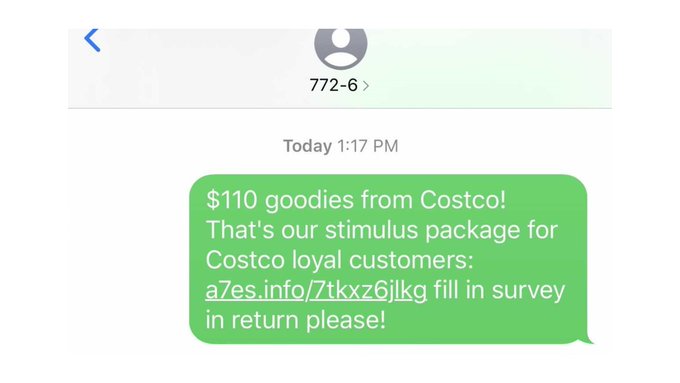
However, it should be noted that scammers are also using Facebook and other social media to spread this scam. According to the FBI, if you click on the link provided by the scammers, you will end up downloading harmful malware.
TIPS
Remember my motto, “trust me, you can’t trust anyone.” Whenever you receive an email, text message or phone call you can never be sure as to who is really contacting you. Never click on a link or download any attachment unless you have absolutely and independently confirmed that the communication was legitimate. You should also be skeptical about offers of money or products for nothing. In the case of scams such as this, you can always go to its website of http://www.costco.com to learn about any promotions or coupons it may be offering.
If you are not a subscriber to Scamicide.com and would like to receive daily emails with the Scam of the day, all you need to do is to go to the bottom of the initial page of http://www.scamicide.com and click on the tab that states “Sign up for this blog.”
Scam of the day – April 3, 2020 – Scammers Posing as CDC Workers Going Door to Door
With more and more people becoming infected with the Coronavirus, people are very concerned and scammers are taking advantage of that concern through a myriad of scams. Here at Scamicide.com I will be posting warnings about these scams to help protect you from being swindled. I also urge you to go to the http://www.scamicide.com website where at the top of the first page you will find a link to a list of Coronavirus scams that is being continually updated.
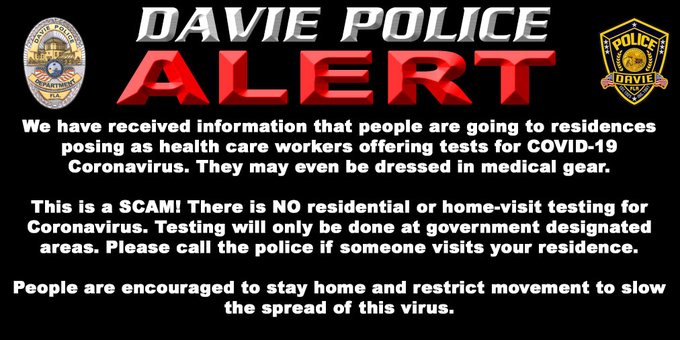
Today’s Coronavirus related scam involves scammers disguising themselves as Centers for Disease Control and Prevention (CDC) workers going door to door dressed in white lab coats and wearing masks and gloves offering Coronavirus testing for a fee. This is a scam. The CDC is not sending people to private homes to perform or sell Coronavirus test kits.
Here is a Tweet from the Davie, Florida police department warning people about this scam.
TIPS
The best source of information regarding Coronavirus testing is the CDC. You can use this link to learn more about testing for the Coronavirus. https://www.cdc.gov/coronavirus/2019-ncov/symptoms-testing/testing.html
It is also important to know that the recent federal stimulus legislation that provided for payments to many people also eliminates all fees for Coronavirus testing. In addition, the law also requires that doctor’s and emergency room visits related to testing for the Coronavirus are free so don’t fall for the claim of a scammer that you need to pay for a test.
If you are not a subscriber to Scamicide.com and would like to receive daily emails with the Scam of the day, all you need to do is to go to the bottom of the initial page of http://www.scamicide.com and click on the tab that states “Sign up for this blog.”
Scam of the day -April 2, 2020 – FTC Scam Bingo
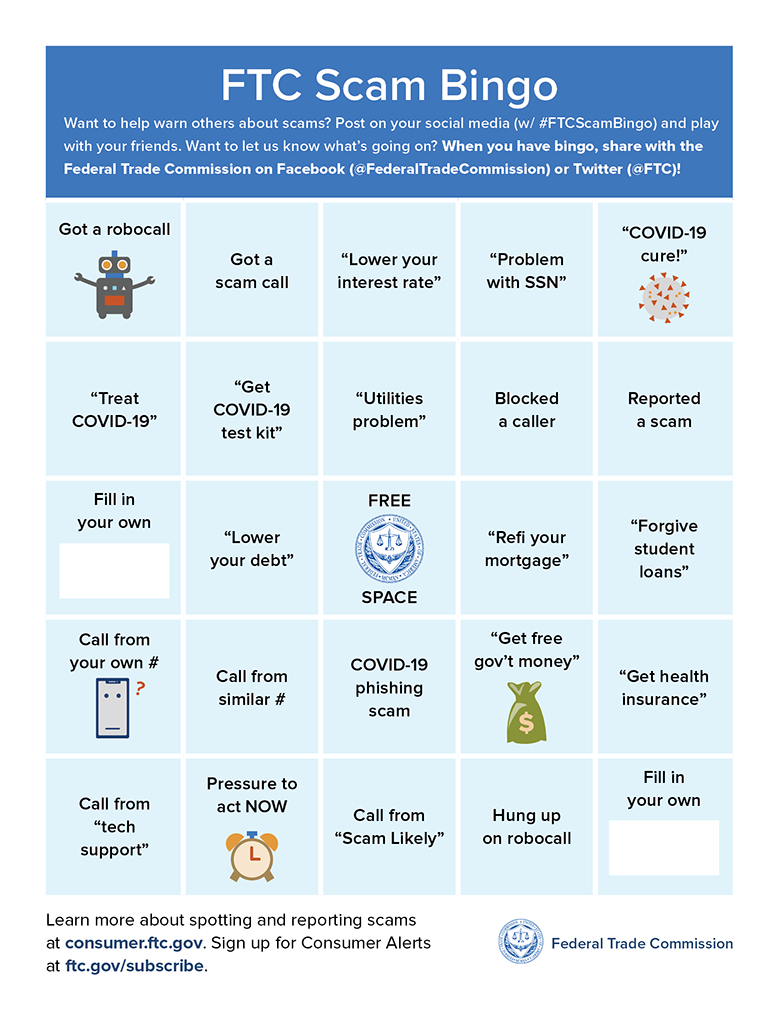
With so many people sheltering in place as a result of the coronavirus pandemic, the FTC has cleverly taken this as an opportunity to provide homebound people with a game to play that helps raise awareness of the scams that we are all facing in increasing numbers. The game is called FTC Scam Bingo. You cover a square when you identify a scam targeting you by phone, email or text message and cover other squares when you take action to avoid scams, such as by hanging up on a robocall. The scams picked by the FTC are all current scams being reported. Here is the FTC Scam Bingo card.
TIPS
The FTC suggests that you print out the bingo card and share it on social media and ask your friends to play as well. With many of us having a lot of time on our hands, reminding ourselves about scams to be avoided and steps to take to avoid scams is indeed a good way to pass the time.
I also want to remind you of the new section of the Scamicide website exclusively dedicated to Coronavirus scams. You can locate the page by going to the top of the http://www.scamicide.com website and clicking on the link to “Coronavirus Scams.”
If you are not a subscriber to Scamicide.com and would like to receive daily emails with the Scam of the day, all you need to do is to go to the bottom of the initial page of http://www.scamicide.com and click on the tab that states “Sign up for this blog.”
Scam of the day – April 1, 2020 – New Mystery Shopper Scam
I have written many times over the last eight years about the mystery shopper scam because it continues to ensnare unwary victims. Last month I told you that the Federal Trade Commission (FTC) issued a new warning about this scam. Mystery shoppers are people hired to shop at a particular store and report on the shopping experience for purposes of quality control. Unlike many scams, there actually are legitimate mystery shopper companies, but they never advertise or recruit through emails, text messages or letters.
The manner in which the scam generally works is that when you answer an advertisement, or respond to a letter, email or a text message to become a mystery shopper, you are sent a bank check. You deposit the check into your own account and spend some of the money on the goods that you purchase which you are allowed to keep and also are directed to keep some of the balance of the check as payment for your services. You are instructed to return the remaining funds by a wire transfer. In a recent Walmart themed mystery shopper scam that targeted a Scamicide reader, the targeted victim was told to wire $1,225 of a $1,595 check back to the scammer. The problem is that the check or money order sent to you is counterfeit, but the money you send by wire from your bank account or through prepaid cards is real and is lost forever.
Reproduced below is an email that I received recently soliciting me to become a mystery shopper.
TIPS
One reason why this scam fools so many people is that there really are mystery shopping jobs although the actual number is quite few and they do not go looking for you. An indication that you are involved with a scam is when you receive a check for more than what is owed you and you are asked to wire the difference back to the sender. This is the basis of many scams. Whenever you receive a check, wait for your bank to tell you that the check has fully cleared before you consider the funds as actually being in your account. Don’t rely on provisional credit which is given after a few days, but which will be rescinded once a check bounces and never accept a check for more than what is owed with the intention to send back the rest. That is always a scam. Also be wary whenever you are asked to wire funds or send gift cards because this is a common theme in many scams because it is difficult to trace and impossible to stop. Legitimate companies do not use gift cards as payments.
One questionable part about this particular email is that the salutation consists of “Hi dear” which indicates that this is a mass emailed message not directed to specific people.
If you receive a mystery shopper scam solicitation or check through the mail you can report it to the United States Postal Service at
http://about.usps.com/publications/pub300a/pub300a_tech_024.htm
You also can report the scam to the Federal Trade Commission (FTC) which investigates these scams at https://www.ftccomplaintassistant.gov/#crnt&panel1-1
On an unrelated topic, I am excited to announce a change to the Scamicide website. The Coronavirus pandemic has resulted in a multitude of scams spreading as fast as the Coronavirus itself. Defending yourself from the Coronavirus and the Coronavirus scams is very important and so I have set up a separate section of the Scamicide website that tells you everything you need to know about these Coronavirus related scams and how to defend yourself from them. This section of Scamicide will be updated regularly. It can be found by clicking on the link at the top of the opening page of Scamicide marked “Coronavirus scams.” I urge you to let your friends know about http://www.scamicide.com in general and the Coronavirus scam section in particular so that we can help more people avoid these scams. Stay safe my friends.
If you are not a subscriber to Scamicide.com and would like to receive daily emails with the Scam of the day, all you need to do is to go to the bottom of the initial page of http://www.scamicide.com and click on the tab that states “Sign up for this blog.”