
Scam of the Day
Scam of the day – November 13, 2023 – Annual Report of Do Not Call Registry
Since it began in 2003, the National Do Not Call list has grown to include more than 249 million phone numbers. When you register your phone number with the Do Not Call list it becomes illegal for telemarketers to contact you by phone. The Do Not Call list does not apply to charities so you still may be contacted by charities even if you have registered for the Do Not Call list. However, when you receive a call from someone purporting to be representing a charity, you can never be sure who is really calling so you should never give your credit card number to someone who calls you allegedly from a charity. If you are interested in a particular charity, contact the charity directly to make your contribution.
If you are registered for the Do Not Call list and you do receive a call from a telemarketer, you can be confident that the call is a scam because no legitimate telemarketer would call you if you are enrolled in the Do Not Call list. It is also important to note that while telemarketing is not in and of itself illegal, telemarketing through robocalls is always illegal. Registering for the Do Not Call list will not stop robocalls. Illegal automated robocalls continue to be a major source of complaint for many people with the most common subjects of illegal robocalls being debt reduction, vacation and timeshares and warranty plans. Recently Congress passed a new law intended to reduce robocalls, but the new legislation is not expected to totally resolve the problem.
Each year, the Federal Trade Commission issues an annual report for the Do Not Call List and this year’s report for 2022, the previous year, shows the greatest number of scam calls relate to impostor scams where the scammer poses as government employee such as of the IRS or the Social Security Administration or of a legitimate company with which you may do business.
The FTC is also reporting that people are now receiving emails informing them that their registration in the Do Not Call list is expiring and that they have to register their phone numbers again. They are then directed to a phony website that gathers information that can be used for purposes of identity theft. The important thing to know is that you never have to reregister your phone number with the Do Not Call list. Once you have registered a number it is permanently on the Do Not Call list until the number is disconnected or you ask for your number to be removed.
TIPS
Registering for the do not call list is easy and free. Merely go to http://www.donotcall.gov to register your phone number.
Finally, you can just choose to ignore any calls that come from numbers you do not recognize. This is a good option. If they are legitimate calls, they will leave a message and you can call them back.
If you are not a subscriber to Scamicide.com and would like to receive daily emails with the Scam of the day, all you need to do is to go to the bottom of the initial page of http://www.scamicide.com and type in your email address on the tab that states “Sign up for this blog.”
Scam of the day – November 12, 2023 – State of Maine Identified as Latest MOVEit Supply Chain Data Breach Victim
Three days ago the Maine state government confirmed that many of its departments had suffered a data breach affecting 1.3 milli0on people with large amounts of sensitive information including Social Security numbers compromised. The data breach at Maine, however was not a result of their computers being hacked directly by cybercriminals, but rather was done by exploiting a vulnerability found in MOVEit software used by Maine as well as 620 other organizations including American Airlines, TD Ameritrade, Johns Hopkins University and other users of the same software who can be assumed to also have suffered data breaches affecting an estimated 40 million people. I have been telling you about these data breaches for months.
This supply chain attack brings back memories of the 2020 SolarWinds supply chain security breach. SolarWinds is a company that provides system management software to 30,000 companies and government agencies. Hackers exploited a vulnerability in its software that, in turn, led to data breaches at thousands of governmental and private entities.
Last year, there were more than 1,800 reported data breaches and probably many more that were not reported affecting 422 million people. The question is not if you will become a victim of a data breach. The question is when.
As I have reminded you many times, we are only as safe and secure as the security of the companies, government agencies and websites that have our personal information. Even if you are extremely diligent in protecting your personal information, you can be in danger of identity theft and scams if your personal information falls into the hands of hackers.
So what can you do to protect yourself from these data breaches that will be occurring?
TIPS
One important lesson is to limit the amount of personal information that you provide to companies and websites whenever possible. For example, your doctor doesn’t need your Social Security number for his or her records.
You should make sure that you have a unique password for each of your online accounts so that if one of your passwords is compromised in a data breach, all of your accounts will not be in danger. If your information is compromised in a data breach, you should immediately change the password for that account.
If you have not already done so, set up dual factor authentication for each of you accounts where it is available. This will protect you from having those accounts stolen by someone who may have access to your password.
https://www.transunion.com/credit-freeze
https://www.experian.com/freeze/center.html
If you are not a subscriber to Scamicide.com and would like to receive daily emails with the Scam of the day, all you need to do is sign up for free using this link. https://scamicide.com/scam-of-the-day/
Scam of the day – November 11, 2023 – Phony Restaurant Delivery Scam
Ordering food online for delivery was somewhat popular prior to the pandemic, but really took off during the pandemic when people wanted restaurant food without having to go to a restaurant. Many restaurants have taken advantage of this interest and set up websites to facilitate ordering food deliveries and companies such as DoorDash and GrubHub also take online orders for food deliveries from multiple restaurants. As could be expected scammers also are getting into the food delivery business although it would be more accurate to say that they got in the business of taking your online orders for food delivery, but deliver nothing except charges on your credit card.
Scammers create websites for phony delivery services using names such as “Order Hero” and “Order Ventures” or they mimic websites of legitimate restaurants or delivery services and through manipulating algorithms used by search engines to rank websites may appear at the top of a Google Chrome or other search engine search. Trust me, you can’t trust anyone.
TIPS
When you order online food from either a restaurant or a delivery service it is important to confirm that you are actually ordering from a legitimate restaurant or delivery service. Take the time to confirm the URL before placing your order and don’t trust a search engine search to be reliable merely because a website appears high on your search. An easy way to confirm that you have the correct URL is to call the restaurant or delivery service to make sure that you are using the correct URL.
As I often remind you, don’t use your debit card for anything other than an ATM card. Only use your credit card for your financial transactions because the protection you have from liability for fraudulent charges is much greater when using your credit card than it is when using your debit card.
Scam of the day – November 10, 2023 – Phony Police and Firefighter Charity Scams
The holiday season will soon be upon us. This is a time when many people give to charities. In particular, you will most likely be contacted by numerous people soliciting charitable contributions on behalf of organizations purporting to support the brave men and women who make up our police and fire departments. Unfortunately, many of those solicitations will be from scammers merely looking to steal money under false pretenses. Whenever you are solicited by phone, you can never be sure who is really contacting you. Even if your Caller ID indicates that the call is coming from a legitimate source, as I have mentioned many times scammers use a simple technique called “spoofing” to manipulate your Caller ID to make their calls appear to come from a legitimate source when the truth is that the call is coming from a scammer. In addition, even if you are on the Federal Do No Call List, the law permits charities to call you, however, unfortunately you can never be sure when you receive a call that purports to be from a charity whether the call is legitimate or not. Similarly when you receive a text message or email solicitation for a charity, you have no way of knowing if the solicitation is from a scammer or a legitimate charity.
Recently police departments around the country have been warning people about a text message scam where people are receiving text messages that appear to come from the local police offering $10 off a hoodie that shows support for the local police department and comes with a link through which you can make a purchase.
TIPS
In regard to the text message scam now circulating, it is important to remember whenever you get a text message, you can’t be sure as to who is really contacting you. Even if the call appears to come from your local police department, scammers can manipulate your Caller ID to make it appear that the call is legitimate when it is not. If you think the text message may be legitimate, merely contact your local police department at a telephone number you know is legitimate to determine whether or not the text message was a scam (at which time you will find out that it is a scam).
Phony charities often have names that sound legitimate and it is difficult to know merely from a solicitation whether or not the charity is a fake. Other times, scammers will use the name of a legitimate charity when they solicit you by phone, email or text message and you can never be sure when you are contacted by email or text message whether or not the solicitation is legitimate. Prior to giving to any charity, I suggest you first look into whether indeed the charity is legitimate or not and the best way I know to do that is to go to http://www.charitynavigator.org where not only can you find out whether the charity is a scam, but also whether or not your donation will be tax deductible, how much of your donation goes toward the charitable purposes of a legitimate charity and how much goes toward salaries, administrative costs and fund raising. Charitynavigator.org will also give you access to the websites and phone numbers of legitimate charities you may wish to consider giving to so you can feel confident when you make a gift that it is going to the right place.
If you are not a subscriber to Scamicide.com and would like to receive daily emails with the Scam of the day, all you need to do is sign up for free using this link. https://scamicide.com/scam-of-the-day/
Scam of the day – November 9, 2023 – “Is it You in this Video” Scam
I wrote about today’s Scam of the day previously but am repeating it again because I have both heard from a number of Scamicide readers who have recently been targeted by this scam as well as being the target of this scam myself. The scam starts when you receive a message on Facebook Messenger that looks like this:

(image: Sophos)
The message will have a link and what appears to be a video, which many people would be tempted to click on out of a concern that the video may be significant, however, when you click on the link, you are taken to a phony Facebook login page. If you fall for the scam and type in your username and password, you will have turned over control of your Facebook account to a criminal. When a criminal gains access to your Facebook account, it enables him or her to be able to send out a wide variety of malware infected posts and messages that will appear to come from you and therefore be more likely to lure your unsuspecting friends into clicking on the links in the posts and messages thereby downloading a wide variety of dangerous malware such as ransomware or keystroke logging malware that can lead to identity theft.
TIPS
Remember my motto, “trust me, you can’t trust anyone.” Whenever you get a Facebook message, email, or text message you can never be sure who is really contacting you. The “friend” you think is communicating with you may well be a criminal who has managed to hack your friend’s Facebook account, email account or phone and use these accounts to send out phishing messages that lure you into clicking on infected links. Never click on a link unless you have absolutely confirmed that it is legitimate.
In the case of this particular Facebook Messenger scam, instead of clicking on the link or providing your user name and password, you should contact your real friend to determine if they sent the message to you. Additionally, it is always a good idea to use dual factor authentication whenever possible so that if somehow you are tricked into providing your user name and password, the criminal still wouldn’t be able to gain access to your account. Here is a link to information about setting up dual factor authentication on your Facebook account. https://www.facebook.com/help/148233965247823
If you are not a subscriber to Scamicide.com and would like to receive daily emails with the Scam of the day, all you need to do is sign up for free using this link. https://scamicide.com/scam-of-the-day/
Scam of the day – November 8, 2023 – Phony Coupon Scams
Even though Thanksgiving has not yet arrived, many people are turning their attention to holiday shopping and holiday shoppers looking to save money are always on the lookout for coupons. Everyone loves coupons and like many things in our lives, coupons which used to be found commonly in newspapers and magazines have migrated online. In recent years scammers have been perpetrating phony coupon scams on social media. Among the companies affected by these phony coupons were Bath and Body Works, Costco, Aldi, Starbucks and Trader Joe’s. As I have warned you many times in the past, Facebook has become a hotbed for phony online coupons. The phony coupons looks quite legitimate which means nothing because it is very easy to copy the company logos and make the coupons appear to be genuine.
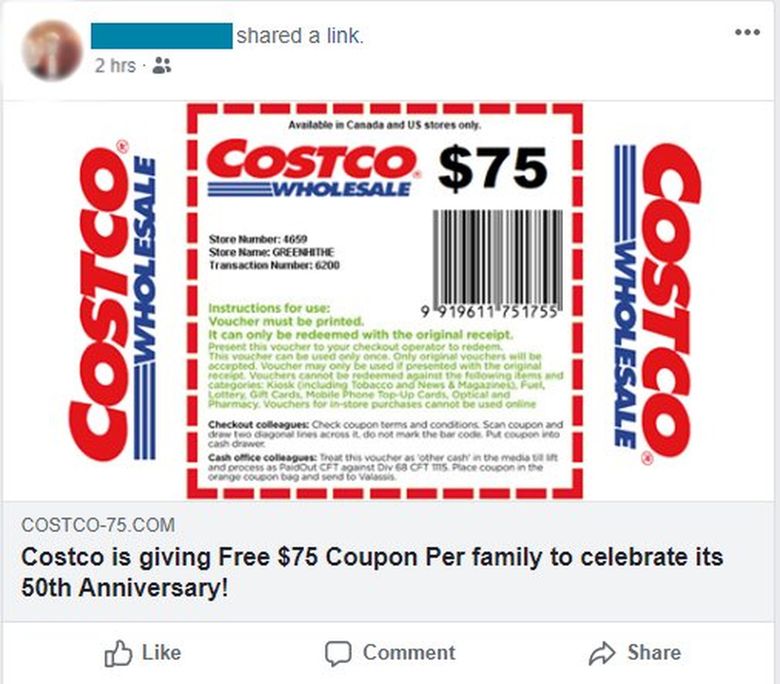
The way that many phony coupon scams work is that in order to qualify for the coupon, you must complete a survey in which you are required to provide much personal information that is used to make you a victim of identity theft. In other versions of the scam, the scammer actually asks for your credit card numbers. In yet another version of the scam you are required to buy many costly items in order to claim your “free” coupon. Many of the coupon scams also require you to forward the coupon to friends which make the phony coupons appear more trustworthy when they are received by your friends. Ultimately, in all of these scams, the coupons are worthless and you get nothing but the opportunity to become a victim of identity theft. Here is a copy of a phony coupon appearing online. It was provided by the Identity Theft Resource Center.
TIPS
If the coupon appears too good to be true, it usually is a scam. No company could cover the cost of giving away vast numbers of $75 coupons although sometimes, participants in legitimate surveys are promised a chance to win a prize in a drawing. Facebook is a favorite venue for scammers perpetrating this type of scam because often unwary victims will unwittingly share the scam with their friends. One way to determine if a coupon is legitimate is to look for the expiration date found on most coupons. The phony Costco coupon shown above like most phony coupons does not carry an expiration date. The best place to go to find out if a coupon is legitimate is to go to the company’s website to see what real coupons are being offered.
If you are not a subscriber to Scamicide.com and would like to receive free daily emails with the Scam of the day, all you need to do is to go to the bottom of the initial page of http://www.scamicide.com and type in your email address on the tab that states “Sign up for this blog.”
Scam of the day – November 7, 2023 – Dirty Dozen Phone Scams
Recently the background check company Been Verified issued a list of its twelve most common phone scams being perpetrated today. The phone is a primary method for scammers who can make large numbers of calls or texts using computers rather than actual phones. Scammers also use prerecorded robocalls to contact people they are attempting to scam. For information about what you can do to protect yourself from robocalls, I suggest you check out his Scam of the day from the past https://scamicide.com/2023/06/28/scam-of-the-day-june-29-2023-48-states-sue-robocall-company/
Among the most common phone scams are text messages purporting to be from various banks telling the victim that his or her bank account has been frozen and providing a number to call to unfreeze it; phone calls purporting to be from Publisher’s Clearing House telling them that they have won a sweepstakes, but are required to pay taxes or fees before collecting their prize; and calls purportedly from the targeted victim’s bank telling them that their debit card was frozen.
TIPS
The goal of all of these calls is to convince people that there is an emergency that requires your immediate attention by providing personal information, clicking on a link to get help or make a payment. As I often tell you, whenever you get a phone call or a text message even if the Caller ID indicates that the call is legitimate, scammers can use a simple technique called spoofing which enables them to make the call appear to come from any number they wish. Trust me, you can’t trust anyone.
Since you can never be sure who is actually calling you, the best course of action if you receive a text message or call that asks you to respond by providing personal information or clicking on a link or making a payment, you should not do so, but rather call the real company or government agency the caller appears to be from at a telephone number you independently confirm is correct. Don’t call the number provided in the call or text.
By the way, Publishers Clearing House never contacts winners by phone.
If you are not a subscriber to Scamicide.com and would like to receive free daily emails with the Scam of the day, all you need to do is to go to the bottom of the initial page of http://www.scamicide.com and type in your email address where it states “Sign up for this blog.”
Scam of the day – November 6, 2023 – Amazon Phishing Email
Recently a Scamicide reader received an email informing her that her Amazon Prime Membership was due for renewal, but that it could not be done because the credit card tied to the account was no longer able to be used, threatening to suspend her Amazon Prime account unless a new credit card was provided. This is a common scam in which the scammers attempt to lure people into providing their credit card information or Amazon user name and password to the scammer posing as an Amazon employee.
But how do you know if you get such an email whether or not the email is legitimate? For starters, the email address of the sender of the email to the Scamicide reader was a long convoluted email address that had no relation to Amazon. The best course of action if you receive such an email and you have any thoughts that it might be legitimate you should communicate directly with Amazon their website or mobile app rather than click on a link in the email that purports to take you to Amazon.
TIPS
While this particular email did not appear very official and did not contain the Amazon logo, other Amazon phishing emails use the Amazon logo and are written with acceptable grammar and punctuation. Some of these phishing emails, which in the past had poor grammar and spelling having been sent from scammers in a country where English is not their native language are now, through AI able to appear entirely legitimate. Never click on a link in an email or text message or provide personal information unless you have confirmed that the email or text message is legitimate. The telephone number to call if you suspect Amazon related fraud is 866-216-1075 or you can call their real customer service number 888-280-4331 Never call the numbers that appears in phishing emails.
Also, because any of us can be scammed, it is a good idea to use dual factor authentication whenever possible to protect your various accounts so that even if someone actually had your password they would not be able to access your account. In order to set up dual factor authentication for your Amazon account use this link. https://www.amazon.com/gp/help/customer/display.html?nodeId=G3PWZPU52FKN7PW4
If you are not a subscriber to Scamicide.com and would like to free receive daily emails with the Scam of the day, all you need to do is sign up for free using this link. https://scamicide.com/scam-of-the-day/
Scam of the day – November 5, 2023 – Mystery Shopper Scams
I have written many times over the last ten years about the mystery shopper scam because it continues to ensnare unwary victims. These scams continue to be effective and are increasing in number so it is important to remind you about them again. Mystery shoppers are people hired to shop at a particular store and report on the shopping experience for purposes of quality control. Unlike many scams, there actually are legitimate mystery shopper companies, but they never advertise or recruit through emails, text messages or letters.
The manner in which the scam generally works is that when you answer an advertisement, or respond to a letter, email or a text message to become a mystery shopper, you are sent a bank check. You deposit the check into your own account and spend some of the money on the goods that you purchase which you are allowed to keep and also are directed to keep some of the balance of the check as payment for your services. You are instructed to return the remaining funds by a wire transfer.
In a Walmart themed mystery shopper scam, the targeted victim was sent a legitimate appearing, but counterfeit check for $2,940 and told to keep $540 as payment and then go to the nearest Walmart and use the remainder of the check to buy six $400 Kroger gift cards and provide the numbers to the scammer. The scam victim was then told to keep the gift cards for their next assignment although there never is another assignment and the scammers use the numbers on the Kroger gift cards to make purchases, making the actual cards worthless. The victim of the scam loses the $2,400 used to purchase the gift cards from the victim’s own bank account when the check bounces.
TIPS
One reason why this scam fools so many people is that there really are mystery shopping jobs although the actual number is quite few and the companies that do mystery shopping do not go looking for you. A firm indication that you are involved with a scam is when you receive a check for more than what is owed you and you are asked to wire the difference back to the sender. This is the basis of many scams. Whenever you receive a check, wait for your bank to tell you that the check has fully cleared before you consider the funds as actually being in your account. Don’t rely on provisional credit which is given after a few days, but which will be rescinded once a check bounces and never accept a check for more than what is owed with the intention to send back the rest. That is always a scam. Also be wary whenever you are asked to wire funds or send gift cards because this is a common theme in many scams because it is difficult to trace and impossible to stop. Legitimate companies do not use gift cards as payments.
For more information about legitimate mystery shoppers, you can go to the website of the Mystery Shopping Professional Association https://www.mspa-americas.org/scam-alerts/
If you are not a subscriber to Scamicide.com and would like to receive free daily emails with the Scam of the day, all you need to do is to go to the bottom of the initial page of http://www.scamicide.com and type in your email address where it states “Sign up for this blog.”
Scam of the day – November 4, 2023 – FTC Takes Action Against Phony Covid Prevention Product
During the recent Coronavirus pandemic I wrote many times about the Federal Trade Commission’s actions against the makers of various unscrupulous scammers who peddled phony cures and treatments for the Coronavirus. The Federal Trade Commission (FTC) sent out 425 warning letters with cease and desist orders to companies marketing phony cures and got court orders against these companies
In July of 2020 the FTC sent out a waring letter and ease and desist order against Gary Kong, Timothy Wetzel and their companies K.W. Technology and K.W. Technology NV Inc the makers and marketers of what they called the Invisible Mask which was a badge worn around the neck which they claimed was scientifically proven to protect anyone wearing it from Covid. The defendants advertised this ineffective, phony product on their own website, YouTube and Facebook where they called it “The 1 Virus Buster Card.” None of their representations were true or supported by any scientific evidence.
Now two years later, three of the four defendants in this case have settled with the FTC and pursuant to the settlement are banned from selling this bogus product. The settlement is awaiting approval of the judge overseeing the case, which is expected to be done soon.
TIPS
As for healthcare products in general, you should be skeptical about any company that promises miraculous cures to illnesses and medical conditions. The world is full of snake oil salesmen. You should also be wary of any healthcare product that is sold exclusively either over the Internet or through mail-order advertisements. The best course of action is to ask your physician about the effectiveness of a particular product or program before you buy it. As for the Coronavirus specifically, the best places to get reliable information are the World Health Organization https://www.who.int/health-topics/coronavirus, the FDA https://www.fda.gov/patients/coronavirus-disease-2019-covid-19-resources-patients or the Centers for Disease Control https://www.cdc.gov/
Remember B.S. – Be skeptical. Whenever there will be breakthroughs to treat, prevent or cure any disease, particularly COVID 19 you are going to hear about it through legitimate news sources first rather than through ads in emails, text messages or posts on social media.
For those of you receiving the Scam of the day through an email, I just want to remind you that if you want to see the ever increasing list of Coronavirus scams go to the first page of the http://www.scamicide.com website and click on the tab at the top of the page that indicates “Coronavirus Scams.” Scamicide was cited by the New York Times as one of three top sources for information about Coronavirus related scams.
If you are not a subscriber to Scamicide.com and would like to receive free daily emails with the Scam of the day, all you need to do is to go to the bottom of the initial page of http://www.scamicide.com and type in your email address in the tab that states “Sign up for this blog.”