
Scam of the Day
Scam of the day – January 26, 2020 – Fake ID Scam
Young people have been using fake IDs in order to buy liquor or to get into clubs for many, many years, however, now in the Internet age, obtaining a fake ID carries tremendous risks of being scammed or becoming a victim of identity theft. It has been estimated that as many as 80% of college students have used fake IDs. In 2015 I told you about New York Governor Andrew Cuomo’s warning that buying a fake ID is a risky enterprise that can lead to the purchaser becoming a victim of identity theft after providing sensitive information to the maker of the fake ID. Now we have the unusual story of a Canadian teenager who actually called the Ontario Provincial Police to complain that he never received the fake ID he paid for and ordered online. In many instances, the companies offering fake IDs online are based in foreign countries and merely take the money, generally a hundred dollars or more, of unwary victims and never send anything in return. As for the cheated young consumers, they are left without recourse because with the obvious exception of the Canadian teenager, most do not go to the police complaining that the company selling them an illegal fake ID didn’t provide the product and even if they did report the scam to the police, there is nothing that can be done to get the money back from the companies located overseas. The most common form of fake ID sold on the internet is a phony driver’s license and some of them are actually well copied counterfeits, but they certainly are not worth the risk.
TIPS
Buying a fake ID online is just too risky a venture. Providing personal information that is often requested for these fake IDs is just an invitation to becoming a victim of identity theft. In addition, when buying illegal goods, you can’t be sure that you will ever get anything in return for the money or Bitcoins you pay before you ever receive anything. Finally, using a fake ID is a crime and if you are caught, you are in serious trouble. The bottom line is that young students would be smart to avoid buying fake IDs. Parents should warn their children of the consequences of fake IDs.
If you are not a subscriber to Scamicide.com and would like to receive daily emails with the Scam of the day, all you need to do is to go to the bottom of the initial page of http://www.scamicide.com and click on the tab that states “Sign up for this blog.”
Scam of the day – January 25, 2020 – FTC Report on Fraud During 2019
The Federal Trade Commission (FTC) has just released its annual report detailing the most common types of scams in 2019. The report also provides information about the FTC’s refund programs to consumers victimized by scams in 2019. Starting with the good news, the FTC returned more than 232 million dollars to 1.9 million people victimized by scams in 2019. The refunds come from money obtained by the government through legal actions against scammers. It sometimes can be difficult to find out if you are eligible for such a refund and what you need to do to claim your refund which is why on the http://www.scamicide.com website we have a section on FTC Refunds where you can find information about all of the FTC’s refund programs and what you need to do to claim any money to which you may be entitled. In addition, when a refund program is instituted for a particular scam, we will include that information in a Scam of the day here at Scamicide.com.
As for the amount of money people lost to scams in 2019, according to the FTC, consumers reported losses of more than 1.9 billion dollars to fraud in 2019 and that figure is undoubtedly less than the actual number because many people do not report being scammed to the FTC. The most common scams were identity theft, impostor scams, phone scams and online shopping scams. Here at Scamicide.com we have reported to you about all of these types of scams and how to avoid them. We will continue to do so. Impostor scams, in particular have increased by 50% in just the last year. Impostor scams often involve a phone call, email or text message from someone posing as the IRS, the Social Security Administration or some other governmental agency. The scammers threaten the targeted victim unless a payment is made. It is important to note that neither the IRS nor the Social Security Administration will ever phone, email or text you demanding the payment of money. They will always initiate contact through regular mail. It is also important to remember that clever scammers can manipulate your Caller ID through a technique called spoofing to make it appear that the call from the scammer is coming from the IRS or some other legitimate entity.
TIPS
You can never be sure when you get an email or a telephone call if it is really from a legitimate source. Even if you have Caller ID, a scammer can use a technique called “spoofing” to make it appear that the call is from a legitimate caller. Emails and text messages may also appear legitimate, but can be merely made to appear as if they are coming from a government agency or a legitimate company, such as your utility company when, in fact, they are coming from a scammer. Trust me, you can’t trust anyone. Never provide personal or financial information to anyone in response to a telephone call, text message or email until you have independently confirmed that the communication was legitimate.
If you are not a subscriber to Scamicide.com and would like to receive daily emails with the Scam of the day, all you need to do is to go to the bottom of the initial page of http://www.scamicide.com and click on the tab that states “Sign up for this blog.”
Scam of the day – January 24, 2020 – Federal Express Delivery Scam
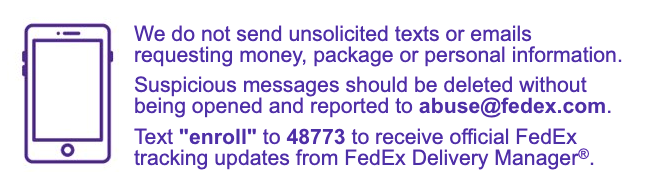
People are receiving phony text messages and emails that appear to come from Federal Express informing them of a pending delivery. Some of the messages contain your name, while others are oddly addressed to “mate.” The email or text message contains a phony tracking code and a link to indicate your delivery preferences. However, if you click on the link you are taken to what appears to be an Amazon satisfaction survey. Once you complete the survey you are asked to provide credit card information in order to claim a free prize. It is all a scam and if you provide your credit card number, you will end up becoming a victim of identity theft.
If you are not a subscriber to Scamicide.com and would like to receive daily emails with the Scam of the day, all you need to do is to go to the bottom of the initial page of http://www.scamicide.com and click on the tab that states “Sign up for this blog.”
Scam of the day – January 23 2020 – Windows 7 Scams
We all remember the massive 2017 WannaCry ransomware attack that affected computers in 74 countries including the UK where its entire health care system was affected. Ransomware is the name for malware that once installed on a computer, often unwittingly through clicking on links in spear phishing emails, encrypts and locks all of the victim’s data. The cybercriminal then threatens to destroy the data unless a ransom is paid. A little discussed aspect of the massive WannaCry attack was that it exploited a a vulnerability in the Windows XP operating system which is extremely outdated and should not be used. Technical support and updates for Windows XP ceased in 2014.
Just about all computer software has a lifecycle. Much like a car which at some point becomes more difficult and expensive to fix rather than dispose of and get a new car, software vulnerabilities are constantly being patched, but at some point in time the software reaches the end of its life cycle and becomes too difficult and expensive to continue patching. While you can choose to continue to use such software, it is extremely risky to do so because such unsupported software is a prime target for a myriad of cyberattacks.
Some time ago, Microsoft announced that it was ending technical support and would no longer be issuing free technical support or software and security updates for the popular Windows 7 operating system on January 14, 2020. Continuing to use Windows 7 now that we have passed the January 14th cutoff date is extremely dangerous and will open you up to what will be numerous malware attacks.
Scammers have been taking advantage of some of the confusion surrounding Microsoft’s ending of support for Windows 7 to scam people. Scammers are calling people pretending they are Microsoft employees to talk to you about what they refer to as your “expiring Windows license” and lure people into paying money over the phone for fees to update your license. In some instances, they ask for remote access to your computer in order to install the new updated software, however this is just a scam to enable them to gain access to your computer and steal your personal information and use it to make you a victim of identity theft.
This scam is made worse because the scammers often use the spoofing technique to manipulate your Caller ID to make the call appear as if it is coming from Microsoft when the truth is that it is not.
TIPS
Microsoft will not be calling you about your “expiring license” or about switching to Windows 10. Anyone who calls you about those matters who represents that they are Microsoft employees is lying.
If you have been using Windows 7 you should upgrade to the newer Windows 10 or some other operating system that is still being updated by the manufacturer. Here is a link to an article that provides information on seven free alternatives to Windows 10. https://www.makeuseof.com/tag/free-alternatives-to-windows-operating-systems/
Providing remote access to anyone to your computer can lead to a myriad of problems including identity theft and the downloading of ransomware. Neither AOL, Yahoo, Apple, Microsoft or any of the other tech companies ever ask for remote access to your computer to fix problems.
If you are not a subscriber to Scamicide.com and would like to receive daily emails with the Scam of the day, all you need to do is to go to the bottom of the initial page of http://www.scamicide.com and click on the tab that states “Sign up for this blog.”
Scam of the day – January 22, 2020 – Census Scams Starting
The United States Census Bureau is conducting a national census as it is required by law to do every ten years. The Census is very important and is required by the Constitution. Census data is used to determine the numbers of members for each state in the House of Representatives which also affects the Electoral College. The Census Bureau will be contacting Americans in a variety of ways including phone calls, letters and even Census Bureau workers who will come to your home. As a part of the census, you will be asked for much personal information, which makes the census a perfect vehicle for identity thieves to pose as census workers in an effort to lure you into providing personal information that will be used to make you a victim of identity theft. A key thing to remember is that the real Census Bureau will never ask you for your Social Security number, bank account numbers or credit card numbers. Anyone posing as a census worker who asks for that information is an identity thief. Recently in Dallas, Robert Cooper was tricked into providing his Medicare number when completing an official-appearing census form he received in the mail. The real Census Bureau may ask if you have health insurance, but it will never ask for your Medicare card number or health insurance account number.
TIPS
Sometime in March the real United States Census Bureau will start sending official letters to everyone regarding the census. You can respond either online, by phone or through the mail. Obviously it is important to make sure that you are providing your information to the United States Census Bureau and not an identity thief. The United States Census Bureau suggests that people go to their website for information about how to confirm when you are contacted by mail, phone or in person whether you are being contacted by a legitimate representative of the United States Census Bureau https://www.census.gov/programs-surveys/surveyhelp/verify-a-survey.html however, personally, I don’t think their advice is up to the task and their advice also requires too much effort. The better way to deal with providing your census information is to provide your information online directly to the census bureau through its website of http://www.census.gov.
If you are not a subscriber to Scamicide.com and would like to receive daily emails with the Scam of the day, all you need to do is to go to the bottom of the initial page of http://www.scamicide.com and click on the tab that states “Sign up for this blog.”
Scam of the day – January 21, 2020 – Puppy Scams Coming From India
According to the Better Business Bureau (BBB) pet scams involving the online sale of non-existent dogs have increased 39% since 2017. People buy dogs or other pets online and although they think they are taking proper precautions, they often end up getting nothing in return for the money that they wire to the scammer who may have a website or some other way of marketing their non-existent pets with photographs and false information. Often the scammers hook their victims for more and more money, such as when even after the victims has paid for the non-existent dog, the victim is asked for further fees for a special crate to transport the dog along with additional transportation company fees.
Recently the BBB for Texas warned consumers about eleven phony dog breeding websites that scammed victims out of thousands of dollars. The eleven phony breeders are Fluffy Frenchies, Fluffy Samoyeds, Kingdom Chows, Loyal Chows, Playful Frenchies, Pride Akitas, Smiling Samoyeds, Star Chow Chow, Stone Akitas, Study Bulldogs and True Frenchies. While all of these phony breeders listed business addresses and phone numbers from the Fort Worth Texas area, none of the addresses or phone numbers indicated on the websites were legitimate. All of the websites were registered to someone in India.
One victim of the scam was told on the day he was supposed to pick up his dog at the Pittsburgh airport that the crate used to send the dog was determined to be insufficient and that an additional $1,900 had to be paid for a proper crate. Of course, it was all a scam.
TIPS
It is simple for a scammer to construct a website that appears to be legitimate and scammers can readily steal the name of a legitimate animal breeder. Always check into the reputation of the breeder with the Better Business Bureau, your state’s attorney general and even Google the name with the word “scam” to see if a legitimate breeder’s name that is being used has been stolen for scams previously. Be wary of anyone who asks you to wire money because that is a telltale sign that a scam is going on because once the money is wired, it is impossible to get it back. If you are told that a courier company is being used to transport the animal, check out the company to make sure it is legitimate and actually shipping the dog. There also are a number of ways such as using the website http://www.tineye.com to search the photos sent to you of the dog to see if they appear elsewhere other than the website attempting to sell you a puppy. If so, this is a good indication that you are being scammed. Also, always get a veterinarian report on any animal before you consider buying it. Finally, you are always going to be better off buying a pet that you can see in person prior to buying the pet.
Some phony breeders claim they are certified by the American Kennel Club (AKC) however, the AKC doesn’t certify breeders. Legitimate breeders will however, register their litters with the AKC and you can find out by calling the AKC’s customer service line 919-233-9767 if a particular litter has been registered.
Here is a link to a television interview I did about pet scams:https://turnto10.com/i-team/consumer-advocate/12-scams-of-christmas-phony-pet-breeder
If you are not a subscriber to Scamicide.com and would like to receive daily emails with the Scam of the day, all you need to do is to go to the bottom of the initial page of http://www.scamicide.com and click on the tab that states “Sign up for this blog.”
Scam of the day – January 20, 2020 – Equifax Settlement Claim Deadline Approaching
There has been a lot of reporting in the media about the major Equifax settlement of claims brought by the Federal Trade Commission (FTC), the Consumer Financial Protection Bureau (CFPB) and all but two of the states’ Attorneys General related to the avoidable 2017 data breach in which personal data on more than 147 million people was stolen. The stolen personal information included the names, dates of birth and Social Security numbers of 147 million people putting them in serious danger of identity theft for the rest of their lives. Unfortunately, much of the reporting, most notably the reporting that everyone would be getting $125 is not accurate.
Here is what the agreement actually provides for:
- Free credit monitoring for four years at all three credit bureaus, Equifax, Experian and TransUnion and six more years of free credit monitoring at just Equifax or if you already have credit monitoring, which we all should have, you can choose to receive a payment of up to $125.
- Additional cash payments of as much as $20.000 for expenses you paid out of pocket in response to the Equifax data breach. These reimbursement payments are intended to cover data breach related payments made by you such as the costs of freezing and unfreezing your accounts (which until September of 2018 cost between $3 and $12 each time you froze and unfroze your credit reports; since September 21, 2018 federal law removed all charges for freezing and unfreezing your credit reports), credit monitoring and fees paid to accountants or lawyers related to the data breach.
- Payments related to the time you spent dealing with the data breach at a rate of $25 per hour. If your claim is for ten hours or less, you are required to describe the actions you took, such as freezing your credit reports at each of the three credit reporting agencies and the time that you spent on these activities. If your claim is for more than ten hours, in addition to describing what you did, you must also provide copies of documents showing that you were a victim of identity theft or other problems related to misuse of your information.
- Seven years of free access to assistance through identity theft restoration services in the event that you do become a victim of identity theft.
- Beginning this year, you can get seven free credit reports each year for seven years from Equifax. Federal law already provides that you can get one free credit report annually from each of the three major credit reporting agencies so now you can receive, upon request seven free credit reports from Equifax which you should spread out throughout the year as well as the single credit report per year from Experian and TransUnion.
Now for what is really going to happen.
While reports of the settlement have proclaimed that Equifax will be paying 700 million dollars to settle the claims against it brought by the various federal agencies and states’ Attorneys General, that number is extremely misleading. Only 425 million dollars of that amount is earmarked for the benefit of consumers and only 31 million dollars of that amount is allocated toward the $125 cash payments. The remaining 394 million dollars allocated toward consumers goes toward paying for the cost of the credit monitoring provided for in the settlement and the reimbursement payments, which most likely will be small for just about everyone. In addition, once $125 payments total the allocated 31 million dollars, the payments will proportionately reduce. This means that if even 5% of the people eligible filed for the $125 payment, they each would receive less than $5.
TIPS
The first step to take is to find out if you were one of the 147 million people affected by the data breach and therefore eligible to apply for benefits under the settlement. Here is a link to the section of the settlement website to input your information to determine if you were a part of the data breach. https://eligibility.equifaxbreachsettlement.com/en/eligibility
If you were affected by the data breach, here is the link to the part of the settlement website where you can file a claim. All claims must be filed no later than January 22, 2020, so if you are eligible and have not filed your claim yet, you should do so without delay. https://www.equifaxbreachsettlement.com/file-a-claim The settlement received final judicial approval on January 14th so the payments should begin shortly.
If you choose to receive free credit monitoring, now that the settlement has been approved by the court and if your claim has been approved, you will receive an activation code and instructions by your choice of email or regular mail. Cash payments will be made by check or debit card and sent by regular mail.
A good question for many people is whether they should have or get identity theft protection services on their own if they accept the free credit monitoring and other services offered through the settlement. My opinion is that the extensive benefits provided by private identity theft protection services can go far beyond the basic services provided by Equifax in the settlement. Services such as Dark Web monitoring, credit score monitoring, Social Security number monitoring and other services that are critical to protecting your identity are nowhere to be found in the services provided by Equifax in the settlement.
If you are not a subscriber to Scamicide.com and would like to receive daily emails with the Scam of the day, all you need to do is to go to the bottom of the initial page of http://www.scamicide.com and click on the tab that states “Sign up for this blog.”
Scam of the day – January 19, 2020 – FTC Shuts Down “Success By Health” Pyramid Scheme
The Federal Trade Commission (FTC) has sued multi-level marketer “Success By Health” and its executives alleging that the company operated an illegal pyramid scheme. The United States Federal Court for Arizona has granted a temporary restraining order shutting down the operation of “Success by Health” while the litigation progresses. According to the FTC, “Success By Health” cheated their victims out of more than seven million dollars. The flagship prodcut of “Success By Health” is an instant coffee product called “MyocoCafe” that contains a mushroom that “Success By Health” represented as providing significant health benefits although there is no evidence to that effect. “Success By Health” operated as a multi-level marketing company, however, rather than a legitimate multi-level marketing company such as Amway, the FTC alleges that “Success By Health” operated as an illegal pyramid scheme through which its distributors made money by recruiting new distributors rather than through selling products which is the hallmark of an illegal pyramid scheme. As Andrew Smith the FTC’s Director of Consumer Protection has said, “Participants in legitimate multi-level marketing companies earn money based on actual sales to real customers rather than recruitment. But pyramid schemes depend on recruitment of new participants to pay out to existing participants, meaning that the vast majority of participants will ultimately lose money.” “Success By Health” executives told prospective distributors that they could earn more than a million dollars per month, however, in order to do so they would have to recruit more than 100,000 affiliates working under them to achieve that level of profit.
Sometimes a legitimate multilevel marketing business may look quite similar to an illegitimate pyramid scheme, which is one of the reasons that so many people fall prey to these scams. For every legitimate multilevel marketing company, such as Mary Kay and Amway, there are many that are just scams. In a legitimate multilevel marketing company, investors make money by selling products to the public and by recruiting new salespeople. In a pyramid scheme the source of profits is based primarily on the recruiting of new members or salespeople.
TIPS
Anyone who is considering investing in what is represented to be a multilevel marketing business should always investigate the company and the terms of investment carefully before investing any money. In addition, you should also check out the company with the FTC and your state’s attorney general to make sure that the company is legitimate before investing any money. Here is a link to information from the FTC that you should consider before investing in a multilevel marketing business. http://www.consumer.ftc.gov/articles/0065-multilevel-marketing
As for supplements that purport to provide health benefits, you should never buy them or sell them unless you have thoroughly investigated the legitimacy of the claims.
If you are not a subscriber to Scamicide.com and would like to receive daily emails with the Scam of the day, all you need to do is to go to the bottom of the initial page of http://www.scamicide.com and click on the tab that states “Sign up for this blog.”
Scam of the day – January 18, 2020 – Critical New Security Updates to Microsoft Windows Operating System
As was made abundantly clear by 2017’s massive Wannacry ransomware attack that exploited a vulnerability in the Microsoft Windows operating system for which Microsoft had already issued a security update, constant updating of the software we all use with the latest security patches and updates is a critical part of avoiding scams and identity theft threats. Whenever important new security updates and patches are issued, we provide access to these so that you can update your software to provide better security on your computers, smartphones, laptops and other electronic devices. Updating your software with the latest security patches and updates as soon as possible is important because identity thieves and scammers are always finding and exploiting vulnerabilities in the software that we all use. Delay in updating your software could lead to disastrous results. However, it is also important to be sure that you are downloading legitimate patches and updates rather than being tricked by an identity thief or scammer into downloading malware under the guise of downloading a security patch or update. Today’s security update involves serious vulnerabilities in the Microsoft Windows operating system which were discovered by the National Security Agency which alerted Microsoft to the problem, for which Microsoft issued a security patch on Tuesday, January 14th.
TIPS
Here is a link to this recent security update https://portal.msrc.microsoft.com/en-us/security-guidance/releasenotedetail/2020-Jan
If you are not a subscriber to Scamicide.com and would like to receive daily emails with the Scam of the day, all you need to do is to go to the bottom of the initial page of http://www.scamicide.com and click on the tab that states “Sign up for this blog.”
Scam of the day – January 17, 2020 – Free Cruise Scam Starts with a Robocall
Over the years I have written numerous times about the problems presented by robocalls and with good reason. Automated robocalls which, for commercial purposes, are illegal, are the number one consumer complaint reported by the public to the Federal Trade Commission (FTC) at a cost to consumers of billions of dollars each year. The ease by which illegal robocalls may be made by computers accounts for much of the problem.
Recently the Federal Trade Commission settled charges it had brought against the operators of a robocall center that used robocalls in which it promised free tickets on a Caribbean cruise merely for taking a survey, however, if someone agreed to take the survey, they were referred to live telemarketers who attempted to sell them extensive upgrades. In addition to violating federal laws pertaining to robocalls, the defendants also violated the federal Do Not Call list by calling people who had registered their numbers to be off limits to telemarketers.
Earlier this year the Federal Communications Commission (FCC) enacted a new rule that allows cell phone carriers to automatically drop robocalls through the use of technology that is able to identify illegal robocalls and block them. This technology is called the SHAKEN/STIR standard. SHAKEN/STIR is an acronym for Signature-based Handling of Asserted Information using toKENs and the Secure Telephone Identity Revisited. SHAKEN/STIR technology verifies calls with a symbol on your phone indicating that the person calling you is legitimate and is actually calling you from the number that appears on your screen. While it doesn’t block robocalls, it does let you know if the call is legitimate so you can decide not to answer shady calls. The FCC required all phone networks to implement the technology by the end of of 2019. AT&T and T-Mobile announced that SHAKEN/STIR is available for calls between those two networks. Previously they had only implemented its use for calls within their own networks. This is not a cure-all, but it is definitely a big step in the battle against phone fraud.
TIPS
While SHAKEN/STIR is important, it is not the only weapon against robocalls. As I first reported to you in the May 16th Scam of the day, Verizon has implemented new services to help its customers avoid illegal robocalls. The new Call Filter service offers spam alerts and new protections from robocalls for its wireless customers. Customers will receive alerts when a call is most likely a scam. The new Call Filter service will also automatically block robocalls based of the customer’s preferred risk level. The Call Filter service is offered in a free version and an enhanced version that among other things will enable customers to create a personal robocall block list. For more information about the Call Filter Services and how to sign up go to https://www.verizonwireless.com/solutions-and-services/call-filter/
There are a number of other options for preventing robocalls including a number of apps that for free or a small fee will reduce and in some instances prevent robocalls.
Samsung’s SmartCall informs you if the call you are receiving is from a known robocaller. This feature is available with newer Samsung Galaxy phones. Here is a link to information about SmartCall and instructions as to how to activate this app.
http://www.samsung.com/levant/apps/smart-call/
Google also has a spam blocker that will warn you when you are receiving a robocall and your screen will turn red. Here is a link to information about the app and how to install it.
https://play.google.com/store/apps/details?id=com.google.android.dialer&hl=en
AT&T also offers free apps to block robocalls on iPhones and Android phones. Here is a link to information about these apps.
https://www.att.com/features/security-apps.html?partner=LinkShare&siteId=TnL5HPStwNw-yrUS1uDw9WGvN._xt67yew&source=ECay0000000CEL00O
Verizon’s CallerName ID is a free service for iPhones and Android phones that will alert you to suspected robocallers. Here is a link to Verizon’s app.
https://www.verizonwireless.com/solutions-and-services/caller-name-id/
T-Mobile offers a free scam blocker of known robocallers for Android phones which you can activate by merely dialing #662#
Sprint offers a paid service to protect your iPhone or Android phone from robocalls. For more information, use this link
http://explore.t-mobile.com/callprotection
For landlines as well as smartphones there are a number of apps such as Nomorobo, Truecaller, Hiya, RoboKiller and YouMail that offer robocall blocking for free or for small monthly charges. Here is a link to those apps. I have used Nomorobo for years and find it to be tremendously useful
https://www.nomorobo.com/
https://www.truecaller.com/
https://hiya.com/
https://www.robokiller.com/
https://play.google.com/store/apps/details?id=com.youmail.android.vvm&hl=en_US https://www.youmail.com/home/apps
Finally, you can just choose to ignore any calls that come from numbers you do not recognize. This is a good option. If they are legitimate calls, they will leave a message and you can call them back.
If you are not a subscriber to Scamicide.com and would like to receive daily emails with the Scam of the day, all you need to do is to go to the bottom of the initial page of http://www.scamicide.com and click on the tab that states “Sign up for this blog.”