
Scam of the Day
Steve Weisman Coronavirus Scam Webinar
Here is a link to a webinar I recently did for the law firm of Margolis and Bloom with which I am affiliated. The webinar discusses the many Coronavirus scams and how to avoid them.
Scam of the day – June 6, 2020 – Dangerous GoDaddy Phishing Email
Here is another good example of a phishing email that is presently being circulated. It is a very compelling and official looking phishing email, but it is as phony as a three dollar bill. Phishing emails are sent by identity thieves and scammers to lure you into either clicking on links contained within the email which will download malware or providing personal information that will be used to make you a victim of identity theft. They generally try to convince you that there is an emergency that requires your immediate attention or else dire consequences will occur.
Copied below is a new phishing email presently being sent to unsuspecting people that appears to come from GoDaddy. For those not familiar with this company, it is a very successful domain registrar and web host company that helps many people set up websites. This particular phishing email is sent from an email address that appears to be that of GoDaddy although it is not a real email address used by GoDaddy. Sophisticated scammers will often create email addresses to send phishing emails that will incorporate a variation of the name of the company they are posing as in order to trick you into believing it is legitimate.
Here is the email presently being circulated.

TIPS
Legitimate emails from your GoDaddy would include your name and account number. Often phishing emails originate in countries where English is not the primary language and the spelling and grammar are poor. However this one has no spelling errors and is grammatically correct. Obviously, if you are not a GoDaddy customer, you will recognize immediately that this is a scam.
As with all phishing emails, two things can happen if you click on the links provided. Either you will be sent to a legitimate looking, but phony webpage where you will be prompted to input personal information that will be used to make you a victim of identity theft or, even worse, merely by clicking on the link, you will download malware such as keystroke logging malware that will steal all of your personal information from your computer and use it to make you a victim of identity theft. If you receive an email like this and think it may possibly be legitimate, merely call your bank or other institution from which the email purports to originate at a telephone number that you know is accurate and you will be able to confirm that it is a scam.
For those of you receiving the Scam of the day through an email, I just want to remind you that if you want to see the ever increasing list of Coronavirus scams go to the first page of the http://www.scamicide.com website and click on the tab at the top of the page that indicates “Coronavirus Scams.”
If you are not a subscriber to Scamicide.com and would like to receive daily emails with the Scam of the day, all you need to do is to go to the bottom of the initial page of http://www.scamicide.com and click on the tab that states “Sign up for this blog.”
Scam of the day – June 5, 2020 – Credit Repair Telemarketer Sued
The Consumer Financial Protection Bureau (Bureau) jointly with Massachusetts Attorney General Maura Healey sued Commonwealth Equity Group, LLC which does business under the name Key Credit Repair alleging that the company engaged in illegal deceptive and abusive tactics in its credit repair business. Credit repair scams are very common as scammers take advantage of people with debt problems and promise to fix their credit and clear their credit reports of adverse information in return for illegal up front fees. Key Credit Repair is alleged to have illegally charged advance fees for their services and misrepresenting Key Credit Repair’s ability to increase consumers’ credit scores and remove negative material from credit reports.
Your credit report is one of the most important documents in your financial life. The information in your credit report as maintained by the three major credit reporting agencies, Equifax, TransUnion and Experian is used to calculate your credit score. This is used by financial institutions to evaluate your creditworthiness and can affect your ability to get a credit card, mortgage loan or a car loan. It also can affect the rate that you will be charged on such loans. In addition, your credit score is used in many states by companies in making hiring decisions and landlords consider credit scores when determining whether or not to rent an apartment or home to someone. Regularly reviewing your credit report is a way to earlier discover in many instances if you have become a victim of identity theft. Recently, in response to the Coronavirus pandemic, the three major credit reporting bureaus have agreed to extend your right to a free copy of your credit report once a year to a free credit report from each of the credit reporting agencies once a week through April of 2021. Here is the link to use to get your free credit reports. https://www.annualcreditreport.com/requestReport/landingPage.action
TIPS
Don’t fall prey to scammers operating phony credit repair companies and never pay an upfront fee to one of these companies. Advance fees for credit repair companies that operate for profit are banned by the Credit Repair Organizations Act. Negative information on your credit report remains on your credit report for seven years and bankruptcies for ten years. Anyone who tells you otherwise is just trying to scam you. Many of the scam credit repair companies use illegal tactics such as applying for a federal employer ID to use as your Social Security number when applying for credit. This is illegal. If you need real credit counseling you can go to this section of the Department of Justice’s website where it lists agencies approved to assist consumers with debt problems. https://www.justice.gov/ust/list-credit-counseling-agencies-approved-pursuant-11-usc-111 You also may consider contacting companies that are affiliated with the National Foundation for Credit Counseling at this link https://www.nfcc.org/
For those of you receiving the Scam of the day through an email, I just want to remind you that if you want to see the ever increasing list of Coronavirus scams go to the first page of the http://www.scamicide.com website and click on the tab at the top of the page that indicates “Coronavirus Scams.”
If you are not a subscriber to Scamicide.com and would like to receive daily emails with the Scam of the day, all you need to do is to go to the bottom of the initial page of http://www.scamicide.com and click on the tab that states “Sign up for this blog.”
Scam of the day – June 4, 2020 – Dangerous SunTrust Phishing Scam
As phishing emails go, the email reproduced below is very legitimate looking. This email comes from a Scamicide reader. The email is a scam and if you click on the links contained in the email, you will either be prompted to provide personal information that will be used to make you a victim of identity theft or alternatively, merely by clicking on the link, you will download keystroke logging malware that will steal your personal information from your computer or smartphone and use it to make you a victim of identity theft. I have deleted the links. The logo found on the email is a good copy, but it is important to remember that it is a simple matter to counterfeit a logo. One indication that it is a scam is that the salutation is directed to “Dear SunTrust Client” rather than being directed to the person receiving the email by name. The email also does not provide an account number which is another indication that it is a scam. For the most part the grammar is good, but there are some striking grammatical errors, which often are an indication that the email was written by someone whose primary language is not English. Yet another indication that this is a phony phishing email is that the email address of the sender has no relation to Sun Trust. As with all phishing emails the intention is to scare you into responding to a purported emergency.
Here is a copy of the email.

| Dear SunTrust Client,
You Have new security message notifications from SunTrust Bank Click www.****.com to read your Message notification. Upon logging in, you may be asked to confirm your identity We appreciate your business and are committed to helping you reach your financial goals. Visit ******.com, or stop by your local branch to learn more about our helpful products and services. Thank you for banking with SunTrust. Sincerely, |
SunTrust Bank, Member FDIC. ©2020 SunTrust Banks, Inc. SunTrust is a federally registered service mark of SunTrust Banks, Inc.
SunTrust Client Commitment: SunTrust will never send unsolicited emails asking clients to provide, update or verify their personal or account information, such as passwords, Social Security numbers, personal identification numbers (PINs), credit or Check Card numbers or other confidential information. As always, SunTrust respects your privacy. To learn more, Visit ****.com/privacy
This email was sent on behalf of SunTrust Customer Care, 1575 Lemon Farris Road, Cookeville, TN 38506.
|
|
For those of you receiving the Scam of the day through an email, I just want to remind you that if you want to see the ever increasing list of Coronavirus scams go to the first page of the http://www.scamicide.com website and click on the tab at the top of the page that indicates “Coronavirus Scams.”
If you are not a subscriber to Scamicide.com and would like to receive daily emails with the Scam of the day, all you need to do is to go to the bottom of the initial page of http://www.scamicide.com and click on the tab that states “Sign up for this blog.”
Scam of the day – June 3, 2020 – Senators Introduce Bill to Protect Seniors From Scams During Pandemic
Minnesota Democratic senator and former presidential candidate Amy Klobuchar along with Kansas Republican senator Jerry Moran have proposed legislation to protect elderly Americans from Coronavirus-related scams. Their bill which is called the Protecting Seniors from Emergency Scams Act, if passed, would require the Federal Trade Commission (FTC) to prepare and file a report with Congress detailing scams directed at older Americans during the Coronavirus pandemic along with suggestions about how to protect seniors from these scams. For years here at Scamicide I have been providing such information to everyone about the scams that threaten all of us including seniors as well as advising people how to avoid these scams.
TIPS
In regard to Coronavirus related scams, I urge you to check out the section of Scamicide that provides details about all of the now prevalent Coronavirus related scams and how to protect yourself from those scams. In regard to scams targeting seniors, who are always a prime target of scammers, I suggest as a starting point, you read this article I wrote for Fraud Magazine which provides a long list of things you can do to protect older people from being scammed. https://www.fraud-magazine.com/article.aspx?id=4295009331
For those of you receiving the Scam of the day through an email, I just want to remind you that if you want to see the ever increasing list of Coronavirus scams go to the first page of the http://www.scamicide.com website and click on the tab at the top of the page that indicates “Coronavirus Scams.”
If you are not a subscriber to Scamicide.com and would like to receive daily emails with the Scam of the day, all you need to do is to go to the bottom of the initial page of http://www.scamicide.com and click on the tab that states “Sign up for this blog.”
Scam of the day – June 2, 2020 – New CARES Act Check Scam Targets College Students
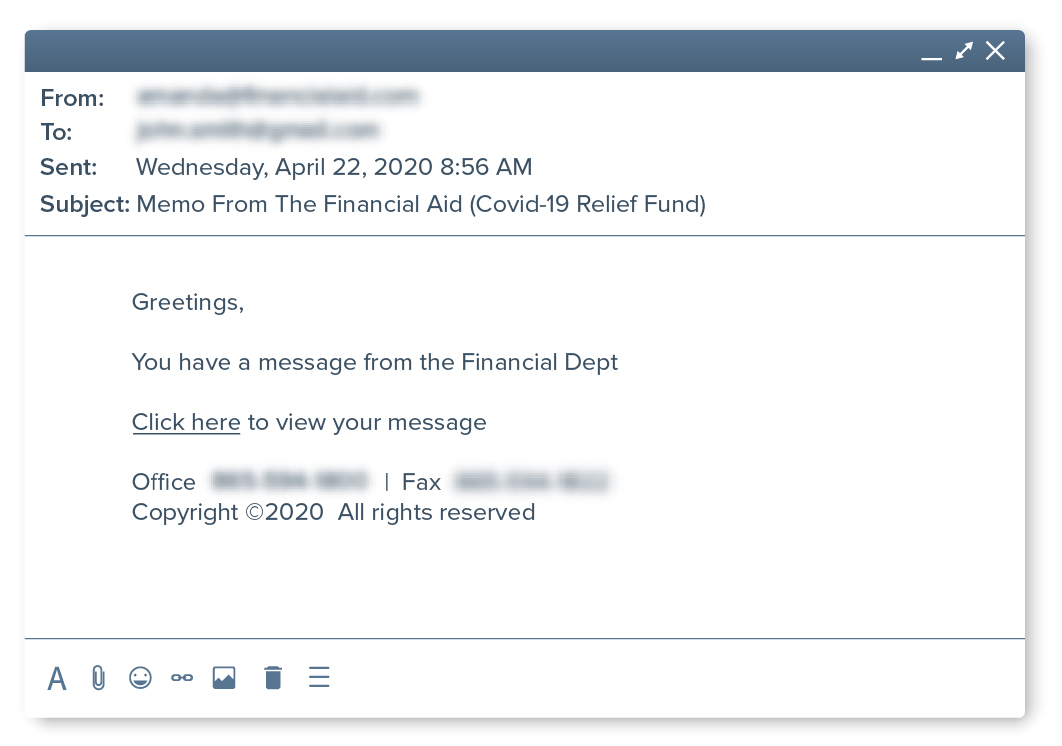
Like most federal legislation, the CARES Act which was enacted into law in late March and provided for billions of dollars of stimulus payments to millions of Americans is complicated. While much of the media focused on payments of as much as $1,200 to people eligible for the program with additional payments of $500 for each qualifying child, the rules regarding eligibility for the payments were in many cases confusing. Scammers are always ready to take advantage of anything in which the public is interested and are ready to exploit any confusion inherent in the subject. In this case, college students are reporting receiving emails such as the one reproduced below which appear to come from the “Financial Department” of the student’s college or university (regardless of whether or not the particular school has a “Financial Department”) that appears to provide important information regarding the CARES Act stimulus payments. This phishing email instructs the student to click on a link that requires the student to enter his or her university login information. Students doing so will either provide information that can be used to make them victims of identity theft or merely by clicking on the link they may unwittingly download malware such as ransomware or keystroke logging malware that can be extremely harmful.
Here is a copy of the email presently being circulated.
TIPS
Always be wary of any email or text message that asks you to click on a link. Always confirm that the email or text message is legitimate before clicking on the link. In this case, if your school does not have an officially designate “Financial Department” you can be confident that the message is a scam. Generally schools will designate a “Financial Aid Department” not a “Financial Department.” Another indication that this particular email is a phishing scam is the fact that at the bottom of the email it indicates that it is copyrighted. There is no reason that such an email would be copyrighted.
And now for the particularly confusing part. College students are ineligible for a stimulus check if they can be claimed as a dependent on someone else’s federal income tax return. Under federal law, students under the age of 24 can be claimed as a dependent on their parents’ federal income tax return and so they would be ineligible to receive a stimulus check themselves. Complicating this even further is that the law provides that even if a college student’s parents do not claim him or her as a dependent on their income tax return, the student is still not eligible for a stimulus check because the law disqualifies them merely by being eligible to be claimed as a dependent regardless of whether or not they actually are claimed as a dependent. There are some exceptions, but the vast majority of college students will neither be eligible to receive a stimulus payment nor be claimed as a qualifying child such that their parents would get a $500 payment related to them.
Scammers are quite active in using the CARES Act stimulus payments as a basis for many other scams as well. It is important to remember that neither the IRS, the Treasury Department or any other federal agency will be contacting you by phone, email or text message about the stimulus checks. Anyone contacting you by phone, email or text message indicating that he or she is a federal employee is a scammer.
For those of you receiving the Scam of the day through an email, I just want to remind you that if you want to see the ever increasing list of Coronavirus scams go to the first page of the http://www.scamicide.com website and click on the tab at the top of the page that indicates “Coronavirus Scams.”
If you are not a subscriber to Scamicide.com and would like to receive daily emails with the Scam of the day, all you need to do is to go to the bottom of the initial page of http://www.scamicide.com and click on the tab that states “Sign up for this blog.”
Scam of the day – June 1, 2020 – AOL Phishing Email
Today’s Scam of the day is about a phishing email presently circulating that attempts to lure you into clicking on a link in order to continue using your AOL account. If you click on the link two things can occur and both are bad. Either you will end up providing personal information to an identity thief or you will. merely by clicking on the link, download dangerous malware such as ransomware on to your phone, computer or other device. Here is the email presently being circulated. The link where it reads “Confirm Here Now” has been disabled. It would not have taken you to a AOL website.
“Dear Esteemed User,
Your mail is out of date and you may not be able to send or receive new messages. We recommend you reconfirm your service within 24 hours.
NOTE: Failure to confirm your mail-box will result in permanent closure.We apologies for the inconvenience.
TIPS
When AOL communicates with its customers about their accounts, they do so by AOL Certified Mail, which will appear as a blue envelope in your inbox and will have an official AOL Mail seal on the border of the email. This particular email had neither. This email also did not have an AOL logo and had no salutation indicating to whom the email was being sent. Whenever you get an email, you cannot be sure who is really sending it. In the case of this email, the email address of the sender had no relation to AOL and most likely was the email address of someone whose email account was hacked and made a part of a botnet of computers used by cybercriminals to send such communications. Never click on a link unless you are absolutely sure that it is legitimate. If you think the email might be legitimate, the best thing to do is to contact the real company that the email purports to be from at an address or phone number that you know is accurate in order to find out if the communication was legitimate or not. Another indication that this email is a scam is that the salutation does not use your name, but instead reads “Dear Esteemed User.” While it is nice to be esteemed, this is not a term that you would find in a legitimate business email.
For those of you receiving the Scam of the day through an email, I just want to remind you that if you want to see the ever increasing list of Coronavirus scams go to the first page of the http://www.scamicide.com website and click on the tab at the top of the page that indicates “Coronavirus Scams.”
If you are not a subscriber to Scamicide.com and would like to receive daily emails with the Scam of the day, all you need to do is to go to the bottom of the initial page of http://www.scamicide.com and click on the tab that states “Sign up for this blog.”
Scam of the day – May 31, 2020 – Is That Stimulus Debit Card Your Got in the Mail a Scam?
Earlier this month the Treasury Department announced that it had electronically sent more than 200 billion dollars of CARES Act stimulus payments to approximately 130 million Americans in the program’s first four weeks. Payments under the CARES Act are determined in the vast majority of instances by the information contained on your 2019 income tax return or if you have not filed a 2019 income tax return yet, by your 2018 income tax return. These tax returns are being used to determine both the amount of the stimulus check that you shall receive as well as to where the stimulus payment will be made. People who had provided their bank account number and bank’s routing number to the IRS as a part of their federal income tax return had their payments sent to their bank accounts electronically. After May 18th the federal government began sending paper checks and debit cards to those people qualifying for the stimulus payments that did not provide bank account information on their most recent federal income tax return. While at first it was thought that only people who were eligible for a CARES Act payment who hadn’t filed an income tax return would be getting the debit card, now the official government position as to who will get their payment through a debit card is that the Bureau of Fiscal Service which is a part of the Treasury Department is making the decision, however, the federal government has not indicated upon what basis the decision will be made. This has created a problem with many people receiving debit cards for their CARES Act payment thinking that the card they receive is a scam and there is a pretty good reason for this because when you get the card in the mail, you are required to activate the card by phone or online and provide your name, address and Social Security number. This has the markings of a scam with the possibility of scammers sending phony debit cards and luring people into providing information that can lead to their becoming victims of identity theft.
So how do you know if the card you receive is legitimate?
TIPS
The legitimate cards are Visa debit cards and the back of the card has the logo for MetaBank. It is being sent by the federal government in a plain envelope that does not indicate that it is being sent by the federal government. Along with the legitimate debit card will be a letter from the Treasury Department indicating that the debit card is being sent in lieu of a paper check. The letter will also contain the 800 number and the website for you to use to activate the card. Make sure you are using the official website or 800 number and not that of a scammer. The only official website to use to activate the card or to get further information about the card is https://www.eipcard.com/ and the only phone number to use is 800-240-8100.
Scammers are quite active in using the CARES Act stimulus payments as a basis for many scams. Neither the IRS, the Treasury Department or any other federal agency will be contacting you by phone, email or text message about the stimulus checks. Anyone contacting you by phone, email or text message indicating that he or she is a federal employee is a scammer.
For those of you receiving the Scam of the day through an email, I just want to remind you that if you want to see the ever increasing list of Coronavirus scams go to the first page of the http://www.scamicide.com website and click on the tab at the top of the page that indicates “Coronavirus Scams.”
If you are not a subscriber to Scamicide.com and would like to receive daily emails with the Scam of the day, all you need to do is to go to the bottom of the initial page of http://www.scamicide.com and click on the tab that states “Sign up for this blog.”
Scam of the day – May 30, 2020 – Mavis Wanczyk Lottery Scam Continues to Grow
It was just 25 days ago that I last wrote about scams related to Mavis Wanczyk, but the proliferation of new scams tied to her makes it important to warn you again. Perhaps it is due to the financial strain so many people are under during this time of the Coronavirus pandemic, but I have received many emails from Scamicide readers telling me about various new incarnations of these scams. Many people may not remember the name of Mavis L. Wanczyk, but she was the lucky winner of a 758 million dollar Powerball drawing in 2017. Not long after she claimed her prize, a scam started appearing in which many people received emails with the message line referring to the Mavis L. Wanczyk Cash Grant. The email indicated that you were chosen to receive a large cash grant from Mavis L. Wanczyk. All the lucky strangers receiving the emails had to do was provide personal information in order to qualify for the grant. In addition, phony social media accounts on Twitter, Facebook and Instagram were also set up in Ms. Wanczyk’s name through which people were contacted with the same phony offer of free money informing them that in order to qualify for the grant they merely needed to provide personal information.
Now the scam appears to be resurfacing in a wide variety of scams around the world including one where French speaking people are getting emails in French purportedly from Ms. Wanczyk offering money for nothing. The scams are also appearing in large numbers through various Instagram accounts and as fast as Instagram closes down one phony Mavis Wanczyk account, another pops up. A Scamicide reader noted that one of the recent phony Instagram accounts purporting to be that of Mavis Wanczyk is maviswanczyk3gs. Many of the versions of this scam now circulating promise $20,000 in return for payments to cover administrative costs. In another creative version of the scam, the targeted victim is told that he would receive $20,000 delivered in person within 24 hours, but shortly thereafter receives a text message in which he is told that there is a delay because money is needed for gas and administrative costs to process the necessary paper work. This text message was followed up by another text message in which the targeted victim is told that the person delivering the check was stopped by an FBI agent and that another fee had to be paid. Why an FBI agent would be involved or require an additional payment is certainly unclear.
TIPS
It is difficult to win a lottery you have entered. It is impossible to win one that you have never entered and neither lottery winners, nor anyone else is sending out messages through the Internet offering free money to anyone who responds with personal information. Never give out personal information that can make you vulnerable to identity theft unless you have absolutely verified that the party requesting the personal information is legitimate and has a legitimate need for the information. Also never pay anything to a lottery claiming you owe fees in order to claim your prize. This is a telltale sign of a scam. No legitimate lottery requires the payment of a fee to collect your winnings or requires you to pay the lottery income taxes on the prize. While income taxes are due on lottery winnings, those taxes are either deducted by the lottery sponsor before giving you your prize or the prize is given to you in full and you are responsible for the payment of any taxes. No lottery collects taxes on behalf of the IRS.
For those of you receiving the Scam of the day through an email, I just want to remind you that if you want to see the ever increasing list of Coronavirus scams go to the first page of the http://www.scamicide.com website and click on the tab at the top of the page that indicates “Coronavirus Scams.”
If you are not a subscriber to Scamicide.com and would like to receive daily emails with the Scam of the day, all you need to do is to go to the bottom of the initial page of http://www.scamicide.com and click on the tab that states “Sign up for this blog.”
Scam of the day – May 29, 2020 – FTC Settles Crowdfunding Complaint
Crowdfunding is the name for the popular process by which people raise funds for a wide variety of projects from movie making to the development of new businesses. Unfortunately, as I have been warning you since 2012, the potential for crowdfunding scams is tremendous. As I reported to you last year, the Federal Trade Commission (FTC) filed a complaint against Douglas Monahan who used his company iBackPack of Texas LLC to operate four crowdfunding scams in which he promised that funds raised would be used to develop a wide range of products including a back pack that would have battery chargers and a Bluetooth speaker. Unfortunately, Monahan did not use the money raised to develop the products he promised, but rather used the money for his own personal expenses and to create further marketing and fund raising efforts. Now Monahan and the FTC have settled the case with Monahan being banned forever from engaging in future crowdfunding activities.
TIPS
The JOBS Act, a federal law that regulates crowdfunding was enacted in 2013, however it was only in March of 2015 that regulations were issued by the SEC to make the law effective. At that time the FTC brought its first charges of operating a crowdfunding scam against Eric Chevalier who settled the claim against him. Even with these new regulations in place, the primary burden of protecting your money in a crowd source investment falls to the individual investors. Check out the person or company online. Find out if they are legitimate or a fraud. Check with the Federal Trade Commission to see if there are complaints against them. Do a Google search in which you merely add the word “scam” to their name or the name of the company and see what comes up. Ask for detailed information from the person or company raising money through crowdfunding so you can understand the project. Read the financial disclosures required to be filed by the SEC under the new JOBS Act regulations. Never give to a project that you do not fully understand. When it comes to investing in a business, an artistic endeavor or even a charity, it is critical to do your research about the people behind the particular venture before you consider sending money. Finally, unless the particular company raising money through crowdfunding is designated as a 501(c)(3) company by the IRS, you cannot deduct your contribution on your income tax return. Also remember, that merely because a crowdfunding appeal appears on a legitimate crowdfunding website does not mean that the website vouches for its legitimacy.
For those of you receiving the Scam of the day through an email, I just want to remind you that if you want to see the ever increasing list of Coronavirus scams go to the first page of the http://www.scamicide.com website and click on the tab at the top of the page that indicates “Coronavirus Scams.”
If you are not a subscriber to Scamicide.com and would like to receive daily emails with the Scam of the day, all you need to do is to go to the bottom of the initial page of http://www.scamicide.com and click on the tab that states “Sign up for this blog.”