
Scam of the Day
Scam of the day – September 1, 2021 – Grand Jury Indicts 8 Alleged Grandparent Scam Criminals
I am sure most of you are familiar with the grandparent scam where a grandparent receives a telephone call from someone purporting to be their grandchild who has gotten into some trouble, most commonly a traffic accident, legal trouble or medical problems in a far away place. The caller pleads for the grandparent to send money immediately to help resolve the problem. However the caller also begs the grandparent not to tell mom and dad. One would think that no one would be gullible enough to fall for this scam, but don’t be so hard on the victims of this scam. Scam artists have a knowledge of psychology of which Freud would have been envious and are able to use that knowledge to persuade their victims to send money right away. While this scam has been going on for approximately thirteen years, it continues to victimize people. Recently, a federal grand jury in San Diego indicted eight defendants for their roles in a national criminal network of criminals who are accused of swindling more than two million dollars from more than seventy elderly people across the country. As is most often the case, the crimes were initiated through a phone call in which the accused criminals impersonated the grandchildren of their intended victims although in some instances, the alleged criminals impersonated lawyers calling purportedly on behalf of the grandchildren. In all of the cases, the alleged criminals convinced the victims that their grandchildren were in imminent need of money for bail, medical expenses for car accident victims or to prevent criminal charges from being filed. In some instances, the alleged criminals persuaded their victims to wire money to the alleged scammers while in other instances they told the victims to mail the money and in some instances, the alleged criminals even came to the homes of their victims to collect the money.
TIPS
Sometimes the scammers do not know the name of their victim’s grandchildren, but often they do. In the San Diego case, the alleged criminals used the nicknames of the grandchildren when speaking to their intended victims. Sometimes they get this information from social media while in other instances they get this information from reading obituaries which may contain the names of grandchildren so merely because the correct name is used in the call is no reason to believe the call. Don’t respond immediately to such a call without calling the real grandchild on his or her cell phone or call the parents and confirm the whereabouts of the grandchild. If a medical problem is the ruse used, you can call the real hospital. If legal problems are the hook you can call the real police. You can also test the caller with a question that could be answered only by the real grandchild, but make sure that it really is a question that only the real grandchild could answer and not just anyone who might read the real grandchild’ s Facebook page or other social media.
Never wire money unless you are absolutely sure about to whom you are wiring the money and it is not a scam. Once you have wired money, it is gone forever. Also, students traveling abroad should register with the State Department’s Smart Traveler Enrollment Program at https://travelregistration.state.gov/ibrs/ui/. This program can help with communications in an emergency situation.
For those of you receiving the Scam of the day through an email, I just want to remind you that if you want to see the ever increasing list of Coronavirus scams go to the first page of the http://www.scamicide.com website and click on the tab at the top of the page that indicates “Coronavirus Scams.” Scamicide was recently cited by the New York Times as one of three top sources for information about Coronavirus related scams.
If you are not a subscriber to Scamicide.com and would like to receive daily emails with the Scam of the day, all you need to do is to go to the bottom of the initial page of http://www.scamicide.com and insert your email address where it states “Sign up for this blog.”
Scam of the day – August 31, 2021 – Microsoft Outlook Phishing Scam
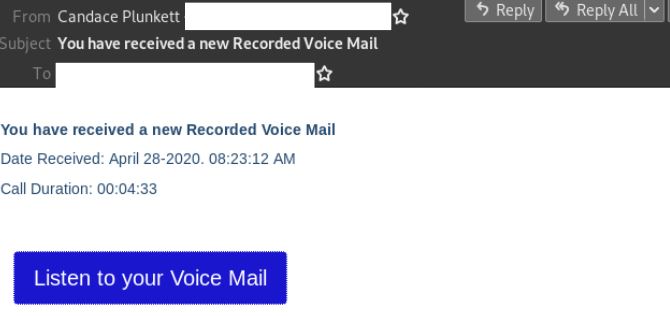
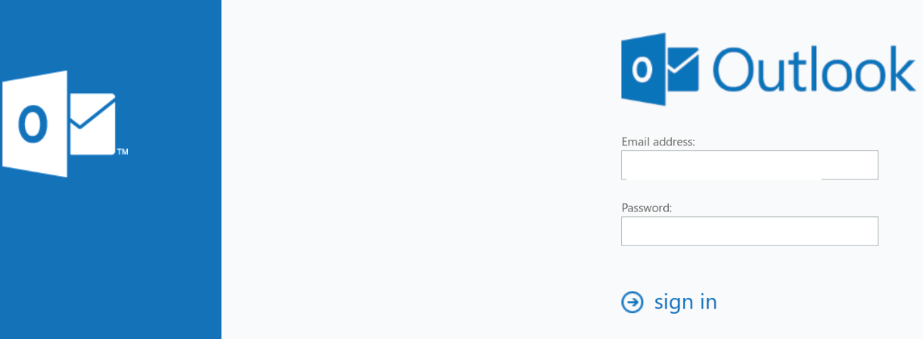
Today’s Scam of the day came from a long time friend and Scamicide reader who was savvy enough not to fall for this very clever scam. It starts when you receive an email that appears to have been sent by Microsoft Outlook informing you that you have received a voice mail message with a link to click on to access the voice mail message. If you do click on the link you will be directed to a phony, but legitimate appearing Outlook login page where you are prompted to provide your email address and password which is the information that the scammers are seeking. Having your Microsoft password and email address can lead to your becoming a victim of identity theft.
Here is a copy of the initial email message:
Here is a copy of the page to which you are directed if you click on the link to “Listen to your Voice Mail.”
TIPS
While this is a very persuasive phishing email that both looks legitimate and appeals to your curiosity, there are a few telltale signs that this is a scam. First and foremost, the email address from which the initial email is sent has no relation to Microsoft or Outlook. It may be the email address of an unfortunate person whose email account was hacked and made a part of a botnet used to send out such phishing emails while covering the tracks of the scammer. Second, nowhere in the email does your name appear. Third, the URL of the login page again has no relation to either Microsoft or Outlook. It is important to remember that unlike the pre-Internet days when counterfeiting took skill, it is very simple to make a very convincing counterfeit email that looks like it is coming from a legitimate company.
As I often advise you, never click on a link in an email unless you have absolutely confirmed that it is legitimate.
For those of you receiving the Scam of the day through an email, I just want to remind you that if you want to see the ever increasing list of Coronavirus scams go to the first page of the http://www.scamicide.com website and click on the tab at the top of the page that indicates “Coronavirus Scams.” Scamicide has been cited by the New York Times as one of three top sources for information about Coronavirus related scams.
If you are not a subscriber to Scamicide.com and would like to receive daily emails with the Scam of the day, all you need to do is sign up for free using this link. https://scamicide.com/scam-of-the-day/
Scam of the day – August 29, 2021 – Phony Restaurant Delivery Scam
Ordering food online for delivery was somewhat popular prior to the pandemic, but has become much more widely used as people want restaurant food without having to go to a restaurant. Many restaurants have taken advantage of this interest and set up websites to facilitate ordering food deliveries and companies such as DoorDash and GrubHub also take online orders for food deliveries from multiple restaurants. As could be expected scammers also are getting into the food delivery business although it would be more accurate to say that they got in the business of taking your online orders for food delivery, but deliver nothing except charges on your credit card.
Scammers create websites for phony delivery services using names such as “Order Hero” and “Order Ventures” or they mimic websites of legitimate restaurants or delivery services and through manipulating algorithms used by search engines to rank websites may appear at the top of a Google Chrome or other search engine search. Trust me, you can’t trust anyone.
TIPS
When you order online food from either a restaurant or a delivery service it is important to confirm that you are actually ordering from a legitimate restaurant or delivery service. Take the time to confirm the URL before placing your order and don’t trust a search engine search to be reliable merely because a website appears high on your search. An easy way to confirm that you have the correct URL is to call the restaurant or delivery service to make sure that you are using the correct URL.
As I often remind you, don’t use your debit card for anything other than an ATM card. Only use your credit card for your financial transactions because the protection you have from liability for fraudulent charges is much greater when using your credit card than it is when using your debit card.
Scam of the day – August 28, 2021 – Phony World Health Organization COVID-19 Lottery
The primary way to defeat the Coronavirus pandemic is through enough people becoming vaccinated to achieve herd immunity. Health officials have indicated that 70% of the population would be required to be vaccinated to reach this important goal. Unfortunately, although the vaccines have proven to be both safe and effective, there are a number of people who, for a variety of reasons, have chosen not to be vaccinated. As an incentive to increasing the number of people vaccinated, a number of states including California, Colorado, Kentucky, Louisiana, Maryland, Michigan, Nevada, New Mexico, North Carolina, Ohio, Oregon, Washington and West Virginia have set up legitimate lotteries for vaccinated people who sign up for the lottery for free. As I told you in May, Ohio was the first state to set up such a lottery.
Taking advantage of public awareness of such lotteries, scammers claiming to be Capital Finance, Inc., a phony financial management firm claiming to be from London are contacting people through emails in which they tell their targeted victims that they have won a million dollar lottery prize set up by the World Health Organization (WHO) in association with the International Monetary Fund (IMF) and the Bill & Melinda Gates Foundation to pay people for losses suffered as a result of the Coronavirus pandemic.
The scammers ask for extensive personal information from the “winners” of the lottery they did not enter which information is then used to commit identity theft. In other instances, like in more conventional lottery scams, the scammers also ask for payments for taxes or costs related to the lottery prize. Of course, there is no prize and any money paid to the scammers is lost forever.
TIPS
First and foremost, there is no Covid19 Lottery Compensation Prize and neither the WHO, nor the IMF nor the Bill & Melinda Gates Foundation are involved in any such lottery.
As with any lottery, it is hard enough to win a legitimate lottery that you have entered. It is impossible to win one that you have not entered. The state vaccination lotteries all require you to enter the lottery. Also. it is important to remember that no legitimate lottery charges anything to collect your prize and legitimate lotteries do not collect income taxes. They either deduct income taxes from your winnings or they pay you the entire amount of your prize and you are responsible for paying your own income taxes.
For those of you receiving the Scam of the day through an email, I just want to remind you that if you want to see the ever increasing list of Coronavirus scams go to the first page of the http://www.scamicide.com website and click on the tab at the top of the page that indicates “Coronavirus Scams.” Scamicide has been cited by the New York Times as one of three top sources for information about Coronavirus related scams.
If you are not a subscriber to Scamicide.com and would like to receive daily emails with the Scam of the day, all you need to do is sign up for free using this link. https://scamicide.com/scam-of-the-day/
Scam of the day – August 27, 2021 – Increase in U.S. Marshal Impostor Scams
Impostor scams have long been among the most lucrative for scammers. While there are many variations of this scam, the most common variations have involved scammers calling their intended victims on the telephone posing as some governmental agency such as the IRS or the Social Security Administration. The scammer then, under a wide variety of pretenses, demands an immediate payment by gift cards, credit card or wired funds. Being asked to pay by gift cards is a definite indication that the call is a scam since no governmental agency requests or accepts payments by gift cards. Alternatively, the scammer demands the victim supply the phony governmental agent with personal information such as your Social Security number which will then be used for identity theft purposes.
Recently the United States Marshals Service for the Northern District of Ohio indicated that there has been a significant increase in impostor scams in which the scammers call their targeted victims and tell them that they have missed important court dates after having been served with subpoenas. Of course are no subpoenas and the targeted victims are called randomly. The scammers then threaten arrest unless they are paid by prepaid debit cards over the phone.
TIPS
As I have often reminded you, through the simple technique of “spoofing” it is very easy for a scammer to manipulate your Caller ID to make a call coming to you appear legitimate when it is not. Therefore you can never truly trust your Caller ID. Trust me, you can’t trust anyone. Even though your Caller ID may indicate that the call is coming from the Office of the U.S. Marshal, the call is coming from a scammer. It is important to note that the U.S. Marshal’s Service never asks for debit card numbers or gift card payments.
If you have any concerns that the call is legitimate, merely hang up and call the court where the supposed case and subpoena was issued to confirm that the original call was an attempt to scam you.
For those of you receiving the Scam of the day through an email, I just want to remind you that if you want to see the ever increasing list of Coronavirus scams go to the first page of the http://www.scamicide.com website and click on the tab at the top of the page that indicates “Coronavirus Scams.” Scamicide has been cited by the New York Times as one of three top sources for information about Coronavirus related scams.
If you are not a subscriber to Scamicide.com and would like to receive daily emails with the Scam of the day, all you need to do is sign up for free using this link. https://scamicide.com/scam-of-the-day/
Scam of the day – August 26, 2021 – Pet Scams Continue to Worsen
“Puppy buying is at an all-time high,” according to the Nebraska Attorney General’s Office and along with the increase in the purchase of puppies that dramatically rose during the Coronavirus pandemic, the number of scams related to puppy buying increased substantially as well. According to Mallory Wojciechowski the president and CEO of the Better Business Bureau (BBB) Americans and Canadians lost approximately 3 million dollars last year to pet scams. Scams involving sales of non-existent puppies had already increased dramatically in the last few years, but really took off during the Coronavirus pandemic when many people were looking for the emotional support of a loving dog. People buy dogs or other pets online and, although they think they are taking proper precautions, they often end up getting nothing in return for the money that they wire to the scammer who may have a website or some other way of marketing their non-existent pets with photographs and false information. Often the scammers hook their victims for more and more money, such as when even after the victims has paid for the non-existent dog, the victim is asked for additional payments for a special crate to transport the dog along with additional transportation company fees.
TIPS
It is simple for a scammer to construct a website that appears to be legitimate and scammers can readily steal the name of a legitimate animal breeder. Always check into the reputation of the breeder with the Better Business Bureau, your state’s attorney general and even Google the name of the breeder with the word “scam” to see if a legitimate breeder’s name that is being used has been stolen for scams previously. Be wary of anyone who asks you to wire money because that is a telltale sign that a scam is going on because once the money is wired, it is impossible to get it back. If you are told that a courier company is being used to transport the animal, check out the company to make sure it is legitimate and actually shipping the dog. There also are a number of ways such as using the website http://www.tineye.com to search the photos sent to you of the dog to see if they appear elsewhere other than the website attempting to sell you a puppy. If so, this is a good indication that you are being scammed. Also, always get a veterinarian report on any animal before you consider buying it. Finally, you are always going to be better off buying a pet that you can see in person prior to buying the pet.
Some phony breeders claim they are certified by the American Kennel Club (AKC) however, the AKC doesn’t certify breeders. Legitimate breeders will however, register their litters with the AKC and you can find out by calling the AKC’s customer service line 919-233-9767 if a particular litter has been registered.
Here is a link to a television interview I did about pet scams:https://turnto10.com/i-team/consumer-advocate/12-scams-of-christmas-phony-pet-breeder
You also might want to consider getting a dog from a local animal shelter where you can both get a great dog and give an animal in need a loving home.
For those of you receiving the Scam of the day through an email, I just want to remind you that if you want to see the ever increasing list of Coronavirus scams go to the first page of the http://www.scamicide.com website and click on the tab at the top of the page that indicates “Coronavirus Scams.” Scamicide was recently cited by the New York Times as one of three top sources for information about Coronavirus related scams.
If you are not a subscriber to Scamicide.com and would like to receive daily emails with the Scam of the day, all you need to do is to go to the bottom of the initial page of http://www.scamicide.com and click on the tab that states “Sign up for this blog.”
Scam of the day – August 25, 2021 – Phony YouTube Activation Link Scam
Smart televisions connected to the Internet which allow you to access popular streaming services such as Netflix or Disney+ are very convenient. Generally, whenever you install an app on your smart television you are required to go to an activation page online to complete the installation which will join your streaming service account with your television. In order to install YouTube on your smart television you must download the app to your television which will respond by providing you with an activation code to use to complete the process online at the URL youtube.com/activate. Some people however, will use search engines such as Google Chrome to confirm that the URL is legitimate. Unfortunately, people are reporting doing a search engine search and being directed to a phony, but legitimate appearing YouTube page where if you type in the activation code a notice will indicate that there is an error and provides a telephone number for customer service for you to call. If you call the number, you are instructed that you are required to pay a refundable fee in order to activate your account. Often the payment is requested in the form of a Zelle, Venmo or gift card payment. Once you make payment by any of these methods, your money is lost forever and your account is not activated.
TIPS
Zelle and Venmo should not be used for business purposes. Their use should be restricted to payments to family members and friends. These services are easy and convenient, but they do not provide the protection from fraud you get when you pay for something with your credit card. Businesses that ask for payments by Zelle or Venmo should be immediately suspect. As for gift cards, they are not meant to be used for payment for business services. No legitimate business asks for payment by way of a gift card. Anytime you are asked to pay for something through the use of a gift card it is a scam. It is as simple as that.
As I have warned you in the past, scammers are able to manipulate the algorithms used by Google Chrome and others search engines so that their phony websites will appear high in a search. This scam has been used quite often by scammers posing as legitimate companies providing customer service telephone numbers for the companies, some of which do not have customer service telephone numbers at all.
In the case of YouTube the simple way to avoid the problem is to make sure you are using the only correct URL which is youtube.com/activate.
For those of you receiving the Scam of the day through an email, I just want to remind you that if you want to see the ever increasing list of Coronavirus scams go to the first page of the http://www.scamicide.com website and click on the tab at the top of the page that indicates “Coronavirus Scams.” Scamicide has been cited by the New York Times as one of three top sources for information about Coronavirus related scams.
If you are not a subscriber to Scamicide.com and would like to receive daily emails with the Scam of the day, all you need to do is sign up for free using this link. https://scamicide.com/scam-of-the-day/
Scam of the day – August 24, 2021 – Counterfeit COVID-19 Vaccination Cards
As many companies, universities and government agencies now require that employees and students be vaccinated against COVID-19, some people are still refusing to get vaccinated although getting the vaccine is the best and safest way to protect yourself and the people with whom you come into contact. This has provided an opportunity for criminals to provide counterfeit vaccination cards to people not wanting to get the vaccine, but still wanting to have access to places that require vaccination. In recent weeks custom officials have seized more than 14 shipments of counterfeit vaccination cards sent from China. Unlike driver’s licenses which generally have sophisticated security features such as holograms to discourage counterfeiting, vaccination cards are relatively unsophisticated in nature and relatively easy to counterfeit. Despite this, Custom officials have described many of the seized counterfeit vaccination cards as low quality with typographical errors and unfinished words. Using a counterfeit vaccination card is a federal offense as well as a violation of state laws as well.
TIPS
Buying a fake vaccination card online is a risky venture. You may pay and get nothing in return or you may get an obviously bogus vaccination card that puts you at increased risk of legal prosecution. It is much simpler and safer to get vaccinated. It is free and provides protection from the Coronavirus for you and the people with whom you come into contact. Finally, purchasing a counterfeit vaccination card online also puts you in danger of being blackmailed by the criminal selling you the card who can threaten to alert authorities of your use of the counterfeit card.
For those of you receiving the Scam of the day through an email, I just want to remind you that if you want to see the ever increasing list of Coronavirus scams go to the first page of the http://www.scamicide.com website and click on the tab at the top of the page that indicates “Coronavirus Scams.” Scamicide was recently cited by the New York Times as one of three top sources for information about Coronavirus related scams.
If you are not a subscriber to Scamicide.com and would like to receive daily emails with the Scam of the day, all you need to do is to go to the bottom of the initial page of http://www.scamicide.com and insert your email address where it indicates “Sign up for this blog.”
Scam of the day – August 23, 2021 – DocuSign Phishing Scam
DocuSign is a company that provides technology for the transmission of contracts and other documents with features for electronic signatures. DocuSign is used by many businesses. Recently, the security vendor Avanan discovered an increasing number of scams in which phony DocuSign messages are being used to sending malware infected links and phishing links luring people into providing personal information that is used for identity theft purposes. I described such a scam to you last May when I received a phishing email, reproduced below that purported to be sent by my landlord in regard to a change in the terms of my lease that required my immediate attention. This phishing email prompts me to click on a link to open a document that needed my signature. The phishing email looked very professional and contained the DocuSign logo and appeared legitimate. However, the email address of the sender was one totally unrelated to either DocuSign or anyone with whom I do business. Most likely it was the email address of someone whose email account had been hacked and made a part of a botnet used by the cybercriminal to send out large numbers of these emails. Additionally, I do not rent any real estate so the email couldn’t apply to me. Scammers send these emails out in large numbers hoping that many people who do rent their homes will be lured into clicking on the link
This phishing email was designed to lure the person receiving the email to click on the link and either provide personal information that could be used for identity theft, or, as more likely in this particular phishing attempt, merely by clicking on the link would have downloaded malware such as ransomware or keystroke logging malware into the computer of the person clicking on the link. Keystroke logging malware would have enabled the cybercriminal to steal all of the personal information from the computer and make that person a victim of identity theft. I removed the link from the email displayed below.
|
TIPS
In this case, I actually followed my own advice as to never click on a link regardless of how legitimate the email or text message may appear until confirming that the message is legitimate. In this case I didn’t even need to confirm that it was not legitimate because of the telltale evidence of the email address of the sender and the fact that I do not have any leases.
The lesson here is clear. You can never be sure when you receive an email as to who is really contacting you. Although sometimes it is obvious when the email address of the sender does not correspond to who is represented as sending the email, but other times the email account of someone or some company you trust could have been hacked and used to send you the malware. Therefore you should never click on a link or download an attachment in an email until you have absolutely and independently confirmed that it is legitimate.
For those of you receiving the Scam of the day through an email, I just want to remind you that if you want to see the ever increasing list of Coronavirus scams go to the first page of the http://www.scamicide.com website and click on the tab at the top of the page that indicates “Coronavirus Scams.” Scamicide has been cited by the New York Times as one of three top sources for information about Coronavirus related scams.
If you are not a subscriber to Scamicide.com and would like to receive daily emails with the Scam of the day, all you need to do is sign up for free using this link. https://scamicide.com/scam-of-the-day/