
Scam of the Day
Scam of the day – November 8, 2021 – FTC Sending Money to Victims of Deceptive Book Seller
In October of 2019 I first told you that the Federal Trade Commission (FTC) had sued Agora Financial, LLC alleging it scammed seniors into buying books, newsletters and other publications that falsely claimed a cure for type 2 diabetes and also perpetrating a scam related to a non-existent government affiliated check program. According to Andrew Smith, the FTC’s Director of the Bureau of Consumer Protection, Agora, “stole money from older adults with lies about having a cure for diabetes and a way to get thousands of dollars in government checks. One of their publications, “The Doctor’s Guide to Reversing Diabetes in 28 days” claimed to provide a cure for type 2 diabetes totally unsupported by scientific evidence. The Doctor’s Guide sold for $249. In addition, Agora also promoted a newsletter entitled “Lifetime Income Report” and a book entitled “Congress’ Secret $1.17 Trillion Giveaway” that promoted a phony, non-existent government program which Agora promised would enable consumers to receive thousands of dollars. Consumers obtaining the worthless book automatically became subscribers to the “Lifetime Income Report” for $99 per year.
Now the FTC is sending checks and PayPal refunds totaling more than two million dollars to victims of the scam. The funds to pay for the refunds came from money recovered from Agora Financial and related defendants. For more information about this refund program go to the tab in the middle of the Scamicide home page entitled “FTC Scam Refunds.” It is important to note that there is never a charge for obtaining a refund through the FTC or any of its refund administrators. Anyone who asks for such a payment is just another scammer.
TIPS
As for all health related products whether they offer a cure for diabetes or even weight loss, the truth is that you should always be wary of programs or products that promise miraculous health benefits. Check with your physician before considering any of these programs or products. As for weight loss products which are the source of many scams, there are no quick fixes when it comes to weight loss and you should be wary of any product that promises you can lose tremendous amounts of weight quickly without dieting or exercise. You should also be wary of any weight loss product that is sold exclusively either over the Internet or through mail-order advertisements. The best course of action is to ask your physician about the effectiveness of a particular weight loss product or program before you reduce your wallet in an effort to reduce your waistline.
As for “get rich quick” books and programs promising money from government programs, you should always research these books and programs thoroughly and with a skeptical eye since many of these are scams.
For those of you receiving the Scam of the day through an email, I just want to remind you that if you want to see the ever increasing list of Coronavirus scams go to the first page of the http://www.scamicide.com website and click on the tab at the top of the page that indicates “Coronavirus Scams.” Scamicide has been cited by the New York Times as one of three top sources for information about Coronavirus related scams.
If you are not a subscriber to Scamicide.com and would like to receive daily emails with the Scam of the day, all you need to do is sign up for free using this link. https://scamicide.com/scam-of-the-day/
Scam of the day – November 7, 2021 – Police Arrest Mailbox Identity Thieves
Identity theft can be high tech, low tech or no tech. Stealing mail from mailboxes for purposes of identity theft has been done by identity thieves for years. Numerous times over the last ten years I have warned you about the danger of having your mail, such as credit card bills or bank statements stolen from your personal mailbox. In addition, many people put themselves in great danger of identity theft by putting their outgoing mail in their mailbox and put up the red flag to alert the mail carrier that there is mail to be picked up. Unfortunately, that is also an alert to identity thieves cruising the neighborhood of mail to be easily stolen.
Antioch Illinois police recently arrested a gang of criminals who they say stole hundred of pieces of mail and used the mail for purposes of identity theft. In one instance, an Antioch resident wrote a check as a donation to St. Jude’s Children Research Hospital and then put the check in an envelope and then put the envelope in their his home mailbox with the red flag raised to alert the postal carrier to pick up the mail. Unfortunately, the red flag alerted the identity thieves who stole the letter, altered the check and then deposited into a mobile app account.
TIPS
In order to avoid becoming a victim of identity theft through your mailbox, you should make sure that it is securely locked so that it is not easily accessed by your friendly neighborhood identity thief and when it comes to outgoing mail, don’t put it in your mailbox for your mail carrier to pick up regardless of how convenient it may be to do so. In fact, identity thieves also steal mail from the U.S. Postal Service mailboxes found on the corners of major streets so, in order to be safe, you should mail your outgoing mail at the post office. It may seem like this is being a bit excessive when it comes to protecting your mail, but remember, even paranoids have enemies.
Another thing you can do to reduce the danger of identity theft through mail theft is to use the Informed Delivery Program of the USPS. The Informed Delivery Program is a free service of the U.S. Postal Service that will send you an email each morning with images of the mail you will be receiving later that day. This service was first done on a pilot basis in 2014 in parts of California, Connecticut, Maryland, Virginia and Washington D.C. and became available to everyone three years later. Identity theft through the stealing of mail such as credit card statements and bank statements from your mailbox is a significant problem and this program both alerts you as to when to look for important mail, as well as let you know if such important mail has been stolen from your mailbox so you can respond more quickly. However, nothing is full proof. A few years ago I told you about the identity theft of more than thirty-five people living in the same Miramar, Florida neighborhood caused by criminals exploiting flaws in the program. These criminals signed up for the program in the names of their victims and were able to see when credit card statements and other mail containing personal information would be delivered so that they were alerted as to when to steal the mail from the mail boxes of their victims and gain access to their credit cards as well as sign her up for additional cards which they also exploited. While in order to set up an Informed Delivery account, you need to answer security questions, the information necessary to answer those questions can often be readily obtained online.
The best way to avoid the problem of someone using the Informed Delivery Program to learn about your upcoming mail deliveries is to sign up for the Informed Delivery Program yourself before an identity thief does so in your name. Here is the link to go to sign up.
https://informeddelivery.usps.com/box/pages/intro/start.action
It is also important to note that if you do sign up for the service, you should use a unique and complex password to prevent identity thieves from hacking your account to let them know when important mail that they can exploit for identity theft purposes will be arriving to your home.
For those of you receiving the Scam of the day through an email, I just want to remind you that if you want to see the ever increasing list of Coronavirus scams go to the first page of the http://www.scamicide.com website and click on the tab at the top of the page that indicates “Coronavirus Scams.” Scamicide has been cited by the New York Times as one of three top sources for information about Coronavirus related scams.
If you are not a subscriber to Scamicide.com and would like to receive daily emails with the Scam of the day, all you need to do is sign up for free using this link. https://scamicide.com/scam-of-the-day/
Scam of the day – November 6, 2021 – New Report Shows Child Identity Theft Worsening
According to a new study recently released by Javelin Strategy & Research more than 1.25 million children became victims of identity theft last year and the true number is probably much greater because in many instances child identity theft is not discovered until the child reaches age 18. Identity thieves steal the identity of a child and then run up large debts using the credit of the child, who generally does not become aware that his or her identity has been stolen until he or she reaches older teen years when the teenager might first apply for a car loan or financial aid for college.
Identity theft of children’s identities is a huge national problem. According to a study by the Carnegie Mellon CyLab, children are more than 51 times more likely to become a victim of identity theft than adults. Children are also the most common victims of “synthetic identity theft.” Many people are not familiar with the term “synthetic Identity theft,” but it poses a significant threat to many people particularly children. Synthetic identity theft occurs when a criminal takes information from a variety of sources to create a new identity to take out loans, purchase goods and services, or fraudulently obtain credit cards. Synthetic identity thieves combine real and fake information to form a new fictional person. They may use your Social Security number and combine it with the name, address and phone number of someone else. The Federal Trade Commission (FTC) has said that synthetic identity theft is the fastest growing type of identity theft. Children are the most common victims of synthetic identity theft and it is often many years before the problem is discovered.
In synthetic identity theft criminals then build the credit score of the synthetic identity by having people use the credit cards and make regular payments until the credit score of the new synthetic identity is high enough for the ultimate payoff, which is referred to as the “bust out.” In the bust out phase, the identity thief uses the new synthetic identity to either make large purchases or take out big loans that are never paid back. Some synthetic identity thieves will take years to build the synthetic identity theft credit score by making payments on cell phone accounts, car loans and more.
TIPS
Some telltale signs of synthetic identity theft include being contacted about an account that you never opened or a debt that you didn’t incur. Also, look for aliases listed on your credit report that you do not use. A dramatic lowering of your credit score coupled with a lack of negative information on your primary credit reports are further indications of synthetic identity theft. The reason that your primary credit report will not show negative information due to synthetic identity theft is because when a criminal uses your Social Security number, but doesn’t use your name, the negative information caused by their actions does not appear on your regular credit report. Instead, the information is added to a sub-file of your credit report which will, however, cause your credit score to drop tremendously.
If you do find out that you or your children have become a victim of synthetic identity theft, notify each of the three credit reporting agencies, Equifax, Experian and TransUnion of the crime and ask them to investigate and remove the false information from your sub-files.
Parents also should, as much as possible, try to limit the places that have their child’s Social Security number and become familiar with the Family Educational Rights Privacy Act which helps you protect the privacy of your child’s school records and enables you to opt out of information sharing by the school with third parties. You also should freeze the credit reports of your children.
Here are the links to information about how to freeze your child’s credit reports at each of the three major credit reporting agencies.
https://www.transunion.com/credit-freeze
https://www.equifax.com/personal/education/identity-theft/freezing-your-childs-credit-report-faq/
For those of you receiving the Scam of the day through an email, I just want to remind you that if you want to see the ever increasing list of Coronavirus scams go to the first page of the http://www.scamicide.com website and click on the tab at the top of the page that indicates “Coronavirus Scams.” Scamicide.com was cited by the New York Times as one of three best sources for information about Coronavirus related scams.
If you are not a subscriber to Scamicide.com and would like to receive daily emails with the Scam of the day, all you need to do is to go to the bottom of the initial page of http://www.scamicide.com and type in your email address where it states “Sign up for this blog.”
Scam of the day – November 5, 2021 – Religious Radio Host Ponzi Schemer Sentenced
In 2019, I told you about criminal charges filed against investment adviser William Neil “Doc” Gallagher who operated a multi-million dollar Ponzi scheme in which he victimized mostly elderly clients since 2014. Gallagher solicited his clients through appearances on radio shows including a Christian-talk radio station. He appealed to religious clients also through his book “Jesus Christ, Money Master: Four Eternal Truths That Deliver Personal Power and Profit.” However, instead of investing the funds provided to him by his clients, Gallagher primarily used the funds to support his own lavish lifestyle and to pay early investors with the money provided by later investors which is the hallmark of a Ponzi scheme. Gallagher’s scam is also a good example of what is called affinity fraud where people put undeserved trust in someone offering an investment opportunity because that person is “someone like me.” Affinity fraud works because people trust other people who may share a common bond, such as family, religion or some other group affiliation. The list goes on and on. Scammers take advantage of every connection they can make with their victims to gain their trust and then steal their money. In Gallagher’s case, his victims put undeserved trust in him because he seemed legitimate on the radio and espoused the same religious views that they did.
In 2020 after pleading guilty he was sentenced to 25 years in prison. Now he has been convicted and sentenced on similar charges to three life sentences plus thirty years.
TIPS
Before investing with anyone, you should investigate the person offering to sell you the investment with the Securities and Exchange Commission’s Central Registration Depository. This will tell you if the broker is licensed and if there have been disciplinary procedures against him or her. You can also check with your own state’s securities regulation office for similar information. Many investment advisers will not be required to register with the SEC, but are required to register with your individual state’s securities regulators. You can find your state’s agency by going to the website of the North American Securities Administrators Association. In the case of Gallagher, he has not been a Registered Investment Adviser since 2009. Many investment advisers will not be required to register with the SEC, but are required to register with your individual state securities regulators. You can find your state’s agency by going to the website of the North American Securities Administrators Association. You should also check with the Financial Industry Regulatory Authority (FINRA) for information about the particular investment adviser.
It is also important to remember that you should never invest in something that you do not completely understand. This was a mistake that many of Bernie Madoff’s victims made. You also may want to check out the SEC’s investor education website at www.investor.gov. Scammers can be very convincing and it may sound like there is a great opportunity for someone to make some money, but you must be careful that the person making money is not the scam artist taking yours. Additionally, investing with someone merely because you trust them because you have heard them on the radio or television is dangerous. Having the same person advise the investment and control the investment such as was the case with Gallagher is a common thread among Ponzi schemers because it enables them to falsify documents to make the investment look profitable. Generally, for additional security it is desirable to have a separate broker-dealer act as custodian for investments chosen by an investment adviser.
For those of you receiving the Scam of the day through an email, I just want to remind you that if you want to see the ever increasing list of Coronavirus scams go to the first page of the http://www.scamicide.com website and click on the tab at the top of the page that indicates “Coronavirus Scams.” Scamicide was cited by the New York Times as one of three top sources for information about Coronavirus related scams.
If you are not a subscriber to Scamicide.com and would like to receive daily emails with the Scam of the day, all you need to do is to go to the bottom of the initial page of http://www.scamicide.com and type in your email address on the tab that states “Sign up for this blog.”
Scam of the day – November 4, 2021 – Tax Debt Compromise Program Scam
A Scamicide reader recently informed me that she had received an early morning weekend robocall informing her of “President Biden’s tax debt compromise program” and offering help eliminating or reducing back taxes. This scam is similar to many other scams where unscrupulous scammers offer non-existent help eliminating tax debts. The first thing to be aware of is that there is no such program described as a “tax debt compromise program” although there has long been an IRS program for “Offers in Compromise” whereby in certain situations the IRS will reduce your tax bill if you qualify.. However, if such a solicitation comes as a robocall, it is a scam because it is illegal to contact you for such services through a robocall.
TIPS
There are many unscrupulous scammers offering to get you a reduction in your income taxes owed and they generally make wild misrepresentations of what they can do for you. If you do have issues with owed income tax you may be eligible for the IRS Offers in Compromise program. The requirements for eligibility for this program can be complicated and if you are considering it, you should contact a legitimate CPA for assistance rather than using the services of someone or some company of questionable legitimacy. You should also investigate anyone who you hire for tax relief to determine if they are legitimate and if complaints have been made against them before retaining them for such a sensitive purpose.
For information about the IRS Offers in Compromise program you can go to the IRS website where it describes the program in detail. https://www.irs.gov/payments/offer-in-compromise
For those of you receiving the Scam of the day through an email, I just want to remind you that if you want to see the ever increasing list of Coronavirus scams go to the first page of the http://www.scamicide.com website and click on the tab at the top of the page that indicates “Coronavirus Scams.” Scamicide has been cited by the New York Times as one of three top sources for information about Coronavirus related scams.
If you are not a subscriber to Scamicide.com and would like to receive daily emails with the Scam of the day, all you need to do is sign up for free using this link. https://scamicide.com/scam-of-the-day/
Scam of the day – November 3, 2021 – FTC’s New Policy Against Deceptive Subscription Services
The Federal Trade Commission (FTC) recently issued a new enforcement policy in which it warns companies not to use illegal and misleading tactics to trap consumers into various subscription services. The FTC took this step in response to increasing complaints by consumers about misleading sign-up tactics including adding unauthorized charges, automatic renewal and continual monthly billings that are impossible to cancel.
While this is a new enforcement policy, the FTC has often brought legal action against companies using illegal subscription practices such as hiding important payment information and companies that converted free trials to paid subscriptions before the free trial period ended.
According to the new policy which can be found here https://www.ftc.gov/system/files/documents/public_statements/1598063/negative_option_policy_statement-10-22-2021-tobureau.pdf companies must disclose clearly and conspicuously all material terms of the services including the cost and how to cancel as well as obtain the consumer’s express informed consent before charging the consumer for a product or service. In addition, companies must provide easy cancellation mechanisms.
TIPS
There is never anything fine in fine print, but whenever you sign up for any service or subscription, particularly one that initially indicates it is free, you should make sure that you have carefully read the fine print indicating the terms of the contract including what you need to do to cancel the service. A particular red flag is when an advertised as “free” service requires you to provide a credit card number under some guise. Scammers do this to start charging your card without your authorization.
It is also a good idea before you sign up for some service or subscription to do a search engine search to see if there have been complaints against the company.
For those of you receiving the Scam of the day through an email, I just want to remind you that if you want to see the ever increasing list of Coronavirus scams go to the first page of the http://www.scamicide.com website and click on the tab at the top of the page that indicates “Coronavirus Scams.” Scamicide was cited by the New York Times as one of three top sources for information about Coronavirus related scams.
If you are not a subscriber to Scamicide.com and would like to receive daily emails with the Scam of the day, all you need to do is to go to the bottom of the initial page of http://www.scamicide.com and click on the tab that states “Sign up for this blog.”
Scam of the day – November 2, 2021 – FTC Sending Refunds to Victims of Tech Support Scam
Tech support scams in which consumers are tricked by scammers into believing there is a problem with their computers that require the expensive services of the scammers constitute a major problem. Tech support scams are increasingly common and victimize consumers 60 years or older about five times more than people between the ages of 20 and 59 according to the Federal Trade Commission (FTC). In February of 2019 I reported to you that the FTC obtained a temporary restraining order against Elite IT Partners, Inc and its principal James Martinos, shutting down the company, which the FTC alleged used deceptive tactics to gain access to consumers’ computers and then sell them expensive repair and other services that were totally unnecessary. Most of the victims of this scam were older consumers.
According to the FTC, Elite used Internet ads targeted at consumers who were looking for email password recovery assistance and lured them into providing their names, email addresses and phone numbers to Elite IT Partners, Inc. Elite’s telemarketers then contacted the consumers posing as well-known companies such as AOL or Yahoo and told the consumers that their computer problems were most likely as a result of their computers being infected with a virus. The telemarketers would then convince the consumers to provide remote access to their computers to Elite who would then run diagnostic tests. These diagnostic tests were totally bogus and always resulted in the consumer being told that he or she needed computer repair as well as antivirus software and services that Elite would provide at a high cost. The FTC further alleged that Elite also charged for additional monthly services that it did not disclose.
In December of 2019 the FTC, Elite IT Partners Inc. and James Martinos reached a settlement of the charges. Under the terms of the settlement, Elite IT Partners Inc. and Martinos were permanently banned from offering or marketing tech support services in the future. A 13.5 million dollar judgment was also imposed, but it was suspended following the payment by Martinos of $173,500 and the turning over to the FTC of other assets. Now the FTC is sending checks to 31,075 victims of the scam.
TIPS
Providing remote access to anyone to your computer can lead to a myriad of problems including identity theft and the downloading of ransomware. Neither AOL, Yahoo, Apple, Microsoft or any of the other tech companies ever ask for remote access to your computer to fix problems. The most common tech support scams start with popups on your computer that provide notices of security problems that contain telephone numbers for you to call to fix the problem, Whenever you get a pop-up, email, or text message that appears to tell you that you have a security problem with your computer, you should never click on any links contained in the message or call the telephone number provided. If your screen freezes, all you need to do is just turn off your computer and restart it. If you are concerned that you may be experiencing a real security problem you can contact tech support at the real tech companies directly by phone or by email using the phone number and email addresses you find on their respective websites.
Remember, whenever you get a phone call, you can never be sure who is really calling you. Scammers can “spoof” a call to you by which they trick your Caller ID to make it appear as if the call is legitimate. Never give personal information or certainly remote access to your computer to someone who calls you unless you have absolutely confirmed that the call is legitimate and there is a need for your response. The better course is to hang up and confirm whether or not the call is legitimate. Most of the time you will find it was not.
For more information about this refund program go to the tab in the middle of the Scamicide home page entitled “FTC Scam Refunds.” It is important to note that there is never a charge for obtaining a refund through the FTC or any of its refund administrators. Anyone who asks for such a payment is just another scammer.
For those of you receiving the Scam of the day through an email, I just want to remind you that if you want to see the ever increasing list of Coronavirus scams go to the first page of the http://www.scamicide.com website and click on the tab at the top of the page that indicates “Coronavirus Scams.” Scamicide was cited by the New York Times as one of three top sources for information about Coronavirus related scams.
If you are not a subscriber to Scamicide.com and would like to receive daily emails with the Scam of the day, all you need to do is to go to the bottom of the initial page of http://www.scamicide.com and type in your email address on the tab that states “Sign up for this blog.”
Scam of the day – November 1, 2021 – Phony PayPal Invoice Scam
The phony invoice scam is a common scam popular with scammers because it is quite effective. It starts when you receive an email that purports to be from a popular company with which many of us do business that indicates that you owe them a significant payment. The scammers count on people being concerned that they are being wrongfully charged for a product they did not order. You are provided a telephone number to call if you dispute the bill. If you call the number, you will be prompted to provide personal information that will be used to make you a victim of identity theft. Here is a copy of the phony invoice presently being circulated.
This email appears to come from PayPal. As always, the purpose of a phishing email is to lure you into clicking on links contained within the email or providing personal information, in this case by phone if you call to dispute the phony bill . If you click on links in phishing emails, you end up downloading malware and if you provide the requested information, it ends up being used to make you a victim of identity theft. This particular phishing email provides a phone number to call if you wish to dispute the obviously phony invoice. If you call the number in the phishing email you will be asked for personal information that will be used to make you a victim of identity theft.
There are a number of red flags that indicate that this is a scam. Your name does not appear anywhere in the invoice. Only your email address appears in the phony invoice. Also, the email was sent from an email address that appears to have nothing to do with PayPal, but is most likely the email address of someone whose email account was hacked and used to send out these scam emails..
Here is a copy of the invoice being circulated.
|
PayPal |
Transaction ID:9485BNMK362500M |
|
|
|
Hello , You sent a payment of $799.99 to Coinbase Inc. It may take a few moments for this transaction to appear in your account
Issues with this transaction? For More Information Call us:- (888) 288-8175 Please do not reply to this email. This mailbox is not monitored and you will not receive a response. For assistance, log in to your PayPal account and click Help in the top right corner of any PayPal page or please contact us toll free at (888) 288-8175. From, PayPal 2211 North First Street (888) 288-8175 |
|||||||||||||||||||||||||||||
TIPS
Once, I received a large invoice from a company with which I do business for goods I did not order, but rather than click on the link provided in the email, I went directly to the company’s website to question the invoice. When the website came up, the first thing I saw was a large announcement that the invoice was a scam and that many people had received these phony invoices. If you ever receive a phony invoice such as this and you think that it may possibly be true, don’t click on links or call phone numbers provided in the email. Rather contact the real company directly at a phone number or website that you know is legitimate where you can confirm that the phishing invoice was a scam.
Never click on links or download attachments in emails or text messages unless you have absolutely confirmed that they are legitimate and don’t call companies at telephone numbers that appear in the email such as this one. Instead, if the email appears to come from a legitimate company, you can call them at a telephone number you confirm is legitimate . Don’t call the number that appears in the email. In the case of PayPal, the real telephone number to call for customer service is 888-221-1161. You can also contact PayPal customer service through this link https://www.paypal.com/us/smarthelp/contact-us
For those of you receiving the Scam of the day through an email, I just want to remind you that if you want to see the ever increasing list of Coronavirus scams go to the first page of the http://www.scamicide.com website and click on the tab at the top of the page that indicates “Coronavirus Scams.” Scamicide has been cited by the New York Times as one of three top sources for information about Coronavirus related scams.
If you are not a subscriber to Scamicide.com and would like to receive daily emails with the Scam of the day, all you need to do is sign up for free using this link. https://scamicide.com/scam-of-the-day/
Scam of the day – October 31, 2021 – Fake IRS Emails About Economic Impact Payments
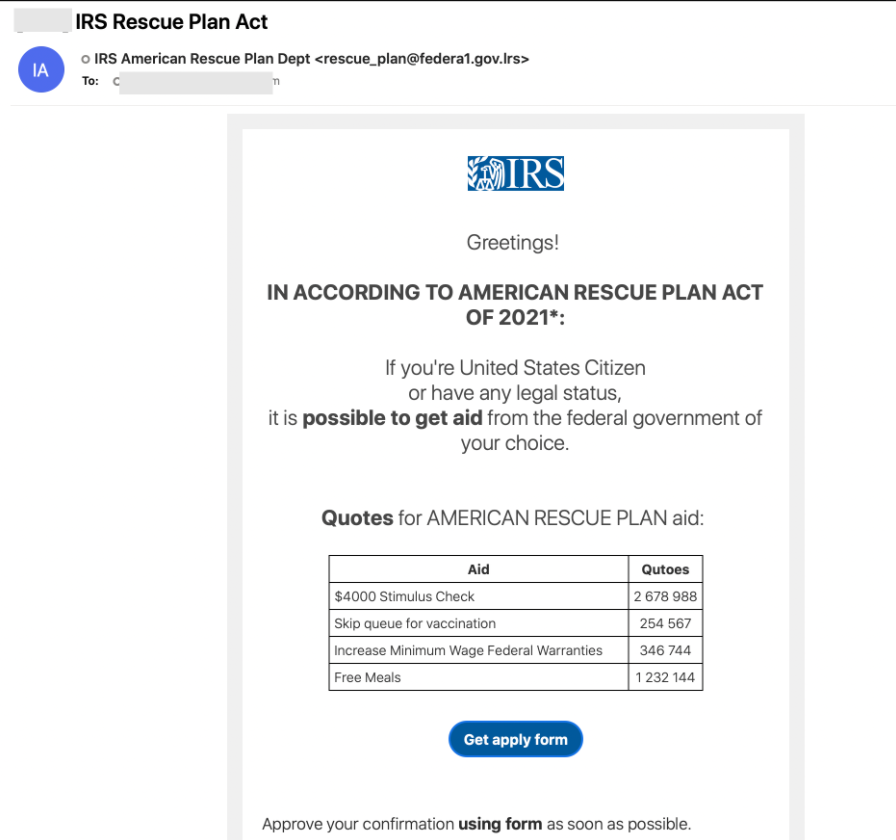
The third round of Economic Impact Payments authorized by the American Rescue Plan Act of 2021 was paid as an advance payment of the tax year 2021 Recovery Rebate Credit. The IRS began sending these payments on March 12, 2021 to eligible people, most of whom have already received their payment. However the IRS sent these payments based on information contained in their 2020 income tax returns and many people who filed later including those who just paid in October after getting an extension on the filing date for their 2020 income tax return will be now getting their payment when the IRS processes their 2020 income tax return (which they are doing very slowly). Scammers are not missing out on this opportunity to scam people or make them victims of identity theft and are capitalizing on interest in these payments by sending emails that appear to come from the IRS asking people to click on links to provide access to a form required in order to authorize the payment. Other forms of the email provide a link to click on to get help with your payment. In either case, only bad things can happen if you click on those links. In some instances, merely by clicking on the link you will download dangerous strains of malware that may include keystroke logging malware that will steal your personal information from your computer and use it to make you a victim of identity theft. In other other instances, you will be prompted to provide personal information directly that will be used to make you a victim of identity theft. Copied below is a similar bogus IRS email about which I told you in March. According to the cybersecurity company Proofpoint which issued a report about this scam, the scammers used email addresses that might appear at first blush to be from the federal government. Some of the email addresses used are us_irs@federa1.irs.c0m, resecue_plan@federa1.irs.c0m and american_rescure@federa1.irs.c0m. If you look closely at the email addresses of the sender, however, you will note that rather than the letter “l” in the word “federal,” the digit “1” appears. Also, each email address ends with .com, but the “o” is replaced with the digit “0.” If you look closely you will also see the word “quotes” is misspelled.
If you click on the tab marked “get apply form” you will end up downloading a type of malware called Dridex that will steal your personal banking information and other login credentials.
TIPS
The truth is that the federal government is not contacting anyone by email in regard to receiving benefits under the American Rescue Plan, which have been and continue to be sent to the bank accounts of eligible people. You do not apply for benefits under the American Rescue Plan. Your stimulus check will be sent to you based on your eligibility as determined from your most recently filed federal income tax return and your payment will be made either electronically to the bank account you indicated in your most recent federal income tax return or sent to you as a paper check or debit card. You do not need to do anything to apply for these benefits.
For detailed information upon which you can rely, you should go to the IRS’ website where it explains all you need to know about this program. https://www.irs.gov/coronavirus/third-economic-impact-payment
For information about the status of your specific stimulus payment, you should only go to this IRS interactive website. https://www.irs.gov/coronavirus/get-my-payment
For those of you receiving the Scam of the day through an email, I just want to remind you that if you want to see the ever increasing list of Coronavirus scams go to the first page of the http://www.scamicide.com website and click on the tab at the top of the page that indicates “Coronavirus Scams.” Scamicide has been cited by the New York Times as one of three top sources for information about Coronavirus related scams.
If you are not a subscriber to Scamicide.com and would like to receive daily emails with the Scam of the day, all you need to do is sign up for free using this link. https://scamicide.com/scam-of-the-day/
Scam of the day – October 30, 2021 – The Dangers of the Unsubscribe Link
I would say it is a pretty fair assumption that most of us get far more emails than we wish to receive. Much email contains solicitations and advertisements that clog up our inboxes and require constant attention to delete, which is why you may be tempted to take advantage of the opportunity presented in many of these emails to click on a link at the bottom of the email to unsubscribe.
Don’t do it.
While the unsubscribe link is probably safe when it comes in an email from a company that you are sure is legitimate, you could run into serious problems if the unsubscribe link is contained in an email from a scammer. The problem is that when you click on the unsubscribe link, you run the risk of being directed to a site that downloads malware on to your computer, laptop or cellphone. In addition, instead of reducing the amount of spam and undesired emails by clicking on the link to unsubscribe, you may end up getting more spam and malware infected emails because the scammers who include an unsubscribe link at the bottom of their emails compile lists of the email addresses of people who click on that link and sell those lists to other scammers as email addresses that they know are valid.
TIPS
In determining whether or not the email you get is truly from a legitimate company, you can check out the email address from which it is sent, but frankly you are better off just using your email provider’s option to block or mark the email as spam in order to prevent further such emails. Frankly, although it may seem like a waste of time, an effective and simple way to deal with the unsubscribe link is to ignore it and merely delete unwanted emails.
For those of you receiving the Scam of the day through an email, I just want to remind you that if you want to see the ever increasing list of Coronavirus scams go to the first page of the http://www.scamicide.com website and click on the tab at the top of the page that indicates “Coronavirus Scams.” Scamicide was recently cited by the New York Times as one of three top sources for information about Coronavirus related scams.
If you are not a subscriber to Scamicide.com and would like to receive daily emails with the Scam of the day, all you need to do is to go to the bottom of the initial page of http://www.scamicide.com and type your email address on the tab that states “Sign up for this blog.”