
Scam of the Day
Scam of the day -October 7, 2026 – IRS Watchdog Report Details Extensive Delays for Victims of Income Tax Identity Theft
The Treasury Inspector General for Tax Administration recently issued a report showing that the IRS continues to experience extensive delays in sending income tax refunds to victims of income tax identity theft with an average processing time now of 655 days. As the report indicated, “These lengthy delays can frustrate and burden taxpayers while they wait to receive their refunds.” According to the report the “increased prevalence and sophistication” of income tax identity theft is making the situation worse. Income tax identity theft, by which identity thieves file phony income tax returns with counterfeit W-2s using the Social Security number and name of their victim remains a major problem for the IRS and taxpayers costing us all billions of dollars each year. However, when someone has stolen your Social Security number and filed an income tax return using your name, the problem becomes particularly personal.
So what can you do to protect yourself from income tax identity theft? First and foremost you should file your return as soon as possible because if you file your income tax return before the identity thief does you should be able to get your refund in a timely manner. However, income tax identity thieves are pretty prompt in filing their phony returns so you should also get a PIN from the IRS to use when filing your tax return.
In 2022 the IRS announced an expansion of its Identity Protection PIN Op-In Program that provides individual taxpayers with a six-digit code that is required to be included on the individual’s income tax return. This will protect someone whose Social Security number had been compromised from becoming a victim of identity theft because the identity thief will not know the six-digit code. Here is a link to the section of the IRS’ website where you can apply for a PIN. https://www.irs.gov/identity-theft-fraud-scams/get-an-identity-protection-pin The PIN is only valid for a single year but will automatically be renewed each year. The easiest way to get a PIN is through your online IRS account. Here is a link to information about getting an online IRS Account. https://www.irs.gov/payments/online-account-for-individuals
TIPS
In addition to protecting the privacy of your Social Security number, the best thing you can do to protect yourself from becoming a victim of income tax identity theft is to file your income tax return as early as possible. A criminal can successfully make you a victim of income tax identity theft only if he or she files an income tax return using your Social Security number before you file your legitimate income tax return. Therefore the earlier you file your income tax return, the more likely you are to avoid becoming a victim of this crime.
The IRS started the Identity Theft Protection PIN program almost ten years ago, but it was only available to people who were already victims of identity theft and to people living in a few specific states chosen by the IRS to test the program. Now anyone can and should obtain an Identity Theft Protection PIN.
If you are not a subscriber to Scamicide.com and would like to receive daily emails with the Scam of the day, all you need to do is sign up for free using this link. https://scamicide.com/scam-of-the-day/
Scam of the day – October 6, 2026 – FTC Sending Additional Refunds to Victims of University of Phoenix Scam Settlement
For profit universities have been a target of state and federal investigations for years. I have written about this topic since 2012. It should be noted that not all for profit colleges are scams, but there are a large number of for profit colleges, sometimes referred to as “diploma mills” that at times offer credit for your “life experience” and lure students in with promises of a helpful degree, but the students end up with a worthless degree and an empty wallet. Sometimes the names of these scamming colleges and universities are confusingly similar to legitimate colleges. For instance, Columbia State University is a diploma mill while Columbia University is an eminent Ivy League school.
In 2019, the University of Phoenix settled charges brought by the Federal Trade Commission (FTC) that it used deceptive advertising to attract students. These ads falsely implied that the University of Phoenix worked with companies such as AT&T, Yahoo and Microsoft to create job opportunities for students and to shape its programs for the jobs. Pursuant to the settlement, the University of Phoenix paid 50 million dollars to the FTC and the FTC began sending refunds to 147,500 former University of Phoenix students in March of 2021 as I told you at that time. Additional rounds of payments were made by the FTC in 2023 and 2025 and now the FTC is sending Zelle payments to people who didn’t cash their check or accept a PayPal payment from the FTC.
TIP
If you attended the University of Phoenix and want to find out if you qualify for the refunds, check out the “FTC Scam Refunds” tab in the middle of the first page of http://www.scamicide.com.
These refund checks are only being sent to student whose debts had not been already cancelled by the University of Phoenix. In addition, in order to qualify for a payment, you must have initially enrolled at the University of Phoenix between October 15, 2012 and December 31, 2016 and must have paid more than $5,000 to the University of Phoenix although this figure can include funds derived from student loans or military benefits.
In addition, recently the Department of Education approved federal student loan forgiveness for people who attended the University of Phoenix and were deceived by the school’s jog placement claims and submitted a valid application for borrower defense. The Department of Education is notifying people whose borrower defense applications were approved. Even if you received a payment from the University of Phoenix settlement fund, you can still appy for loan forgiveness through the borrower defense program.
If you are considering attending a for profit school, first check it out with the United States Department of Education’s website at https://ope.ed.gov/dapip/#/home to make sure it is an accredited institution.
You also should investigate whether a local college, university or community college would be more cost effective for you. For profit colleges and universities are often more expensive than these other alternatives without offering any distinct advantages. Also, check out the graduation rates of any for profit college you are considering and finally, investigate the job prospects in your field of study. Don’t just take the word of the college.
If you are not a subscriber to Scamicide.com and would like to receive daily emails with the Scam of the day, all you need to do is sign up for free using this link. https://scamicide.com/scam-of-the-day/
Scam of the day – October 5, 2026 – Why Scammers Love WhatsApp, Telegram and Signal
According to the Federal Trade Commission (FTC) more scams in the United States are started on social media than on any other platform at a cost of 2 billion dollars in 2025 and that figure is undoubtedly low because many victims, often out of embarrassment, do not report being victimized. A study done by the Fin Tech company Revolut found that 60% of all scams in the UK originated on the Meta platforms Facebook, Instagram and WhatsApp with investment scams being the most common form of scam. Revolut referred to social media as a “hotbed” for scams.
Social media based scams take many forms, but are often based on our trusting the people we encounter as friends on social media. Remember my motto, “trust me, you can’t trust anyone.” Scammers harvest information about you that you post on social media to learn more about you and your interests and use that information to target you with a wide variety of scams including investment scams, romance scams and sales of phony products.
One way to recognize a scam is when you start communication with someone on social media such as LinkedIn, Facebook or Instagram or even through email and they want to move your discussions to WhatsApp, Telegram or Signal which are all legitimate encrypted messaging platforms, but are favorites of scammers because they are encrypted and not monitored as well as other social media where the platforms may be using AI for scam detection.
TIPS
Don’t accept friend requests from everyone who asks to be your friend on social media and don’t trust communications on social media merely because they appear to come from your friends. Often social media accounts are hacked or cloned and the scammers, posing as your friends, leverage the trust that you have in your friends to lure you into phony investments, phony sales and romances. Further, even if a communication comes from a real friend, often people will forward scams that they have been fooled into thinking are legitimate.
Use your privacy settings to limit who can see the information you post on social media.
Remember it is good rule to never click on links that may appear on social media, text messages or emails unless you have absolutely confirmed that they are legitimate because the risk of downloading malware is too great.
As for WhatsApp, Telegram and Signal, no legitimate employer offering a job or financial advisor will switch platforms after they have made initial contact with you.
If you are not a subscriber to Scamicide.com and would like to receive free daily emails with the Scam of the day, all you need to do is to go to the bottom of the initial page of http://www.scamicide.com and type in your email address in the tab that states “Sign up for this blog.”
Scam of the day – October 4, 2026 – Medicare Open Enrollment Scams
The annual open enrollment period for Medicare begins on October 15th and will end on December 7th. This is the only time during the year that people enrolled in Medicare can change their Medicare health plans, Medigap plans and prescription drug plans. By now, people already enrolled in Medicare should have received an Annual Notice of Change from their health insurance providers describing any changes to their plans such as the dropping of particular drugs from their prescription drug plan. If you are satisfied with your plans, you do not need to do anything.
Scammers and identity thieves view the open enrollment period as senior citizen hunting season as myriads of Medicare scams are common during this time. Seniors may be contacted by someone purporting to be from their insurance company asking them to verify information. This is a common tactic of identity thieves trying to trick their victims into providing information. They also may be contacted by people claiming to have supplemental insurance programs that will save them thousands of dollars. Here too, you cannot be sure that they are legitimate when they contact you by phone, text message, email or even regular mail. In addition, scammers send phishing emails that appear to come from your employer asking you to review and approve your health care benefit and then lure you into clicking on malware infected links or providing personal information that can lead to your becoming a victim of identity theft.
TIPS
Never give personal information to anyone who calls you on the phone because you can never be sure who is actually on the other end of the line. Through a technique called “spoofing,” a scammer can manipulate your Caller ID and make it appear that the call is from the government or some legitimate company when in fact, it is from an identity thief who is eager to steal your money. If you want to get information you can trust about what Medicare insurance plans are available to you and at what cost, merely go to the “Plan Finder” section of Medicare’s website http://www.medicare.gov. If you want to speak with someone on the phone, call Medicare at its 24 hour hotline 1-800-MEDICARE. Your Medicare options can be quite confusing. Fortunately, the State Health Insurance Assistance Programs (SHIP) which is a national network of federally funded programs provides free Medicare counseling. Here is a link to SHIP’s website https://www.shiptacenter.org/
If you are not a subscriber to Scamicide.com and would like to receive daily emails with the Scam of the day, all you need to do is to go to the bottom of the initial page of http://www.scamicide.com and type in your email address in the tab that states “Sign up for this blog.”
Scam of the day – October 3, 2026 – Halloween Costume Scams
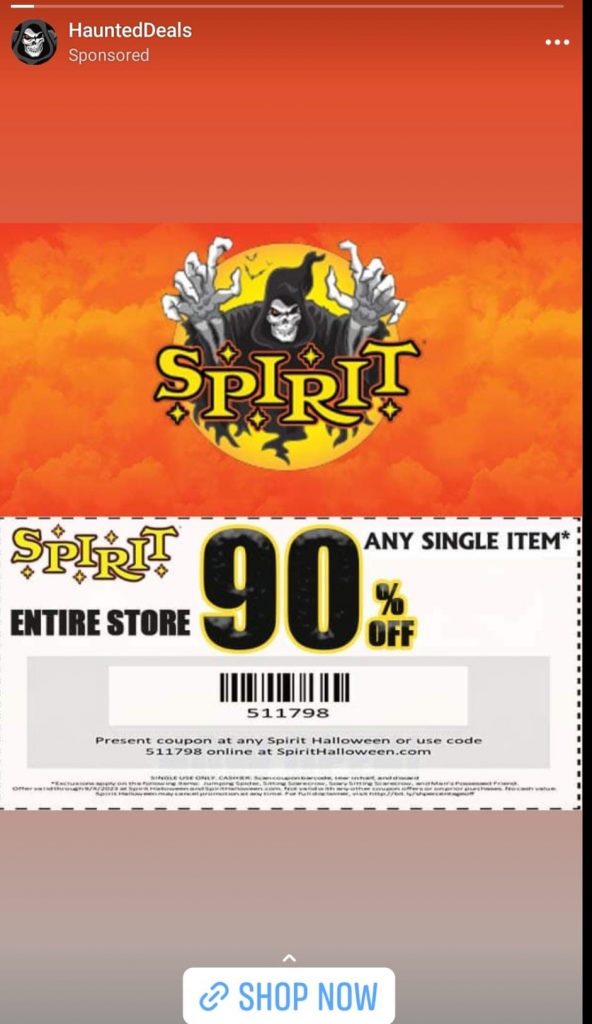
It is only October 3rd but many people are preparing for Halloween. Celebrating Halloween has become a major event in recent years with many adults searching for elaborate costumes and of course whenever many people are interested in something, scammers appear ready to take advantage of that interest. Scammers have set up phony Halloween costume websites, often posing as legitimate costume websites. Often the ads for their phony websites are posted on social media as well as appearing high in search engine searches because the scammers either purchase an advertisement in order to get a high position in a search engine search or because they are skilled enough to manipulate the algorithms the search engines use to obtain a high ranking. Pictured below is one of the phony ads that has appeared in social media. Anyone ordering online from one of these phony websites will end up providing their credit card to a scammer.
TIPS
The 90% discount in the advertisement pictured above should give you pause because generally anytime the price is too good to be true, it is a scam. Also, whenever you order anything online you should use your credit card rather than your debit card because the protection you get from fraud when using your credit card is much greater than the protection you get when using your debit card.
Scam of the day – October 2, 2026 – Zelle, Venmo or Cash App Accidental Payment Scam
Law Enforcement in Houston recently issued a warning about an insidious new scam involving the electronic person-to-person payment services Venmo, Zelle and Cash App that starts with unexpected funds appearing in your account followed shortly by a message from someone telling you that they mistakenly sent the money to your account and ask for you to send it back to them. Often the scammers tell their intended victim that they need the money to be returned right away because it is needed for rent, a medical bill or some emergency. It is easy to see how convincing this scam can be. The problem is that in many instances the original payment came from a compromised bank account, hacked Venmo, Zelle or Cash App account or stolen credit card and when the crime is discovered the payment will be reversed, however, if you make a return payment from your own account, it is a voluntary authorized payment and you will lose the money you send.
In another version of the scam the scammers initially contact their victims with fake emails that appear to come from Zelle, Venmo or Cash App leading the targeted victim to believe they have received a payment to their account when they actually have received nothing.
Finally, in yet another version of the scam, you receive funds through a money laundering scheme making the scam victim a part of a criminal scheme.
TIPS
Fortunately, this is an easy scam to avoid. Whenever you get what appears to be an unexpected payment and a request to refund the payment, you should never send anything to the person requesting the refund. Instead merely contact your payment service, whether it be Zelle, Venmo or Cash App and let them sort it out at no risk to you.
If you are not a subscriber to Scamicide.com and would like to receive daily emails with the Scam of the day, all you need to do is to go to the bottom of the initial page of http://www.scamicide.com and type in your email address where it states “Sign up for this blog.”
Scam of the day – October 1, 2026 – Publishers Clearing House Scam Alert: How to Spot Fake Prize Calls and Letters
In the last few years there has been an increase in reports of scammers calling people on the telephone and telling them that they have won one of the Publishers Clearing House lotteries, but that they have to pay fees or taxes before being able to claim their prize. In addition there are reports of targeted victims receiving phony notifications by regular mail that they have won a Publishers Clearing House lottery, but that again they must pay fees or taxes before being able to receive their prize.
It is hard to win any lottery. It is impossible to win one that you have not even entered and yet scam artists have found that it is extremely lucrative to scam people by convincing them that they have won various lotteries. With so many people entered into the Publishers Clearing House lotteries, it is easier for scammers to convince people that they have won. Manny Guerrero of Las Vegas lost $180,000 to scammers posing as Publishers Clear House who called him on the telephone and convinced him that he had won a multi-million dollar prize, but that he needed to pay $180,000 to the scammers for tax owed on the winnings before he could claim his prize.
Most lottery scams involve the victim being told that they need to pay taxes or administrative fees directly to the lottery sponsor; however no legitimate lottery requires you to do so. As with many effective scams, the pitch of the scammer may seem legitimate. Income taxes are due on lottery winnings, but with legitimate lotteries they are either deducted from the lottery winnings before you receive your prize or you are responsible for paying the taxes directly to the IRS. No legitimate lottery collects taxes on behalf of the IRS from lottery winners. Other times, the scammer tell the “winners” that in order to collect their prizes, they need to pay administrative fees. Often, the victims are told to send the fees back to the scammer by gift cards. Gift cards are a favorite of scammers because they are the equivalent of sending cash.
After years of declining revenues Publishers Clearing House filed for bankruptcy in 2025 and its assets were sold to ARB Interactive who are now operating the company as PCH Digital LLC. Publishers Clearing House is still doing sweepstakes, but now almost exclusively online rather than through the formerly familiar mailings.
TIPS
Fortunately, there is an easy way to know, when you are contacted by Publishers Clearing House by phone, email or text message informing you that you have won one of its major multi-million dollar prizes, whether you have been contacted by the real Publishers Clearing House. Publishers Clearing House only contacts major prize winners in person or by regular mail. They do not contact winners by phone, email or text message so if you do receive a notification of your winning one of their major multi-million dollar prizes by those means of communication you know it is a scam.
Even if the Caller ID on your phone indicates the call is from Publishers Clearing House, it is very easy for a scammer to use a technique called “spoofing” to make it appear that the call is coming from Publishers Clearing House rather than the scammer who is really making the call. Trust me, you can’t trust anyone.
In addition, no winners of the Publishers Clearinghouse sweepstakes are ever required to make a payment of any kind to claim their prize so if you are told that you have won, but are required to make any kind of payment before you can claim your prize, you can be sure that it is a scam. As for other lotteries, remember, you can’t win a lottery you haven’t entered and no legitimate lottery asks you to pay them administrative fees or taxes.
Also, as I often tell you, it is always a red flag that you are involved with a scam when you are asked to pay for anything with gift cards. Gift cards are a favorite method of payment for scammers because they are easy to convert into cash and impossible to trace.
If you are not a subscriber to Scamicide.com and would like to receive free daily emails with the Scam of the day, all you need to do is sign up for free using this link. https://scamicide.com/scam-of-the-day/
Scam of the day – September 30, 2026 – FTC Sending Refunds to Victims of Business Opportunity Scam
In the Scam of the day for September 12, 2024 I told you that the Federal Trade Commission (FTC) had settled lawsuits it had brought against Robert William Shafer and Samuel J. Smith who had operated a business opportunity scam called Blueprint To Wealth that targeted people seeking to start their own businesses. The two scammers charged their victims fees of between $3,000 and $21,000 in addition to administrative fees for membership in the scheme which promised its members turnkey online businesses that were represented to be operated on the members’ behalf, however, there was no business at all other than selling the same scam to other people. According to the terms of the settlement, both defendants are banned from operating business opportunity projects in the future and were required to turn over cash and bank accounts.
As part of the settlement, the defendants’ forfeited funds were used to send refunds from the FTC to victims of the scam beginning in September of 2025, however, because there are still funds remaining from the forfeitures the FTC is sending additional payments to victims of the scam. If you were a victim of this scam and need information about getting your payment from the FTC go to the FTC Refund tab in the middle of the first page of Scamicide.com
TIPS
The sale of business opportunities is regulated by the FTC’s Business Opportunity Rule which requires the sellers of business opportunities to provide a one-page disclosure document outlining important facts about the offering including informing you about any legal actions in which the sellers have been involved. The disclosure also has to provide you with details as to any refund policy and provide a list of references. Additionally, as is always the case with these types of scams, if they make claims about how much money you can earn through their scheme, they must provide you with an Earnings Claim Statement that indicates in detail the specifics of those claims and the opportunity to see written proof of the claims.
Before considering any kind of business opportunity, you should have a lawyer review these required disclosures and if the person offering you the business opportunity does not provide these documents, you should consider that a red flag that this is a scam. You also should investigate the people behind the offering as well as the particular type of business opportunity.
You also can do a Google or other search engine search of any company from which you are considering making a purchase in which you type in the company’s name along with the words “scam” or “complaints” and see what you come up with.
If you are not a subscriber to Scamicide.com and would like to receive daily emails with the Scam of the day, all you need to do is to go to the bottom of the initial page of http://www.scamicide.com and type in your email address on the tab that states “Sign up for this blog.”
Scam of the day – September 29, 2026 – The Danger of Homograph Attacks
Chances are you haven’t heard of the term, “homograph attack,” but it refers to a cyberthreat that can easily result in your becoming a victim of identity theft or a scam victim. A homograph attack is a type of cyber attack where attackers exploit look alike characters, often from different alphabets to create misleading domain names, usernames, or URLs that appear legitimate but actually lead to malicious sites. Homograph attacks have been around since the early 2000s, but have increased dramatically since 2020 when the federal government first warned about them. The attack starts with an email from what appears to be a legitimate source such as your bank informing you of an emergency requiring you to either click on a link or provide personal information.
Homograph attacks exploit similarities between the Roman alphabet used in the English language and the Cyrillic alphabet developed for Slavic speaking people which is used in more than 50 languages including Russian. In the example below in the real email address the Roman “a” is used while in the second phony email address the Cyrillic version is used which is easy to miss. Similarly without even changing the alphabet, some scammers will replace a lowercase L “l” with the number “1” which can also be easily missed.
Recently scammers have been sending phishing emails posing as Microsoft and using the email address rnicrosoft.com which at first glance appears legitimate, but instead of the letter “m” at the start of the email address it uses the letters “r” and “n” which give the appearance of an “m.”
TIPS
Remember my motto, “trust me, you can’t trust anyone.” You have to be skeptical whenever you receive an email or text message asking for personal information or requesting you to click on a link because you can never be sure if the communication is legitimate or not at initial viewing. Always absolutely confirm whether the communication is legitimate before ever providing personal information or clicking on a link that could contain harmful malware. Phishing emails will always make it appear that there is an emergency to which you must respond immediately, but it is important to take your time to make sure that the communication is legitimate before responding.
Also, don’t rely on your security software to totally protect you because while it is critical to have good security software on all of your devices and to keep it up to date with the latest updates, the most updated security software will not protect you from malware that exploits zero day defects which are software vulnerabilities not yet discovered. It generally takes the security software companies about a month before to come up with defenses against the latest strains of malware.
If you are not a subscriber to Scamicide.com and would like to receive free daily emails with the Scam of the day, all you need to do is to go to the bottom of the initial page of http://www.scamicide.com and type in your email address where it states “Sign up for this blog.”
Scam of the day – September 28, 2026 – Hurricane Charity Scams
Natural disasters such as hurricanes are common occurrences. Hurricane season runs this year from June 1st until November 30th. Hurricanes often cause tremendous damage and loss of property. They also bring out the best in people who want to donate to charities to help the victims. Unfortunately natural disasters also bring out the worst in scammers who are quick to take advantage of the generosity of people by contacting them posing as charities, but instead of collecting funds to help the victims of these natural disasters, these scam artists steal the money for themselves under false pretenses. Making matters even worse, scammers will use information from data brokers and public sources to identify people who are likely to be susceptible to solicitations of donations to charities providing help to hurricane victims. Scammers also contact people through social media with pleas for charitable donations with the ads specifically targeting likely victims through the use of the algorithms used by social media. Often these social media posts will contain AI enhanced photos and videos and you can never be sure if the posts are legitimate.
Charities are not subject to the federal Do Not Call List so even if you are signed up for the federal Do Not Call List, legitimate charities are able to contact you by phone. The problem is that whenever you get a phone call, you can never be sure as to who is really calling you so you may be contacted either by a fake charity or a scammer posing as a legitimate charity. Using a technique called spoofing, the scammers can manipulate your Caller ID to make it appear that the call is coming from a legitimate charity when it is not. Similarly, when you are solicited for a charitable contribution by email, social media or text message you cannot be sure as to whether the person contacting you is legitimate or not.
TIPS
Never provide credit card information over the phone to anyone whom you have not called or in response to an email or text message. Before you give to any charity, you may wish to check out the charity with http://www.charitynavigator.org where you can learn whether or not the charity itself is a scam.
If you are not a subscriber to Scamicide.com and would like to receive daily emails with the Scam of the day, all you need to do is to go to the bottom of the initial page of http://www.scamicide.com and type in your email where it states “Sign up for this blog.”