
Scam of the Day
Scam of the day – November 7, 2024 – Beware of Evil Twins
Whether we are at the airport, a hotel, a shopping mall, a coffee shop or almost anywhere else, you will usually find free public Wi-Fi service offered so that we can use our cell phones, laptops or tablets to connect to the Internet. However with this convenience can come danger. Too many people assume that the Wi-Fi that they are using is secure and this is not always the case. In fact, often an identity thief will go to the same coffee shop or other venue and set up his or her own Wi-Fi which is what you may unwittingly be tapping into when you think you are connecting to the Wi-Fi of the particular coffee shop or other place you find yourself at. Technologically, it is easy to set up a phony Wi-Fi that can steal data from your cell phone, laptop or tablet and use that information to make you a victim of identity theft. Recently, Florida Attorney General Ashley Moody issued a warning about these scammer created phony Wi-Fi networks which she calls “Evil twins.”
So what can you do to make using public Wi-Fi safe?
TIPS
It is always a good idea to make sure that your cell phone, tablet or laptop has a good firewall and is protected by anti-virus and anti-malware security software that is updated with the latest security updates. It is also a good idea not to use public Wi-Fi for banking or other financial transactions or, for that matter, anything that requires you to provide login credentials. Sensitive data should not be sent over public Wi-Fi. If you are going to use public Wi-Fi, the first thing you should do is check the hotspot name. Identity thieves often set up their phony Wi-Fi with names that appear quite similar to the legitimate Wi-Fi. For example, the public Wi-Fi offered at your coffee shop may be named GoodCoffee while the phony one may be something that with a cursory look appears legitimate, such as Go0dCoffee.
Always make sure when using public Wi-Fi that you are on the legitimate Wi-Fi site before proceeding to use it. Many cell phones and other devices automatically connect to nearby networks, which can connect you to the identity thief’s phony Wi-Fi before you realize it. Therefore disable automatic connection to networks. Finally, the best thing you can do to protect your privacy and security when using public Wi-fi is to use a Virtual Private Network app which will encrypt all of your data before sending it through the Wi-Fi connection. Here is a link to an article I wrote about VPNs that will tell you all you need to know (and possibly more) about VPNs. https://au.norton.com/internetsecurity-wifi-how-does-a-vpn-work.html and here is a link to an article that lists ten good VPNs that you can get for free. https://www.techradar.com/vpn/best-free-vpn
If you are not a subscriber to Scamicide.com and would like to receive daily emails with the Scam of the day, all you need to do is sign up for free using this link. https://scamicide.com/scam-of-the-day/
Scam of the day – November 6, 2024 -Scammers Use AI to Pose as Police
In the Star Wars movies, the “force” provided power that could used for good or as exemplified by Darth Vader, the “dark side” and so it is with artificial intelligence. Artificial intelligence can be use to combat scams through recognizing patterns present in scams as well as through machine learning algorithms even use historical data to recognize signs of new scams. However, AI has also proven already to be a tremendous weapon for scammers using the dark side of the force to, among other things, create more effective phishing emails. Using AI to create deepfake audios and videos to enhance their scams is now a serious problem.
Recently, the Salt Lake City Utah Police Department reported that scammers were sending out emails to people with a deepfake video that appeared to show Police Chief Mike Brown telling the person receiving the email that they “owed the federal government nearly $100,000” and extorted the targeted victim to make a payment to the scammer. Video and audio of the police chief was readily available for the scammers to create the deepfake. A similar deepfake voice cloning audio was done last summer by scammers posing as Tulsa, Oklahoma police officer Eric Spradlin
TIPS
As always, you can never be sure whenever you get an email as to who is actually contacting you so anytime you are asked for personal information, click on a link or make a payment, you should independently confirm that the email is legitimate before responding.
In this case, the email address of the sender was readily able to be recognized as not that of the Salt Lake City Police Department and no police department is going to send anyone such an email with a video. Further, local police departments would not be collecting money on behalf of the federal government nor would a demand be made for “around” $100,000. Also, while deepfakes can be very difficult to recognize as phony, this particular deepfake video contained unnatural speech patterns.
If you are not a subscriber to Scamicide.com and would like to receive daily emails with the Scam of the day, all you need to do is sign up for free using this link. https://scamicide.com/scam-of-the-day/
Scam of the day – November 5, 2024 – Ingenious New Debit Card Scam
For years identity thieves and scammers would use skimmers installed at ATMs and on card processing equipment such as at gas pumps (where this is still a problem) and at retail checkouts to steal the debit or credit card information from the magnetic strip on the card and then use it to access the victim’s account. The development of the chip credit card where a computer chip is contained on the card which provides a new number each time the card is used dramatically reduced the amount of credit and debit card theft with the exception of online purchases where the chip cannot be used (well, nobody’s perfect). Now however, clever criminals have come up with a new way to access your bank account through your debit card.
The scam starts when you get a phone call that appears to come from your bank informing you that there has been fraudulent activity on your debit card. Using a technique called “spoofing” the scammers are able to manipulate your Caller ID so that it indicates that your bank is calling you. The scammer then goes on to tell you that you need to cut up your card, but keep the chip from the card to be picked up by a bank employee. The phony bank employee then shows up to pick up the chip and using social engineering lures the victim into providing his or her PIN.
Once the scammer has your PIN and the chip, he or she can create a debit card and go to any ATM and empty your bank account.
TIPS
Whenever you get a phone call, you can never be sure who is actually calling you. If you get a call that purports to be from your bank informing you of some problem, you should hang up and call your bank at a telephone number that you know is accurate to determine if the call was a scam. You also can go online to your bank account to determine that no fraudulent access had occurred.
In addition, no bank will ever ask you to give them back the chip on your credit card or ask for your PIN.
B.S. Be skeptical!
If you are not a subscriber to Scamicide.com and would like to receive daily emails with the Scam of the day, all you need to do is sign up for free using this link. https://scamicide.com/scam-of-the-day/
Scam of the day – November 4, 2024 – FTC Sending Refunds to Victims of Credit Karma Pre-Approved Credit Card Scam
The Federal Trade Commission (FTC) is sending payments to victims of a credit card offer scam that was operated by the personal finance company Credit Karma between 2018 and 2021. Credit Karma sent notices to hundreds of thousands of people telling them that they were “pre-approved” for credit cards offered by banks that used Credit Karma to promote their financial products. Unfortunately, many “pre-approved” people after completing the necessary credit card applications were denied the credit cards. Unfortunately, for those applying for the credit cards which they were led to believe was a sure thing but were denied, their credit scores were reduced because applying for the credit card constituted a hard inquiry on their credit report, which upon their being denied the card damaged their credit score.
The FTC took legal action against Credit Karma for this scam in September of 2022 and soon settled the claim with Credit Karma. Under the terms of the settlement, Credit Karma paid three million dollars to the FTC to be distributed to people harmed by the scam.
TIPS
The FTC sent notices to people who were eligible for a refund instructing them to file a claim prior to March 4, 2024. Now the FTC is sending checks to the 50,994 people who filed for a refund.
For more information, go to the “FTC Scam Refunds” section of Scamicide.com which can be found in the middle of the first page of Scamicide.com.
If you are not a subscriber to Scamicide.com and would like to receive daily emails with the Scam of the day, all you need to do is to go to the bottom of the initial page of http://www.scamicide.com and type in your email address on the tab that states “Sign up for this blog.”
Scam of the day – November 3, 2024 – Data Breach at Landmark Admin
Landmark Admin is a company with which you may not be familiar, but one which may have your personal information and it recently disclosed that it had suffered a data breach affecting more than 800,000 people. Landmark Admin is company that provides administrative services to major insurance companies. Landmark first determined it had been hacked last May whereupon it disconnected the affected systems and blocked remote access to its networks. It then brought in a cybersecurity team to investigate and while the investigation was going on, the company was hacked again in June. Last week, Landmark Admin filed notices of the data breach and has sent letters to those people affected by the breach. Here is a link to that letter https://static1.squarespace.com/static/64026b23ed9cd8111728dd9c/t/667c9b08ed0f885223dc1ca2/1719442184225/Landmark+Admin+-+Substitute+Notice+-+6-26-2024.pdf
Among the insurance companies whose customers were affected by this breach were Continental Mutual Insurance Company and Capital Life Insurance Company. The compromised information is particularly sensitive since it included names, Social Security numbers, bank account and routing numbers and other sensitive personal information that can lead to identity theft.
TIPS
Victims of this data breach should freeze their credit if they have not already done so. Freezing your credit is actually something everyone should do. It is free and easy to do. In addition, it protects you from someone using your identity to obtain loans or make large purchases even if they have your Social Security number. If you have not already done so, put a credit freeze on your credit reports at all of the major credit reporting agencies. Here are links to each of them with instructions about how to get a credit freeze:
https://www.transunion.com/credit-freeze
https://www.experian.com/freeze/center.html
If you are not a subscriber to Scamicide.com and would like to receive daily emails with the Scam of the day, all you need to do is sign up for free using this link. https://scamicide.com/scam-of-the-day/
Scam of the day – November 2, 2024 – “Kind” Can Be a Dirty Word
The Dalai Llama has said that his religion is very simple – it is kindness. And certainly we all could use a bit more kindness in our lives, however, when the word “kindly” appears in an email or text message that you receive, it can be a tip off that you are being contacted by a scammer or identity thief based in a country other than the United States, particularly countries that were once part of the British Empire where they have adopted the use of British speech patterns. According to Tim Bajarin, the chairman of the market research company Creative Strategies in an interview with Reader’s Digest, ‘You’ll often hear it used in countries with British influence, perhaps once a colonial country, where English isn’t their mother tongue.” Nigeria, for instance, a hub of international scams was a British colony from 1900 until 1960 and the British influence is still strong there.
So when you get an email or a text message that appears to be from a governmental agency such as the IRS or a company such as Amazon that uses the word “kindly” in a communication requesting a payment, personal information or asking you to click on a link or download an attachment under any pretense, you should immediately remember BS, be skeptical.
TIPS
It is a simple matter for a scammer to use spoofing to manipulate your Caller ID and make a phone call appear to come from a legitimate source. Similarly phishing emails and text messages can also appear to be sent by legitimate sources when the source is a criminal. Therefore you should never make a payment, click on a link, download an attachment or make a payment in response to any communication unless you have absolutely confirmed that the communication was legitimate.
If you are not a subscriber to Scamicide.com and would like to receive free daily emails with the Scam of the day, all you need to do is to go to the bottom of the initial page of http://www.scamicide.com and type in your email address on the tab that states “Sign up for this blog.”
Scam of the day – November 1, 2024 – Healthcare Data Breach Affects 100 Million People
Data breaches are all too common and according to a 2023 report by IBM healthcare companies account for approximately 27% of all data breaches. Healthcare companies are targeted for a number of reasons including the general lack of security of many healthcare companies and the extensive personal and medical information they store including health insurance information that can be sold by criminals on the dark web for large prices enabling other people to access your health insurance. Having your health insurance policy used by an identity thief is particularly dangerous because it can result in your medical records being corrupted by the medical information of the identity thief and the difficulty in getting this information removed from your medical records. Having the medical information of an identity thief on your medical records could even result in your getting a blood transfusion of the wrong blood type.
Recently Change Healthcare disclosed that it had suffered the largest data breach of health care information in American history. A hundred million people were affected by this data breach.
TIPS
As for the victims of this data breach, the first thing they should do is freeze their credit if they have not already done so. Freezing your credit is actually something everyone should do. It is free and easy to do. In addition, it protects you from someone using your identity to obtain loans or make large purchases even if they have your Social Security number. If you have not already done so, put a credit freeze on your credit reports at all of the major credit reporting agencies. Here are links to each of them with instructions about how to get a credit freeze:
https://www.transunion.com/credit-freeze
https://www.experian.com/freeze/center.html
If you are not a subscriber to Scamicide.com and would like to receive daily emails with the Scam of the day, all you need to do is sign up for free using this link. https://scamicide.com/scam-of-the-day/
Scam of the day – October 31, 2024 – FTC Sending Additional Refunds to Victims of Student Loan Relief Scam
I have written many times over the last twelve years about student loan scams because scammers have successfully targeted college students and their parents for a variety of scams related to these extensive loans. In October of 2017 the Federal Trade Commission, working with the Attorneys General of eleven states, launched what it cleverly calls, Operation Game of Loans to jointly target these various student loan scams. Some scammers promise dramatic reductions of debt of 50% or more in return for upfront fees of between $500 and $2,500. Often these scam companies have names that make it appear that they are endorsed by the federal government in order to trick people into trusting them. Another student loan scam involves promises related to consolidating student loans.
Sometimes the scammers represent that they are associated with the U.S. Department of Education although the Department of Education does not associate with private lenders in regard to student loan consolidation. These scammers also charge significant fees for their student loan consolidation services when the truth is that there is no fee for legitimate student loan consolidation. It is also important to remember that consolidating your student loans does not lower your interest or monthly payment. Instead, after loan consolidation the student’s monthly payment is equal to a weighted average of the interest rates on the student’s current loans.
In 2021 the FTC settled its claims against Student Advocates Team LLC and other related defendants who had been accused of charging illegal upfront fees that they led consumers to believe were being applied to their student loans. Student Advocates Team also falsely promised they could permanently lower or even eliminate consumers’ loan payments or balances. Pursuant to the settlement, Student Advocates Team LLC was permanently banned from the debt relief business. In 2022 the FTC refunded more than $822,000 to victims of Student Advocates’ scam and now two years later a second round of refunds is being sent to thousand of victims of the scam.
TIPS
The old adage still is true. If it sounds too good to be true, it probably isn’t true. Many of these student loan debt relief scammers promise quick loan forgiveness, which is unrealistic. In addition, you should never pay any upfront fees for student loan debt relief assistance. Those fees are illegal and are a sure indication that you are being scammed. Also, remember my motto, “trust me, you can’t trust anyone.” Don’t trust scammers merely because they use names that sound like they are affiliated with the government either
For information you can trust about federal student loan repayment option, go to https://studentaid.ed.gov/sa/repay-loans . There you can learn about loan deferments, forbearance, repayment and loan forgiveness programs and there is never an application fee. If you owe private student loans, contact your loan servicer directly. You can also look into student loan refinancing rather than consolidating the loans. Refinancing student loans can result in a lower interest rate. For more information about student loans go to https://www.consumer.ftc.gov/articles/1028-student-loans Here is a link to a calculator that can help you determine whether you will save more by consolidating or refinancing student loans.https://www.makelemonade.co/calculators/student-loan-consolidation-refinancing-calculator/
Here also is a link to an FTC video that explains student loan scams and what you can do to protect yourself. https://www.youtube.com/watch?v=7TjSI4Q6ztQ
If you were a victim of the Student Advocates student debt relief scam you should receive a check shortly. For more information about this refund, you can call the refund administrator, JND Legal Administration at 877-540-0989. Remember there never is a fee of any kind to receive your refund so if you are contacted by someone asking for such a fee, it is a scam.
If you are not a subscriber to Scamicide.com and would like to receive daily emails with the Scam of the day, all you need to do is sign up for free using this link. https://scamicide.com/scam-of-the-day/
Scam of the day – October 30, 2024 – Customer Service Number Scam
In the past I have told you about scammers increasingly setting up phony websites that appear to be for customer service or tech support of many of the companies with which we do business. Often the scammers either purchase an ad to appear at the top of a search engine search or they manipulate the algorithms used by Google and other search engines to make their phony customer service number appear high on a search.
A variation on this scam occurs also where scammers purchase telephone numbers that are a single digit off of the legitimate phone numbers for many companies’ tech support or customer support in order to take advantage of common consumer misdials. A Scamicide reader had an issue with his Sprint account and called his customer support phone number where he was told that he was eligible for a special promotion and a gift card if he just provided some personal information. It was at this point that the savvy Scamicide reader realized he had mistakenly called the wrong number which was merely a digit off from the correct Sprint customer support number. He hung up and avoided being scammed.
Others have not been so lucky and have provided personal information that leads to identity theft after misdialing a customer support number.
TIPS
The best place to look for a telephone number for customer support or tech support is right on your bill or the legitimate website of the company. Even when you do call legitimate tech support or customer service telephone numbers take extra care to make sure that you are dialing correctly and not calling a clever scammer who may have purchased a telephone number that is a digit off of the correct phone number in an attempt to ensnare people who may misdial the number.
Also, remember you can’t trust Alexa or Siri to provide you with the correct number because they only access the information appearing at the top of a search engine search. As I indicated earlier, often those numbers are fake numbers put their by scammers.
If you are not a subscriber to Scamicide.com and would like to receive free daily emails with the Scam of the day, all you need to do is to go to the bottom of the initial page of http://www.scamicide.com and type in your email address where it states “Sign up for this blog.”
Scam of the day – October 29, 2024 – Phony Coupon Scams
Even though Thanksgiving (or even Halloween) has not yet arrived, many people are turning their attention to holiday shopping and holiday shoppers looking to save money are always on the lookout for coupons. Everyone loves coupons and like many things in our lives, coupons which used to be found commonly in newspapers and magazines have migrated online. In recent years scammers have been perpetrating phony coupon scams on social media. Among the companies affected by these phony coupons were Bath and Body Works, Costco, Aldi, Starbucks and Trader Joe’s. As I have warned you many times in the past, Facebook has become a hotbed for phony online coupons. The phony coupons looks quite legitimate which means nothing because it is very easy to copy the company logos and make the coupons appear to be genuine.
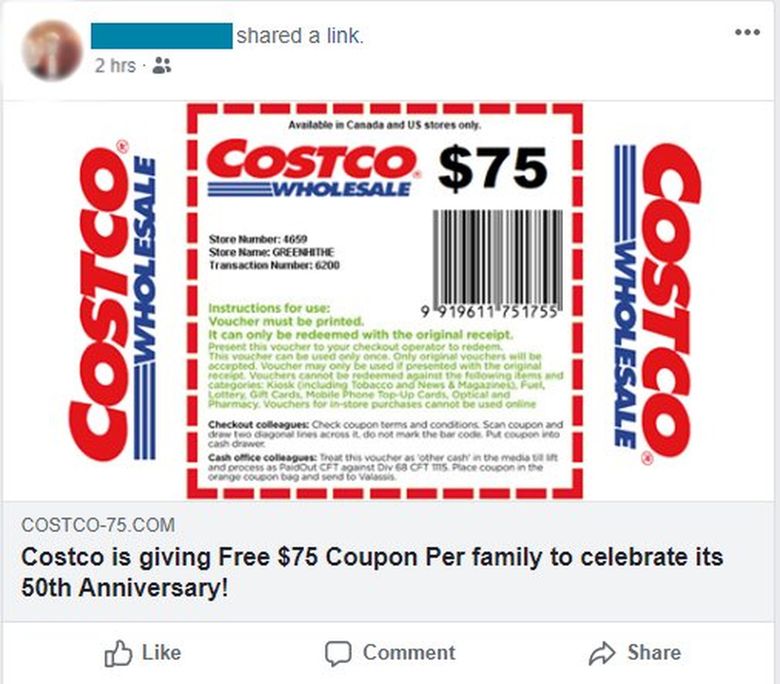
The way that many phony coupon scams work is that in order to qualify for the coupon, you must complete a survey in which you are required to provide much personal information that is used to make you a victim of identity theft. In other versions of the scam, the scammer actually asks for your credit card numbers. In yet another version of the scam you are required to buy many costly items in order to claim your “free” coupon. Many of the coupon scams also require you to forward the coupon to friends which make the phony coupons appear more trustworthy when they are received by your friends. Ultimately, in all of these scams, the coupons are worthless and you get nothing but the opportunity to become a victim of identity theft. Here is a copy of a phony coupon appearing online. It was provided by the Identity Theft Resource Center.
TIPS
If the coupon appears too good to be true, it usually is a scam. No company could cover the cost of giving away vast numbers of $75 coupons although sometimes, participants in legitimate surveys are promised a chance to win a prize in a drawing. Facebook is a favorite venue for scammers perpetrating this type of scam because often unwary victims will unwittingly share the scam with their friends. One way to determine if a coupon is legitimate is to look for the expiration date found on most coupons. The phony Costco coupon shown above like most phony coupons does not carry an expiration date. The best place to go to find out if a coupon is legitimate is to go to the company’s website to see what real coupons are being offered.
If you are not a subscriber to Scamicide.com and would like to receive free daily emails with the Scam of the day, all you need to do is to go to the bottom of the initial page of http://www.scamicide.com and type in your email address on the tab that states “Sign up for this blog.”