
Scam of the Day
Scam of the day – September 24, 2024 – Protecting Yourself When Shopping Online
Every year, the number of people shopping online and the money spent through online shopping grows significantly. And why not? The convenience alone of being able to shop from the comfort and privacy of your home is reason enough for many of us to shop online. But how safe is it? According to the FTC the number one reported fraud is online shopping scams. However, following some basic precautions can go a long way in protecting you from being scammed when shopping online
TIPS
Here is a list of some online shopping tips:
1. Make sure that the computer, laptop, tablet or phone you use is equipped with the anti-virus and anti-malware software and that you have updated the software with the latest security patches.
2. As with shopping at brick and mortar stores, don’t use a debit card for online purchases, as well. In the event of a data breach, the consumer protection laws in regard to fraudulent use of your debit card are not as protective as those that apply when your credit card is fraudulently used.
3. Don’t supply your credit card number unless the address of the website is preceded by the letters “https.” That additional letter “s” indicates that the transmission of your data is encrypted and secure.
4. Don’t leave your credit card number on record with the online retailers you use for the sake of convenience. Doing so only makes you more likely to become a victim of identity theft if the company suffers a data breach (and many of them will).
5. Don’t click on coupons or ads that you may receive by way of an email or text message regardless of how good they appear. They may be loaded with malware that will be downloaded on to your computer, tablet or phone if you click on the link. That malware can steal all of your personal information and lead to your becoming a victim of identity theft. Any legitimate coupon you might receive through an email or a text message will also be available on the website of the company where you want to shop.
6. Limit your online shopping to companies that you know and trust. Merely because a company comes up high on a Google search does not mean that the company is legitimate. Any company offering a price that appears too good to be true, should be particularly suspect. In tomorrow’s Scam of the day I will tell you how to confirm if a retail website is legitimate or a counterfeit website.
7. Use distinct and complex passwords for each online company with which you shop and use dual factor authentication whenever possible.
If you are not a subscriber to Scamicide.com and would like to receive daily emails with the Scam of the day, all you need to do is to go to the bottom of the initial page of http://www.scamicide.com and type in your email address on the tab that states “Sign up for this blog.”
Scam of the day – September 23, 2024 – Celebrity Deepfake Scams Continue
For years I have told you about scammers posing as various popular celebrities in ads and on social media luring people into making payments for worthless products. However, with the increased of Artificial Intelligence these phony ads and scams have become both more believable looking and more frequent as the deepfake and other AI technology becomes readily available to less technologically savvy scammers.In my Scam of the day for September 7, 2023 https://scamicide.com/2023/09/06/scam-of-the-day-september-7-2023-gordon-ramsay-hexclad-cookware-scam/ I told you about a scam where a deepfake image of Chef Gordon Ramsey was used to trick people into a scam involving Hexclad cookware. Videos also appeared on social media such as TikTok and Facebook that appeared to show Taylor Swift endorsing and giving away Le Crueset cookware. If you click on the link provided you are sent to counterfeit websites of popular cooking websites where you see further phony testimonials. You are then asked to provide credit or debit card information to cover the cost of the shipping of the free cookware. Unfortunately, just as there was no free Hexclad cookware being given away by Gordon Ramsay, there is no free Le Crueset cookware being given away by Taylor Swift and all you succeed in doing is giving your credit card or debit card information to a scammer.
More recently Tom Hanks warned people of online ads for “miracle cures and wonder drugs” that used AI voice cloning to make it appear as if he was endorsing these bogus products which he was not.
TIPS
Of course, anything too good to be true is generally not true and the offer of expensive cookware for free should immediately arouse skepticism. In cases such as this, if you had any thought that the offer might be legitimate you should confirm the offer by going to the official website of both Taylor Swift and of LeCrueset. If the offer was in any way legitimate, it would appear on both of those websites.
As for any celebrity endorsement, you should not take it at face value. Confirm on the celebrity’s website to see if they really do endorse a particular product.
While it can be difficult to do, you can also identify many deepfake videos in a number of ways. One unusual thing that deepfakes often get wrong is how they show fingers. Often deepfakes have a sixth finger or leave off a thumb. Teeth, eyes and ears may also be flawed in appearance. Another flaw often that appears in deepfakes is accessories such as necklaces, earrings, scarves and even shirt buttons may appear warped.
If you are not a subscriber to Scamicide.com and would like to receive free daily emails with the Scam of the day, all you need to do is to go to the bottom of the initial page of http://www.scamicide.com and type in your email address on the tab that states “Sign up for this blog.”
Scam of the day – September 22, 2024 – Back to School Shopping Scams
The new school year is in its early days and school shopping is in high gear for many parents and students. Much of back to school shopping, like other shopping, is done online and people are constantly looking for bargains from trusted companies such as Walmart and Dick’s Sporting Goods. Scammers are constantly setting up phony retail websites. Some of these phony websites are for totally made up companies that you have never heard of, but which are offering tremendous discounts on popular goods while other phony websites are counterfeit websites of legitimate online retailers. Unfortunately, it is very easy for scammers to construct phony websites with legitimate appearing logos of companies you trust. The cybersecurity software company Trend Micro announced that it had found more than 205,000 phony websites touting back to school sales.
So how do you determine if you are on a legitimate website?
TIPS
Scam of the day – September 21, 2024 – New Variation of the Sextortion Scam
I have been warning you about sextortion scams for eight years. Generally sextortion scams begin with an email in which you are told that your computer and web cam have been hacked and that the scammers have video of you watching porn online. In the email, the scammer threatens to send the videos to people on his contact list unless you pay a ransom in Bitcoin or some other cryptocurrency.
In the most recent version of this scam, people around the country are receiving such sextortion emails with some new twists. First, the email contains a photograph of your home with a threat to contact you at your home, referring to your home’s address if you don’t pay the demanded Bitcoin ransom. Second, the email refers to a type of Spyware called Pegasus that can steal information from you computer without being discovered. In fact, Pegasus spyware does exist, but it is used only by government agencies.
TIPS
Scammers use services such as Google Maps to obtain the photos used in the emails and use AI to gather other personal information used in the email to make it appear more believable, but the truth is that they do not have the videos that they claim to have because if they did, they would show it to you in the email.
In regard to your web cam being hacked, while often this is merely a threat and the scammer has not hacked your web cam, however web cams can be hacked. One thing you can do to protect your webcam from being hacked is to make sure that you change the default password on your webcam when you first install it. Another simple thing I do and you can, as well, is to merely put a post it note over your webcam when it is not in use. This is a technique used by both Pope Francis and former FBI director James Comey.
If you are not a subscriber to Scamicide.com and would like to receive free daily emails with the Scam of the day, all you need to do is to go to the bottom of the initial page of http://www.scamicide.com and type in your email address on the tab that states “Sign up for this blog.”
Scam of the day – September 20, 2024 – WhatsApp Job Scam
I have been warning you about job scams for twelve years. These scams appear in many platforms including social media, emails, and even on legitimate online employment websites. Recently the Federal Trade Commission issued a warning about a new job scam that originates with a text message on WhatsApp. The text message offers a remote job promising to pay as much as $600 a day, however it doesn’t even identify the company offering the job. In order to be hired, you need to provide your Social Security number which is not particularly unusual since you would have to provide it to any legitimate employer. However, being required to provide it after one initial contact is certainly unusual.
There is no job and if you provide your Social Security number, it will be used to make you a victim of identity theft.
In some instances the scammers will copy outdated online job postings of legitimate companies, but include the scammers contact information. Once you contact them, the scammers request your Social Security number or in other instances request your bank account information in order to send you an advance payment, when in reality the scammers merely want to gain access to your bank account.
TIPS
Not providing the name of the company purportedly offering the job is a red flag that this is a scam as is the demand for your Social Security number so early in the hiring process. Before providing any personal information or scheduling a virtual interview for any job offer you find online, go the real company’s website and not through a link provided by the “recruiter.” There you can go to the company’s “career opportunities” or “jobs” page to see if the company actually is hiring and even then you should apply directly through the company’s encrypted site rather than through links provided by the recruiter.
If you are not a subscriber to Scamicide.com and would like to receive daily emails with the Scam of the day, all you need to do is sign up for free using this link. https://scamicide.com/scam-of-the-day/
Scam of the day – September 19, 2024 – Phony Coupon Scams
Everyone loves coupons and like many things in our lives, coupons which used to be found commonly in newspapers and magazines have migrated online. In recent years scammers have been perpetrating phony coupon scams on social media. Among the companies affected by these phony coupons were Bath and Body Works, Costco, Aldi, Starbucks and Trader Joe’s. As I have warned you many times in the past, Facebook has become a hotbed for phony online coupons. The phony coupons looks quite legitimate which means nothing because it is very easy to copy the company logos and make the coupons appear to be genuine.
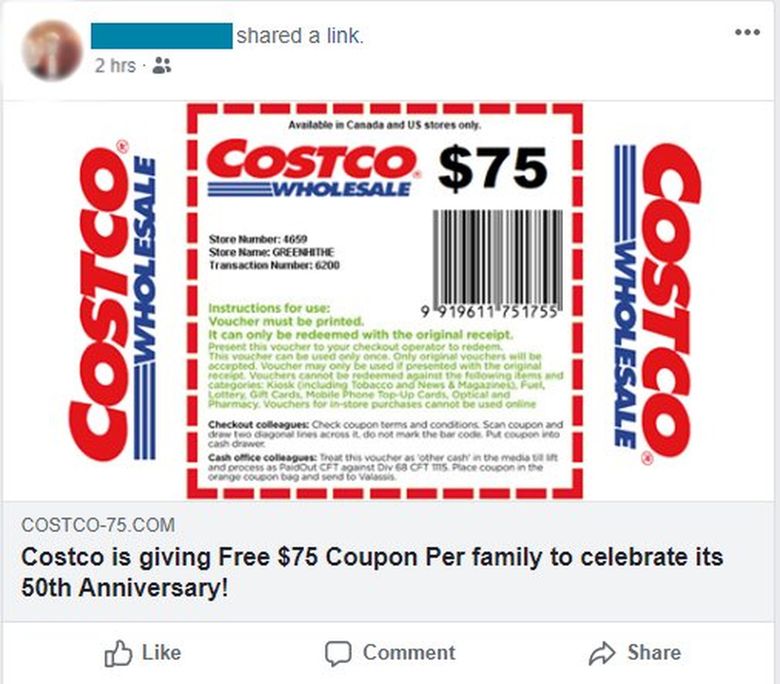
The way that many phony coupon scams work is that in order to qualify for the coupon, you must complete a survey in which you are required to provide much personal information that is used to make you a victim of identity theft. In other versions of the scam, the scammer actually asks for your credit card numbers. In yet another version of the scam you are required to buy many costly items in order to claim your “free” coupon. Many of the coupon scams also require you to forward the coupon to friends which make the phony coupons appear more trustworthy when they are received by your friends. Ultimately, in all of these scams, the coupons are worthless and you get nothing but the opportunity to become a victim of identity theft. Here is a copy of a phony coupon appearing online. It was provided by the Identity Theft Resource Center.
TIPS
If the coupon appears too good to be true, it usually is a scam. No company could cover the cost of giving away vast numbers of $75 coupons although sometimes, participants in legitimate surveys are promised a chance to win a prize in a drawing. Facebook is a favorite venue for scammers perpetrating this type of scam because often unwary victims will unwittingly share the scam with their friends. One way to determine if a coupon is legitimate is to look for the expiration date found on most coupons. The phony Costco coupon shown above like most phony coupons does not carry an expiration date. The best place to go to find out if a coupon is legitimate is to go to the company’s website to see what real coupons are being offered.
If you are not a subscriber to Scamicide.com and would like to receive free daily emails with the Scam of the day, all you need to do is to go to the bottom of the initial page of http://www.scamicide.com and type in your email address on the tab that states “Sign up for this blog.”
Scam of the day – September 18, 2024 – New Variation on Old Phishing Scam
Most scams follow long established patterns, but as time goes on and technology evolves these scams evolve into new forms. The phony invoice scam is a common scam popular with scammers because it is quite effective. It starts when you receive an email that purports to be from a popular company with which many of us do business that indicates that you owe them a significant payment. The scammers count on people being concerned that they are being wrongfully charged for a product they did not order. You are provided a telephone number to call if you dispute the bill. If you call the number, you will be prompted to provide personal information that will be used to make you a victim of identity theft.
In an updated new version of this tried and true scam an Arizona man received an email that appeared to come from iMyFone, a company with which the man did business. The email indicated that $199.99 had been deducted from his account and that it the withdrawal was a mistake, he should call a phone number provided which the man promptly did. When he called the number, the scammer, posing as a support person asked him to install software on his computer to give them remote access to his computer in order to facilitate expediting the refund, which the trusting Arizona man did. With this remote access the scammers were able to transfer money from his savings account to his checking account which made it appear as if he had gotten a refund, however, the money credited to his checking account was not $199.99, but rather $19,999. The Arizona man was then promptly notified by the scammer posing as a iMyFone employee that a mistake had been made resulting in the excessive payment made and requested that the Arizona man wire the excess payment back to them at an account they provided him with. Since everything appeared to be legitimate, he complied and it wasn’t until later that he realized he had been scammed.
Scam of the day – September 17, 2024 – Election Scams (Part 3)
Today’s Scam of the day is the third in a series of Scams of the day dealing with election related scams.
A common election time scam involves a call purportedly from your city or town clerk informing you that you need to re-register or you will be removed from the voting lists. You are then told that you can re-register over the phone merely by providing some personal information, such as your Social Security number. The truth is that you will not be called by your city or town clerk and told that you need to re-register and voter registration is not done by phone.
Another common election related scam deals with political polls. Political polls have been a major part of our election process for many years. Generally, people are contacted by telephone to answer questions about the candidates and their policies. Because it is so common at this time of year to be called by a political pollster, scammers call posing as pollsters in an effort to trick their victims into providing information that can be used for purposes of identity theft. Often they will dangle the reward of a gift card or other prize to lure people into participating in the scam poll. Again spoofing can be used to make the call appear legitimate.
TIPS
In regard to the first scam, as I indicated above, you will not be called by your city or town clerk and told that you need to re-register and voter registration is not done by phone. Sometimes scammers will even ask for a payment for registering by phone. The truth is that there is no charge for registering to vote.
As for political poll scams, legitimate pollsters do not offer prizes or other compensation for participating in their polls. They also will never ask for personal information such as your Social Security number, credit card number or banking information. Anyone posing as a pollster asking for such information is a scammer and you should hang up immediately.
If you are not a subscriber to Scamicide.com and would like to receive daily emails with the Scam of the day, all you need to do is to go to the bottom of the initial page of http://www.scamicide.com and click on the tab that states “Sign up for this blog.”
Scam of the day – September 16, 2024 – Election Scams (Part 2)
Scammers are taking advantage of the public’s interest in the elections to make robocalls in which they pose as candidates asking for donations. This particular scam can easily seem legitimate. Caller ID can be tricked through a technique called “spoofing” to make it appear to your Caller ID as if the call is coming from a candidate or some political organization and recordings of the candidate can also be incorporated into the call to make the call appear more legitimate. And now through the use of AI the voice of the particular candidate can be cloned and used by scammers posing as the candidate.
Even more significantly, calls from political candidates and other political calls are exempt from the federal Do-Not-Call List, so it would be legal for you to get a call from a politician or political group seeking donations even if you are enrolled in the Do-Not-Call List.
So how do you protect yourself from being scammed?
TIPS
Whenever you receive a telephone call, you can never be sure as to who is really contacting you, so you should never give personal or financial information to anyone over the phone whom you have not called.
If you do wish to contribute to a political campaign, the best way to do this is by going to the candidate’s official website and make your contribution. Even then, make sure that when you are giving your donation online that the website address begins with https instead of just http. Https indicates that your communication is being encrypted for better security.
Finally, when making a donation, you should use a credit card rather than a debit card because if you are scammed it is easier to get your money refunded with a credit card than a debit card.
If you are not a subscriber to Scamicide.com and would like to receive free daily emails with the Scam of the day, all you need to do is to go to the bottom of the initial page of http://www.scamicide.com and type in your email address in the tab that states “Sign up for this blog.”
Scam of the day – September 15, 2024 – Election Scams (Part 1)
The much anticipated November elections are coming soon and there is heightened interest in the presidential election and other contests and, of course, when people are interested in something, scammers take advantage of that interest to formulate scams related to that interest. Today and for the succeeding two days I will be describing some election scams about which you should be aware.
Political Action Committees (PACs) are busy raising money to funnel to candidates and organizations trying to influence legislation. Unfortunately, for the last ten years scammers have been setting up phony PACs that promise to use your money on behalf of your favored candidate or cause, but instead keep the money for their own use. Scammers are calling, emailing and texting people posing as legitimate PACS seeking contributions and even if you are on the federal Do Not Call List, you still are allowed by law to be contacted by phone call or text message by PACs.
TIPS
Legitimate PACs are required to file with the Federal Election Commission so before giving to any PAC you should check with the FEC to determine if the PAC has filed the necessary documents. If it isn’t registered it is a scam. Unfortunately, even if you find the PAC soliciting your donation is registered, scammers have registered phony PACs and falsify the financial documentation of their spending which they are required to file so merely because a PAC is registered does not mean that it is legitimate.
Limiting your donations to well established PACs is a good policy to avoid being scammed.
Also, if a PAC doesn’t ask for your employment information and citizenship status it is a scam because legitimate PACs are barred from taking donations from federal contractors or foreign nationals, which is why legitimate PACs will always inquire about your job status and citizenship.
If you are not a subscriber to Scamicide.com and would like to receive free daily emails with the Scam of the day, all you need to do is sign up using this link. https://scamicide.com/scam-of-the-day/