
Scam of the Day
Scam of the day – June 27, 2025 – Phony Coupon Scams
Everyone loves coupons and like many things in our lives, coupons which used to be found commonly in newspapers and magazines have migrated online. In recent years scammers have been perpetrating phony coupon scams on social media. Among the companies affected by these phony coupons were Bath and Body Works, Costco, Aldi, Starbucks and Trader Joe’s. As I have warned you many times in the past, Facebook has become a hotbed for phony online coupons. The phony coupons looks quite legitimate which means nothing because it is very easy to copy the company logos and make the coupons appear to be genuine.
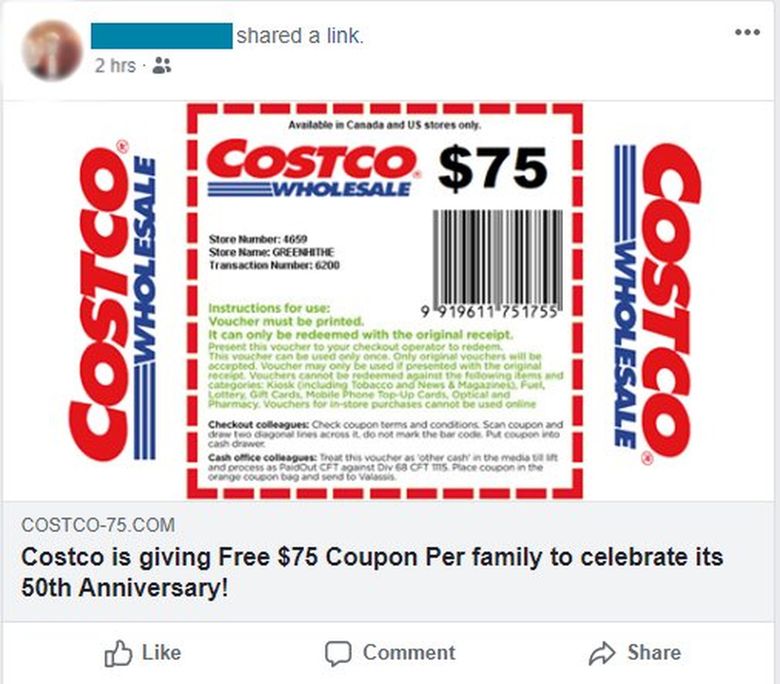
The way that many phony coupon scams work is that in order to qualify for the coupon, you must complete a survey in which you are required to provide much personal information that is used to make you a victim of identity theft. In other versions of the scam, the scammer actually asks for your credit card numbers. In yet another version of the scam you are required to buy many costly items in order to claim your “free” coupon. Many of the coupon scams also require you to forward the coupon to friends which make the phony coupons appear more trustworthy when they are received by your friends. Ultimately, in all of these scams, the coupons are worthless and you get nothing but the opportunity to become a victim of identity theft. Here is a copy of a phony coupon appearing online. It was provided by the Identity Theft Resource Center.
TIPS
If the coupon appears too good to be true, it usually is a scam. No company could cover the cost of giving away vast numbers of $75 coupons although sometimes, participants in legitimate surveys are promised a chance to win a prize in a drawing. Facebook is a favorite venue for scammers perpetrating this type of scam because often unwary victims will unwittingly share the scam with their friends. One way to determine if a coupon is legitimate is to look for the expiration date found on most coupons. The phony Costco coupon shown above like most phony coupons does not carry an expiration date. The best place to go to find out if a coupon is legitimate is to go to the company’s website to see what real coupons are being offered.
If you are not a subscriber to Scamicide.com and would like to receive free daily emails with the Scam of the day, all you need to do is to go to the bottom of the initial page of http://www.scamicide.com and type in your email address on the tab that states “Sign up for this blog.”
Scam of the day – June 26, 2025 – How to Keep Your Cryptocurrency Wallet Safe
I have been writing about cryptocurrency scams for years. There a variety of scams that attempt to steal your cryptocurrencies from you. One of the most important decisions anyone should make when deciding whether to invest in cryptocurrencies is what kind of a wallet they will hold their investment in. Many cryptocurrency scams involve people being tricked into turning over access to their cryptocurrency wallets and losing all of their funds.
Your digital wallet is where the key that allows you to access your cryptocurrency account is found. If your key falls into the hands of a hacker, you can easily lose all of your cryptocurrency account so it is of paramount importance to secure your digital wallet. Digital wallets can either be hot wallets or cold wallets. Hot wallets are connected to the Internet which makes them more susceptible to being hacked which is why a cold wallet which is not connected to the Internet, but rather is is kept in a portable hard drive is your best bet.
TIPS
When doing cryptocurrency transactions online, use a Virtual Private Network (VPN) to provide encryption for your communications which will make the transactions more secure and refrain from using public WIFI for cryptocurrency transactions. Use a strong, complex password for your account and consider using a password manager or store your password on a portable hard drive that you keep in a secure spot.
Use dual factor authentication for your account for additional security, however, it is important to note that many cryptocurrency thefts have occurred when hackers were able to defeat dual factor authentication through SIM swapping whereby they contact the cell phone service provider of their victim, answer a security question and manage to get the cell phone service provider to switch the phone number of the victim to a phone controlled by the criminal thus defeating the dual factor authentication.
The best thing you can do to protect your SIM card from being swapped is to set up a PIN or password to be used for access to your mobile service provider account. This will help prevent a criminal from calling your carrier posing as you and convincing your mobile carrier to swap your SIM card to the criminal’s phone merely by providing personal identifying information or answering a security question.
Finally, I strongly urge anyone considering investing in cryptocurrencies as well as any investment to research the investment thoroughly before investing. No one should ever invest in anything they do not fully understand.
If you are not a subscriber to Scamicide.com and would like to receive daily emails with the Scam of the day, all you need to do is sign up for free using this link. https://scamicide.com/scam-of-the-day/
Scam of the day – June 25, 2025 – Watch Out For “Juice Jacking”
The colorful term “juice jacking” was first used in 2011 to describe the danger of data theft when you use a public charging station to recharge your phone or other mobile device. In 2019, the Los Angeles District Attorney issued a warning about the dangers of charging your phone at the USB chargers commonly found at airports, hotels and other public locations. Both the FBI and the Federal Communications Commission have issued warnings about juice jacking as well. The problem with juice jacking is the fact that information is transferred between your cell phone and the charger as soon as you plug your cell phone into the charging station you are using to recharge your cell phone.
Among the information that is transferred is the name of your device, the manufacturer and model, serial number, firmware information, file system and electronic chip ID which would all be shared with a computer that you may be using to recharge your phone. And while this information may seem to be innocuous, this information is sufficient for a sophisticated hacker to use to gain much further information from your cell phone that could be used to your detriment. As for the charging stations at airports and elsewhere, they can be either infected with malware or be a fake charging station with the sole purpose of infecting your cell phone. Once you plug your phone into one of those already infected charging stations or a totally phony charging station, it can install and delete applications, including stealing your data or installing malware such as ransomware. Fortunately, however, the risk of having your information stolen through a malware infected public charger is not as bad as it used to be because cell phone manufacturers have improved the security of their phones. Unfortunately, the technology used by criminals to hack public charging stations is easy to obtain and at little cost.
TIPS
So what can you do? Obviously, you should never use a strange computer to recharge your phone. The risk is too great. As for charging stations, it is better to be safe than sorry, so I advise that you avoid public charging stations and instead bring your own USB charger that you merely have to plug into an AC outlet rather than use any public charging station. This simple solution will solve any problems involved with juice jacking.
Make sure that your cell phone is secured with a password, fingerprint or iris scanner and do not unlock the cell phone while it is charging. Always protect the data on your cell phone with encryption programs and finally, use security software programs for your cell phone and make sure that it is updated with the latest security patches.
If you do decide to use a USB charger such as found at airports and other sites, watch your screen when you plug in your phone because phone makers have updated their technology such that you will immediately see a prompt asking if you want to trust the charger. The answer to that question is a resounding NO.
Scam of the day – June 24, 2025 – Extended Car Warranty Scams
Recently, there has been an increase in extended car warranty scams. These scams often start with a robocall. Other times the scam begins with a postcard. Often the caller even knows the make, model and year of your car. They will tell you that your car’s warranty is about to expire, but that you can purchase an extended warranty that will provide tremendous benefits. Unfortunately, the tremendous benefits are limited to the scammer that sells you a worthless contract.
Extended warranty scams have been with us for years. Actually, they are not “extended” warranties at all because if you read the fine print you will notice that although the notice you may receive, often by postcard, looks official it is not from either the car manufacturer who issued your original warranty or the car dealer who sold you the car. The warranties themselves vary from scammer to scammer with some of the “extended” warranties being relatively worthless, but with all of them based on misrepresentations. In 2016 the FTC sent out more than four million dollars in refunds to thousands of victims of an extended warranty scam perpetrated by Fereidoun “Fred” Khalilian and his company The Dolce Group Worldwide, LLC. Using the name My Car Solutions, victims received robocalls luring them into paying for extended automobile warranties that, in truth, provided no coverage. In the case of Khalililian, his extended warranty scams were sold through illegal robocalls. Whenever someone tries to sell you something through a robocall, you can be sure it is a scam because commercial calls initiated through robocalls are illegal.
If you are registered for the Do Not Call list and you do receive a call from a telemarketer, you can be confident that the call is a scam because no legitimate telemarketer would call you if you are enrolled in the Do Not Call list. It is also important to note that while telemarketing is not, in and of itself, illegal, commercial telemarketing through robocalls is always illegal.
TIPS
In regard to car warranties, it is always a good idea to check with your local auto dealer as to what warranties cover your car. Never trust anything that comes to you by way of an illegal robocall or telemarketing call if you have enrolled in the federal Do Not Call List. Never feel pressured to act immediately when someone calls you on the phone with an unsolicited offer and never give any personal information including your credit card over the phone to someone who calls you because you can never be sure who is actually calling.
Registering for the Do Not Call List is easy and free. Merely go to http://www.donotcall.gov to register your phone number.
If you are not a subscriber to Scamicide.com and would like to receive daily emails with the Scam of the day, all you need to do is sign up for free using this link. https://scamicide.com/scam-of-the-day/
Scam of the day – June 23, 2025 – How Scammers Hack Your Bank Account
Two years ago I told you about a scam where scammers lured people into providing their bank account number and bank’s routing number to the scammer under the pretense of needing the information in order to send you a reward for finding a stolen car that, in fact, had not been stolen. A bank routing number is the number used by your bank for wiring funds.
While it may not seem like your bank account number and the routing number of your bank would be very important information to protect, armed with this information a scammer can steal your money in a variety of ways. They can use that information to purchase goods online. They can set up recurring payments, such as for utilities. They can create counterfeit checks to access your bank account and make checks payable to themselves.
While some scammers trick people into providing their bank account number and bank’s routing number as was done in the Scam of the day for May 9, 2023, they also may get this information from stealing your checks.
TIPS
In order to protect your checks from being stolen, you should not mail checks and put the letters in your home mailbox. Scammers scout neighborhoods looking for mailboxes with the red flag up indicating that there is outgoing mail and then steal it. You can’t even trust mailing checks in the blue U.S. Postal Service mailboxes because, as I have written in the past, those mailboxes are broken into and mail stolen from them by scammers. If you must mail checks, do so at the Post Office.
If you do become a victim of this type of scam, freeze your account immediately and notify the police and the fraud department of your bank. Change your online banking password and make sure you are using dual factor authentication. Fortunately, if you notify your bank within sixty days of receiving your monthly statement indicating that your bank account has been accessed you are not liable for the money taken from your account.
If you are not a subscriber to Scamicide.com and would like to receive daily emails with the Scam of the day, all you need to do is to go to the bottom of the initial page of http://www.scamicide.com and type in your email address on the tab that states “Sign up for this blog.”
Scam of the day – June 22, 2025 – Aflac Data Breach
When you hear the name Aflac, you probably like me hear the quacking duck from their commercials. Unfortunately, however the recently announced data breach at Aflac is no quacking matter. Aflac disclosed on June 20th that it had suffered a data breach that may have compromised sensitive personal information held by the company, which offers a range of insurance products to millions of people. According to Aflac, it noticed suspicious activity on its networks on June 12th and is now in the early stages of investigating the extent of the data breach. Aflac’s press release states that it had not been infected with ransomware, but doesn’t yet know the extent of the data breach which may include social security numbers and other sensitive information.
It is believed that this data breach was the work of the infamous hacking group called Scattered Spider which focuses its efforts on one specific industry at a time, often using ransomware. In the past it had focused onthe retail sector and now, according to the Google Threat Intelligence Group is targeting the insurance industry. Earlier this month Erie Insurance suffered a data breach attributed to Scattered Spider.
TIPS
Alfac is offering free credit monitoring and identity theft insurance to its customers for two years. If you are an Aflac customer and wish to get those free benefits, you should call Aflac’s Call Center at 1-855-0305.
Potential victims of this data breach should freeze their credit if they have not already done so. Freezing your credit is actually something everyone should do. It is free and easy to do. In addition, it protects you from someone using your identity to obtain loans or make large purchases even if they have your Social Security number. If you have not already done so, put a credit freeze on your credit reports at all of the major credit reporting agencies. Here are links to each of them with instructions about how to get a credit freeze:
https://www.transunion.com/credit-freeze
https://www.experian.com/freeze/center.html
If you are not a subscriber to Scamicide.com and would like to receive daily emails with the Scam of the day, all you need to do is sign up for free using this link. https://scamicide.com/scam-of-the-day/
Scam of the day – June 21, 2025 – Mavis Wanczyk Lottery Scams Continue to Claim Victims
She’s back! I have been writing about scams related to Mavis Wanczyk for eight years but recently I have received many emails from Scamicide readers telling me about various new incarnations of a variety of scams that share the same hook which is that Mavis Wanczyk is giving money away to lucky people. Many of you may not remember the name of Mavis Wanczyk, but she was the lucky winner of a 758 million dollar Powerball drawing in 2017. Not long after she claimed her prize, a scam started appearing in which many people received emails with the message line referring to the Mavis Wanczyk Cash Grant. The email indicated that you were chosen to receive a large cash grant from Mavis Wanczyk. All the lucky strangers receiving the emails had to do was provide personal information in order to qualify for the grant. In addition, phony social media accounts on Twitter, Facebook and Instagram were also set up in Ms. Wanczyk’s name through which people were contacted with the same phony offer of free money informing them that in order to qualify for the grant they merely needed to provide personal information.
Phony Mavis Wanczyk Instagram accounts continue to pop up as quick as Instagram learns about them and takes them down.
Another version of the Mavis Wanczyk lottery scam that victimized a Scamicide reader started with a text message purportedly from Mavis Wanczyk informing the targeted victim that she would give $15,000 to the targeted victim. All the victim had to do was pay some fees. After paying $3,786.68 through untraceable Bitcoin cryptocurrency, the victim still had not received anything who was then prompted to send an additional $300 for expedited delivery of his check. After paying that amount, the scammers still had not sent anything, but did demand access to the victim’s Facebook account. Finally, the greedy scammers even threatened to turn in the victim to the FBI unless they were paid $500. It does take quite a bit of gall for criminals to threaten victims with reporting them to law enforcement, but gall does not appear to be in short supply when it comes to scammers.
TIPS
It is difficult to win a lottery you have entered. It is impossible to win one that you have never entered and neither lottery winners, nor anyone else is sending out messages through the Internet offering free money to anyone who responds with personal information. Never give out personal information that can make you vulnerable to identity theft unless you have absolutely verified that the party requesting the personal information is legitimate and has a legitimate need for the information. Also never pay anything to a lottery claiming you owe fees in order to claim your prize. This is a telltale sign of a scam. No legitimate lottery requires the payment of a fee to collect your winnings or requires you to pay the lottery income taxes on the prize. While income taxes are due on lottery winnings, those taxes are either deducted by the lottery sponsor before giving you your prize or the prize is given to you in full and you are responsible for the payment of any taxes. No lottery collects taxes on behalf of the IRS.
You should never give anyone access to your social media accounts because scammers use your account to scam others who trust you and fall for scams that appear to come from you.
Finally and most importantly, remember neither Mavis Wanczyk nor any other lottery winner is giving away money to strangers.
If you are not a subscriber to Scamicide.com and would like to receive free daily emails with the Scam of the day, all you need to do is to go to the bottom of the initial page of http://www.scamicide.com and insert your email address where it indicates “Sign up for this blog.”
Scam of the day – June 20, 2025 – At Home Job May Be Money Laundering
Laundering money derived from a scam is an essential element of many scams. Scammers can be extremely clever at distancing themselves from their scams in order to avoid detection. The people they enlist either as willing or unknowing participants in the laundering of the proceeds of a scam are called money mules. Scams in which innocent people are lured into being unknowing money mules are numerous. One of the more common of these involves work at home scams where your job is to receive goods, often electronics that have been shipped to you, inspect them and then reship them to an address provided to you by your new employer.
The problem is that these goods have been purchased with stolen credit cards and you have just become an accomplice to the crime when you ship them to someone else who will then sell them to turn the merchandise into cash. Other times the scammers will say that your job is to receive funds sent to you by the scammer, deposit the funds in your own bank account and wire the funds to people who the scammers tell you are either clients or suppliers of the scammers’ phony company. Finally, money mules are also used is in a variation of the romance scam where you are asked by your romantic partner to wire funds to someone on behalf of the scammer under a variety of pretenses.
Many times the scammers will use the names of legitimate businesses when attempting to lure people into the reshipping scam.
TIP
As always, if it sounds too good to be true, it usually is. Check out work at home scams with the big two – your local attorney general and the FTC. And, as always, you can Google the name of the particular company offering you the work at home program with the word “scam” next to it and see what turns up.
As for reshipping goods as a work at home job, it is important to remember that there are no such legal jobs for reshippers. They are always a scam and you should steer clear of them. You also should never use your own bank account to transfer funds for an employer. Finally, you should always be skeptical of someone with whom you have recently established an online romantic relationship who either asks you for money (the most common scam) or asks you to pass on money to a third party as directed by the scammer.
If you are not a subscriber to Scamicide.com and would like to receive daily emails with the Scam of the day, all you need to do is sign up for free using this link. https://scamicide.com/scam-of-the-day/
Scam of the day – June 18, 2025 – Google Voice Code Scam
Today’s Scam of the day was originally sent to me by a Scamicide reader who listed a small item for sale on Craigslist along with his cell phone number for people to contact him. Someone responded to his ad through a text message in which they indicated that they were interested in purchasing the item but wanted to verify that the Scamicide reader was a real person by having the Scamicide reader send a 6 digit code that the Scammers would send in a separate text message. The Scamicide reader’s Scamdar (a word I invented to describe when you are suspicious of a scam, similar to radar) was activated and he did not provide the 6 digit code which was a good thing because the person answering the advertisement was indeed a scammer.
The scam involves the Google Voice/Google Phone service which is a free phone number provided to you by Google. Calls to that number are forwarded to your cell phone. In order to set up a Google Phone number you need to provide your phone number for verification purposes. Google then texts or calls you with a 6 digit code that you must enter online to finish the process. The good news is that if you fall for the scam and send the 6 digit code to the scammer, you won’t lose any money, however, you can be sure that a scammer will be using your phone number to perpetrate scams and hide his or her tracks.
TIPS
If you do fall for the scam, you need to get your personal number back. This is a somewhat complicated process. Here is a link to help you. https://support.google.com/voice/answer/159519?hl=en#zippy=%2Cyour-linked-number-was-claimed%2Cyour-google-voice-number-was-reclaimed
A good rule to remember to avoid this problem is to never enter any 6 digit code on calls or text messages from Google unless you have initiated the process and requested that your number be used for your Google Voice Account.