
Scam of the Day
Scam of the day – October 19, 2025 – U.S. Government Sanctions Cambodian Organization Over Pig Butchering Scams
Earlier this week, the federal government sanctioned Prince Group, a Cambodian conglomerate after designating it a transnational criminal organization. These sanctions prevent American companies and individuals from doing business with it. At that same time, its leader Chen Zhi was indicated by the Justice Department over his companies involvement with many scams, including pig butchering scams. Fifteen billion dollars worth of Bitcoin of ChenZhi was also seized. I have written many times since 2019 about pig butchering scams and their relationship to romance scams.
Romance scams generally follow a familiar pattern with the scammers establishing relationships with people, generally women, online through various legitimate dating websites and social media using fake names, locations and images. The FBI issued a warning about the trend in romance scams in which the scammer tells his victim that he or she has inside knowledge about cryptocurrency investing and directs the victim to a phony website that purports to be a legitimate cryptocurrency trading site. Not long after “investing” in the cryptocurrencies provided, the victim soon finds that there is no investment and that she or he has lost all of the invested money. This scam originated in China in 2019 and is called sha zhu pan or pig butchering in English. The name is derived from the practice of scammers taking their time and gradually luring in victims, “fattening them up” by convincing them to continually “invest” more money and then stealing all of the money.
The scammers initially contact their victims on dating or social media apps and pretend to develop a close relationship. After a while the scammer informs the targeted victim that he or she is making a lot of money investing in cryptocurrencies and suggests the victim download and use a cryptocurrency app used by the scammer. Generally, the victims are lured into investing more and more money by what appears to be both dramatic increases in the value of their account and their ability to withdraw some of their profits. However, once the victim has been persuaded to invest larger and larger sums of money, the scammers steal the money and the victim is left with nothing.
The Blockchain Data Platform Chainalysis issued its 2024 Crypto Crime Report in which it found that big butchering romance scams increased last year by 8500% from incidents of the crime in 2020.
You might be surprised to learn that typically the victims of this scam are highly educated people. Unfortunately, they also are targeted because they may have also recently gone through a divorce or some other personal difficulty. While the victims are people of all ages, most victims are anywhere from their mid-30s to their early fifties with the average loss per victim averaging $121.926 with one victim, according to the IRS losing two million dollars to the scammers.
Meta recently announced that it had taken down 2 million Facebook, Instagram, WhatsApp and Messenger accounts this year used for pig butchering scams with most of these accounts based in Myanmar, Laos, the UAE, the Philippines and Cambodia.
TIPS
It is important to remember that you should never invest in something that you do not completely understand. This was a mistake that many of Bernie Madoff’s victims made. Cryptocurrency scams quite often involve complicated language and investment terms that is purposefully unclear in an effort to confuse potential investors from understanding the real facts. You also may want to check out the SEC’s investor education website at www.investor.gov. Scammers can be very convincing and it may sound like there is a great opportunity for someone to make some money, but you must be careful that the person making money is not the scam artist taking yours.
Also, the apps used in the pig butchering scam may appear to be legitimate, but they are not found on official app platforms such as Google Play or the Apple App Store. Do your homework before investing in cryptocurrencies and only do business with well established cryptocurrency exchanges. Never invest merely because of the recommendation of someone you may have met online.
If you are not a subscriber to Scamicide.com and would like to receive daily emails with the Scam of the day, all you need to do is sign up for free using this link. https://scamicide.com/scam-of-the-day/
Scam of the day – October 18, 2025 – Delivery Text Message Scam
I have reported to you about delivery scams for years. Today’s version of a delivery scam involves a phishing email sent by a Scamicide reader, reproduced below made to look like a tracking order which are sent in large numbers to people with the hope and expectation that people expecting a delivery will fall for the scam. If you click on the “Track my order,” “Click to review,” or “Click to view” links you will either be lured into providing personal information that will lead to identity theft or even worse, merely by clicking on the links you will download dangerous malware. I have disabled the links in the email below. If you had hovered your mouse over the links you would see that the address it would be taking you to a site that had nothing to do with any of the major delivery companies such as Federal Express or UPS.
Your Order is on the Move! 🚚 Hello xxxxxxx@aol.com, We’ve got great news — your order has shipped and is on its way to you! Click below to follow your package in real-time: Track my order Order Number: Click to review Estimated Delivery Date: Click to view Questions or need help? Our support team is here 24/7. Contact us Thanks for shopping with us. We hope you love your purchase!
TIPS
This particular phony delivery tracking email is easy to spot as a scam. The email address of the sender does not indicate the name of any particular delivery company nor does any company name appear in the email. Even if it did, however, it is a simple matter for a scammer to insert the name and logo of a legitimate delivery company into such an email
If you are expecting a delivery, merely use the app or go to the website of the delivery company being used where you will be able to track packages.
If you are not a subscriber to Scamicide.com and would like to receive free daily emails with the Scam of the day, all you need to do is to go to the bottom of the initial page of http://www.scamicide.com and type in your email address on the tab that states “Sign up for this blog.”
Scam of the day – October 17, 2025 – Hacking Into Your Bank Account Using Voice Cloning Technology
As we all know, passwords as a method of authentication for your accounts are not particularly secure. Passwords may be stolen or compromised in a data breach. Biometrics such as a finger print are a good tool for verification to open your phone, but what about accessing your bank account? Many banks offer voice verification whereby your voice on the phone acts as your password allowing you access to your account. Banks using this technology say that it is a safe and secure option. Banks saying this are wrong.
Due to now widely available AI voice cloning technology, it can be a simple matter for an identity thief to clone your voice from social media or anywhere else your voice appears and use it to access your bank account if you are using voice verification at your bank. The susceptibility of voice verification technology to AI voice cloning has been proven by tech researchers in numerous instances.
TIPS
It must be noted that there have not been reports of widespread hacking of bank accounts through voice cloning, but with the vulnerability of present voice verification systems at banks and elsewhere to readily available AI voice cloning technology, there will be. However, as I always urge you to do, you should use dual factor authentication whenever possible including if you are using voice verification for your bank account so that even if someone were to try to access your bank account using AI voice cloning technology, they would not be able to do so. Just as we all should be protective of personal information we post on social media that can be leveraged against us for scams and identity theft purposes, we should consider whether we wish to take the risk of posting audio.
If you are not a subscriber to Scamicide.com and would like to receive free daily emails with the Scam of the day, all you need to do is to go to the bottom of the initial page of http://www.scamicide.com and type in your email address in the tab that states “Sign up for this blog.”
Scam of the day – October 16, 2025 – Probate Estate Scams
The death of a family member or loved one is always difficult and scammers take advantage of the emotional vulnerability of families at this time by contacting them after a probate has been started to settle the estate of the deceased. Scammers troll the probate court records for estate filings which can be done online and harvest the names of the deceased, the names of the heirs of the estate and assets that make up the estate. All of this information is publicly available in the records of the probate court. The scammers then use this information to craft believable scams in which the scammers pose as attorneys and debt collectors demanding payments for non-existent debts. They threaten legal action if they are not paid immediately and often demand payment by wire transfers, cryptocurrencies or gift cards. Phone calls may appear to come from actual companies that the deceased may have done business with because the scammers can “spoof” those numbers so your Caller ID makes it appear as if the call is coming from the legitimate company rather than actual number from which the scammer is using to make the call.
TIPS
A red flag that this is a scam is when the payment is demanded immediately by wired funds and particularly, gift cards and cryptocurrencies. No legitimate company demands payment by gift cards or cryptocurrencies, however they are a favorite method of payment for scammers because they are pretty much impossible to trace.
The key to avoiding becoming a victim of this type of scam is to always ask for written confirmation of any demanded debt. Further verify any debts and confer with your attorney handling the estate on your behalf before making any payment.
If you are not a subscriber to Scamicide.com and would like to receive free daily emails with the Scam of the day, all you need to do is to go to the bottom of the initial page of http://www.scamicide.com and type in your email address where it indicates “Sign up for this blog.”
Scam of the day – October 15, 2025 – Pastor Gift Card Scam Continues to Claim Victims
I first warned you about this particular scam in 2017, but it has recently resurfaced in many places around the country. Most recently, parishioners of the Nativity Lutheran Church in Bend, Oregon received emails that appeared to come from their Pastor, Chris Kramer in which they were asked to buy Target gift cards and provide the numbers of the gift cards to the phony Pastor Kramer to help with a “delicate” situation. The email contained the photo of the pastor and was written in a manner that closely followed his writing style. The scammers may have been aided by AI in doing so. This wasn’t even the first time this type of scam had targeted parishioners of the church. A similar less sophisticated version of the email was done five years ago.
Generally in this scam, local church, synagogue or mosque members receive what appear to be emails from their religious leaders asking them to make contributions through gift cards and credit cards. In 2017 the scams primarily asked targeted victims to wire money to accounts and people named in the emails. The emails come from email addresses that appear at first glance to be that of the local religious leaders, but a closer inspection will disclose that it is coming from a different email provider than what their religious leader. Often, the scammers harvest information from church websites to make their phony requests appear legitimate.
TIPS
The key to protecting yourself from this scam is to first be skeptical whenever you get a request to wire money or make a payment through gift cards because once money has been wired, it is gone forever which is why it is a favorite method of payment for scammers. As for gift cards, once you provide the numbers from the gift cards, the scammers utilize the gift cards to make purchases that they quickly sell in order to get cash. No religious institution solicits gift card payments nor does the IRS which is why when someone posing as a religious institution or the IRS asks for a payment through gift cards you can be sure it is a scam. The second thing that we all should do is to always confirm the legitimacy of any request for a donation of any kind before making a payment.
If you are not a subscriber to Scamicide.com and would like to receive daily emails with the Scam of the day, all you need to do is to go to the bottom of the initial page of http://www.scamicide.com and type in your email address where it states “Sign up for this blog.”
Scam of the day – October 14, 2025 – Facebook Cloning Continues to be a Problem
Recently I got a Facebook friend request from a good friend of mine. The only problem was that we were already were Facebook friends.
If one of your friends received a Facebook friend request that appeared to come from you, it does not mean that your account was hacked. It does mean however that, most likely, your account was cloned in the sense that someone has set up a Facebook account or some other social media account in your name or a slight variation of it in order to trick people into trusting messages that they post, to lure them into scams or to trick them into clicking on links containing malware.
This is nothing new. Facebook estimates that there are as many as 60 million phony cloned Facebook accounts including hundreds of its founder Mark Zuckerberg. Facebook tries to remove the cloned accounts when it becomes aware of them, but they consistently spring up again soon thereafter. You also should let your friends know that your account has been cloned and warn them not to accept any new friend requests from you. If you do find that someone has set up a Facebook account in your name, you should contact Facebook as soon as possible in order for Facebook to take action to cancel the phony cloned account. Here is a link you can use to report such a phony or cloned account. https://www.facebook.com/help/306643639690823?helpref=uf_permalink
TIPS
As indicated above, if you do receive a friend request from someone who already is a Facebook friend of yours, you should contact the friend to let them know that their Facebook account has been cloned so they can report it to Facebook and get the phony, cloned account taken down. It is also important to remember that there will be times that you are contacted by what appear to be real friends or acquaintances where the truth is that it really is not them contacting you, but someone posing as them. Never click on links in any email or text message unless you have absolutely confirmed that the communication is legitimate. Never provide personal information in response to any communication as well until you have confirmed that it is legitimate. As I always warn you, trust me, you can’t trust anyone.
This is probably also a good time to remind you about steps you can take to actually make your Facebook account more impervious to actually being hacked. The first thing you should do is make sure you have a strong password. For some advice about choosing a strong password, go to the Search scams tab in http://www.scamicide.com and write in “strong password” which will bring up a number of Scams of the day in which I described how to pick a strong password.
You should also enable two factor authentication for your account which will dramatically strengthen the security of your Facebook account. Here is a link with more information about how to install dual factor authentication for your Facebook account. https://m.facebook.com/help/148233965247823?helpref=faq_content
You also may want to review your privacy settings on Facebook to make them less vulnerable to hackers. Here is a link with more information about adjusting your privacy settings on Facebook. https://m.facebook.com/help/193677450678703?helpref=hc_fnav&refid=69
If you are not a subscriber to Scamicide.com and would like to receive free daily emails with the Scam of the day, all you need to do is to go to the bottom of the initial page of http://www.scamicide.com and type in your email address where it indicates “Sign up for this blog.”
Scam of the day – October 13, 2025 – Halloween Costume Scam
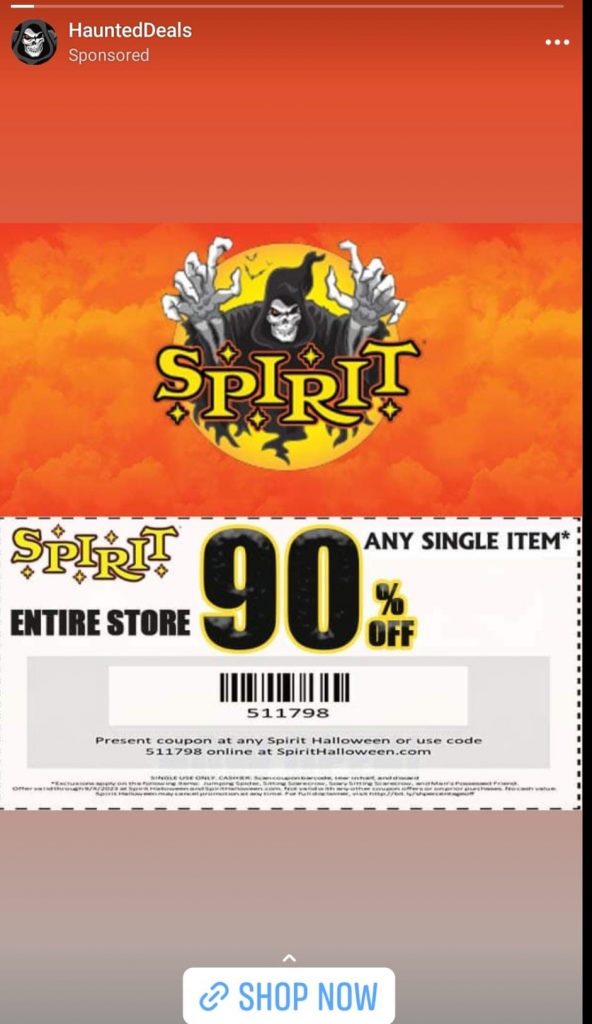
Celebrating Halloween has become a major event in recent years with many adults searching for elaborate costumes and of course whenever many people are interested in something, scammers appear ready to take advantage of that interest. Scammers have set up phony Halloween costume websites, often posing as legitimate costume websites. Often the ads for their phony websites are posted on social media as well as appearing high in search engine searches because the scammers either purchase an advertisement in order to get a high position in a search engine search or because they are skilled enough to manipulate the algorithms the search engines use to obtain a high ranking. Pictured below is one of the phony ads that has appeared in social media. Anyone ordering online from one of these phony websites will end up providing their credit card to a scammer.
TIPS
The 90% discount in the advertisement pictured above should give you pause because generally anytime the price is too good to be true, it is a scam. Also, whenever you order anything online you should use your credit card rather than your debit card because the protection you get from fraud when using your credit card is much greater than the protection you get when using your debit card.
Scam of the day – October 10, 2025 – PayPal Resolution Center Scam
PayPal is a popular payment service used successfully by many people particularly when making purchases through eBay. However, because it is so popular with the public, it is also popular with scammers who over the years have created numerous PayPal based scams about which I have reported to you in the past. Many of the scams involve phony invoices that lure you into clicking on malware infected links or providing personal information that is used to make you a victim of identity theft.
Today’s Scam of the day is one that has been around since 2018, but is resurfacing, as many scams do. It starts with a phony email purporting to be from PayPal that indicates that PayPal is investigating a payment reversal due to your receiving an unauthorized payment due to a transaction error. You are directed in the email to click on a link to login and access your PayPal Resolution Center. Don’t do it! Clicking on the link will take you to a phony PayPal website that will lure you into providing your password and other personal information that will lead to identity theft.
TIPS
Fortunately, this particular scam is easy to avoid. You should start out by being aware that this scam is active and remembering my motto, “BS – Be skeptical.” The easy way to avoid this scam is to never log into your PayPal account through a link in an email because to do so may merely take you to fake email account. Always access your PayPal account independently through your browser.
Legitimate emails from a company with which you do business would include the last four digits of your account and include your name rather than just your email address. Often these emails have neither.
Other telltale signs that this is a scam is that the email address of the sender often has no relation to PayPal, but is merely the email address of someone whose email account was hacked and made a part of a botnet to send out these phishing emails. Also, merely because the email may contain a PayPal logo does not mean that the email is legitimate. It is easy to counterfeit a PayPal logo.
If you are not a subscriber to Scamicide.com and would like to receive free daily emails with the Scam of the day, all you need to do is to go to the bottom of the initial page of http://www.scamicide.com and type in your email address on the tab that states “Sign up for this blog.”