
Scam of the Day
Scam of the day – October 29, 2025 – New Sophisticated PayPal Scam
PayPal is a popular payment service used successfully by many people particularly when making purchases through eBay. However, because it is so popular with the public, it is also popular with scammers who over the years have created numerous PayPal based scams about which I have reported to you in the past. Many of the scams involve phony invoices that lure you into clicking on malware infected links or providing personal information that is used to make you a victim of identity theft.
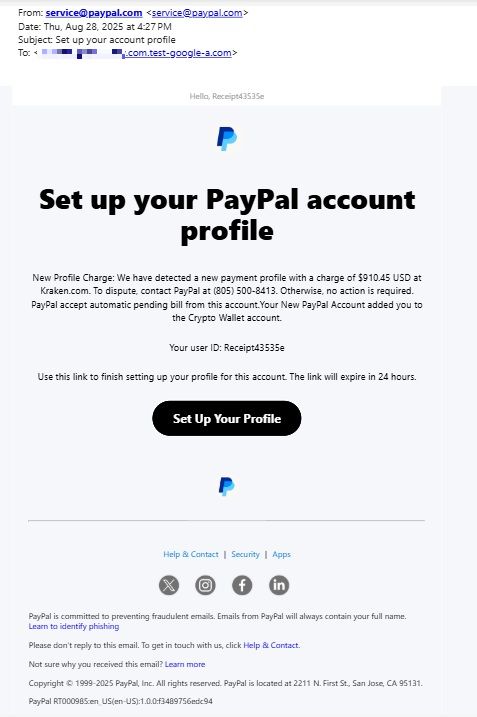
This new scam starts with an email, reproduced below that apears to come from a legitimate PayPal email address. Often scammers use botnets of infected computers to send out such phishing emails so that the email address of the sender clearly shows it is not coming from the real company the scammer is posing as. However, in this instance the scammers use special software programs that allow them to “spoof” a legitimate PayPal email address even though the phishing email is not coming from PayPal. The subject line indicates “Set up your account Profile” while the email itself refers to a charge that you have not made. Often PayPal phishing scams provide fake links and telephone numbers to use to dispute phony claims with the intention of gathring information from you to facilitate access to your account.
In this case, if you click on the link to set up your profile, it actually takes you to PayPal, but not to set up your profile, but rather to provide information to add the scammer as a secondary user of your account, thereby allowing them to utilize your account
TIPS
Fortunately, this particular scam is easy to avoid. You should start out by being aware that this scam is active and remembering my motto, “BS – Be skeptical.” The easy way to avoid this scam is to never log into your PayPal account through a link in an email because to do so may merely take you to fake email account. Always access your PayPal account independently through your browser. There you can find any legitimate communications from PayPal.
Another indication that this is a scam is that it is sent to you as part of a bulk mailing and is not sent to your email address solely.
Legitimate emails from a company with which you do business would include the last four digits of your account and include your name rather than just your email address. This email had neither.
Set up dual factor authentication for your PayPal account will help prevent scammers from accessing your accounts and is something you definitely should do.
If you are not a subscriber to Scamicide.com and would like to receive free daily emails with the Scam of the day, all you need to do is to go to the bottom of the initial page of http://www.scamicide.com and type in your email address on the tab that states “Sign up for this blog.”
Scam of the day – October 28, 2025 – Another Major Health Care Data Breach
An analysis of the health care breach data base maintained by the Department of Health and Human Services done by Security Week indicated that in 2024 there were 720 data breaches affecting as many as 186 million people. And just this week we learned of a data breach at medcial imaging provider Simon Med Imaging that compromised the data of 1.2 million people. While the data breach was only disclosed this past week, the hacking occured between January 21st and February 5th of this year. SimonMed has not indicated precisely what information was taken other than the names of its patients, but it is thought to have included much sensitive informaiton that could result in identity theft. The Medusa ransomware gang announced on its Dark Web portal in February that it had hacked SimonMed Imaging and leaked some of hte stolen data as proof of their claim. At that time Medusa demanded a million dollar ransom payment. While the company has not confirmed any payment, the fact that Medusa no longer lists the data breach on its site is a good indication that the ransom was paid.
Healthcare companies are targeted for a number of reasons including the general lack of security of many healthcare companies and the extensive personal and medical information they store including health insurance information that can be sold by criminals on the dark web for large prices enabling other people to access your health insurance. Having your health insurance policy used by an identity thief is particularly dangerous because it can result in your medical records being corrupted by the medical information of the identity thief and the difficulty in getting this information removed from your medical records. Having the medical information of an identity thief on your medical records could even result in your getting a blood transfusion of the wrong blood type.
TIPS
This is a good time to remind you that although various health care providers often ask for your Social Security number, they do not need it. You should politely refuse to provide it when asked. The fewer places that have your Social Security number the less vulnerable you are to identity theft.
As for the victims of these data breaches, the first thing they should do is freeze their credit if they have not already done so. Freezing your credit is actually something everyone should do. It is free and easy to do. In addition, it protects you from someone using your identity to obtain loans or make large purchases even if they have your Social Security number. If you have not already done so, put a credit freeze on your credit reports at each of the major credit reporting agencies. Here are links to each of them with instructions about how to get a credit freeze:
https://www.transunion.com/credit-freeze
https://www.experian.com/freeze/center.html
If you are not a subscriber to Scamicide.com and would like to receive daily emails with the Scam of the day, all you need to do is sign up for free using this link. https://scamicide.com/scam-of-the-day/
Scam of the day – October 27, 2025 – Phony Sirius XM Invoice Scam
The phony invoice scam is a common scam popular with scammers because it is quite effective. It starts when you receive an email that purports to be from a popular company with which many of us do business that indicates that you owe them a significant payment. The scammers count on people being concerned that they are being wrongfully charged for a product they did not order. You are provided a telephone number to call if you dispute the bill. If you call the number, you will be prompted to provide personal information that will be used to make you a victim of identity theft.
The copied email below was provided by a longtime Scamicide reader attempts to lure you into clicking on a link in order to renew an expired satellite radio Sirius XM account for free which right away should be a red flag that this is a scam. As always, the purpose of a phishing email is to lure you into clicking on links contained within the email or providing personal information. If you click on links in phishing emails, you end up either downloading malware or providing information used to make you a victim of identity theft.
There are a number of red flags that indicate that this is a scam. Your name does not appear anywhere in the invoice. Also, the email was sent from an email address that has no relation to Sirius XM.
Here is a copy of the invoice being circulated.

TIPS
Once, I received a large invoice from a company with which I do business for goods I did not order, but rather than click on the link provided in the email, I went directly to the company’s website to question the invoice. When the website came up, the first thing I saw was a large announcement that the invoice was a scam and that many people had received these phony invoices. If you ever receive a phony invoice such as this and you think that it may possibly be true, don’t click on links or call phone numbers provided in the email. Rather, contact the real company directly at a phone number or website that you know is legitimate where you can confirm that the phishing invoice was a scam.
If you receive this particular phishing email and want to check on your account, here is a link you can trust with contact information for Sirius XM. https://www.siriusxm.com/contact-us
If you are not a subscriber to Scamicide.com and would like to receive daily emails with the Scam of the day, all you need to do is sign up for free using this link. https://scamicide.com/scam-of-the-day/
Scam of the day – October 26, 2025 – Gas Pump Skimmers Continue to be a Problem
In 2020 the Federal Trade Commission (FTC) issued a warning about the dangers presented by skimmers on gas pumps. I have warned you about the dangers of skimmers for many years. Skimmers are small electronic devices that are easily installed by an identity thief on gas pumps, ATMs and other card reading devices. The skimmer steals all of the information from old style magnetic strip credit card or debit cards which then enables the identity thief to use that information to access the victim’s credit card or bank account when the skimmer is used on a debit card. Each skimmer can hold information on as many as 2,400 cards.
MasterCard and Visa announced in December of 2016 that the deadline for the installation of EMV chip card readers on gas pumps was being delayed three years to October 1, 2020. This deadline was further delayed due to the Coronavirus pandemic to April 17, 2021 at which time less than half of the gas pumps in the United States complied with the requirement to install EMV chip card readers. And although that deadline has long since passed, due to the cost involved, many gas pumps still are not enabled for your chip credit card. It has been estimated that about 40% of gas pumps still have not been updated with EMV chip card readers, leaving them susceptible to skimmers.
Making matters worse, last year, the Aurora, Colorado police department issued a warning that scammers were drilling holes in the contactless payment screens on gas pumps where you can merely scan your credit card with its RFID chip rather than insert it into any card reader. By damaging the contactless payment screen, it becomes inoperable thereby requiring the customer to use the credit card reader on the gas pump where the identity thief had already installed a skimmer to steal your credit card or debit card information.
TIPS
Always look for signs of tampering on any machine you use to swipe your credit card or debit card although the more advanced forms of skimmers are installed in the gas pump’s interior and cannot be detected from an inspection of the outside of the pump. Keys to open the gas pumps to allow the installation of the skimmer are readily available online. If the card inserting mechanism appears loose or in any other way tampered, don’t use it. In regard to the contactless payment screen, if it is not working, there is a high likelihood that it may have been tampered with so in that instance pay for your gas inside the gas station office.
Debit cards, when compromised through a skimmer put the customers at risk of having the bank accounts tied to their cards entirely emptied if the theft is not promptly reported and even if the victim reports the theft immediately, the victim loses access to his or her bank account while the matter is investigated by the bank. Debit cards should not be used for purchases at gas pumps. Instead use your credit card and monitor your account regularly to find out early if you have become a victim of this scam. With a credit card, your liability for fraudulent purchases is limited by law to no more than $50 and I am not aware of any credit card companies that hold their customers responsible for any fraudulent purchases. However, fraudulent debit purchases do not come with the same federal legal protection.
When choosing a particular gas pump, you may wish to pick the pump closest to the building and within the sight line of the attendant. Criminals are less likely to install skimmers in pumps where they could be observed making the illegal installation of a skimmer.
If you are not a subscriber to Scamicide.com and would like to receive free daily emails with the Scam of the day, all you need to do is sign up for free using this link. https://scamicide.com/scam-of-the-day/
Scam of the day – October 25, 2025 – Income Tax Implications of Being Scammed
It is bad enough to be scammed, but to have to pay income taxes on money you have been scammed out of certainly adds insult to injury. Prior to 2017 if a scammer convinced you to take money out of your retirement accounts and send the funds to the scammer, you could get a theft and loss deduction to ease the sting just a bit. However, with the passage of the Tax Cuts and Jobs Act in 2017, the rules were changed such that you can only take a deduction under Internal Revenue Code Section 165 for your scam losses if the transaction was entered into for a profit such as when you are a victim of an investment scam. However, for imposter scams, romance scams, tech support scams and more, you are not able to deduct your losses and if you took the money out of your retirement account to pay the scammer, the results are even worse because the full amount of your withdrawal unless it was from a tax-free Roth IRA will be fully subject to income tax and if you are under the age of 59 1/2 the IRS makes it worse by adding its standard early withdrawal penalty.
TIPS
Obviously taking the steps to avoid being scammed in the first place is your first line of defense. In every Scam of the day we provide tips to avoid the particular Scam of the day.
In regard to the punitive tax laws that penalize scam victims with income taxes on funds they have unfairly lost to scammers The Tax Relief for Victims of Crimes, Scams and Disasters Act, a bipartisan bill has been introduced in both the House of Representatives and the Senate as House bill HR 6938 and Senate bill S 3976. The bill is sponsored by Democratic Representative Jamie Raskin of Maryland and Democratic Senator Tammy Baldwin of Wisconsin as well as Republican Representative Greg Steube of Florida and Republican Senator Peter Welch of Vermont. The bill would not only reinstate the theft loss deduction for all scam loss victims, but would apply retroactively so that scam victims would be able to amend their previous returns and get back the extra income taxes they paid due to the 2017 law changes. I urge you to contact your own Senators and Representatives and ask them to support the passage of this bill into law.
If you are not a subscriber to Scamicide.com and would like to receive daily emails with the Scam of the day, all you need to do is to go to the bottom of the initial page of http://www.scamicide.com and type in your email address on the tab that states “Sign up for this blog.”
Scam of the day – October 24, 2025 – Google Voice Scam
Today’s Scam of the day was originally sent to me by a Scamicide reader who listed a small item for sale on Craigslist along with his cell phone number for people to contact him. Someone responded to his ad through a text message in which they indicated that they were interested in purchasing the item but wanted to verify that the Scamicide reader was a real person by having the Scamicide reader send a 6 digit code that the Scammers would send in a separate text message. The Scamicide reader’s Scamdar (a word I invented to describe when you are suspicious of a scam, similar to radar) was activated and he did not provide the 6 digit code which was a good thing because the person answering the advertisement was indeed a scammer.
The scam involves the Google Voice/Google Phone service which is a free phone number provided to you by Google. Calls to that number are forwarded to your cell phone. In order to set up a Google Phone number you need to provide your phone number for verification purposes. Google then texts or calls you with a 6 digit code that you must enter online to finish the process. The good news is that if you fall for the scam and send the 6 digit code to the scammer, you won’t lose any money, however, you can be sure that a scammer will be using your phone number to perpetrate scams and hide his or her tracks.
TIPS
If you do fall for the scam, you need to get your personal number back. This is a somewhat complicated process. Here is a link to help you. https://support.google.com/voice/answer/159519?hl=en#zippy=%2Cyour-linked-number-was-claimed%2Cyour-google-voice-number-was-reclaimed
A good rule to remember to avoid this problem is to never enter any 6 digit code on calls or text messages from Google unless you have initiated the process and requested that your number be used for your Google Voice Account.
Scam of the day – October 23, 2025 – Lottery Scams
Lottery scams are one of the most prevalent types of scams and scammers cheat people out of millions of dollars each year by tricking people into sending money to the scammers after being told that they have won a lottery, but are required to pay some fees or taxes in order to collect their prize. According to the Federal Trade Commission (FTC) Americans lost $351 million to lottery scams last year. It is hard to win any lottery. It is impossible to win one that you have not even entered and yet scam artists, the only criminals we refer to as artists have found that it is extremely lucrative to scam people by convincing them that they have won various lotteries.
Most lottery scams involve the victims being told that they need to pay taxes or administrative fees directly to the lottery sponsor; however no legitimate lottery requires you to do so. As with many effective scams, the pitch of the scammer seems legitimate. Income taxes are due on lottery winnings, but with legitimate lotteries they are either deducted from the lottery winnings before you receive your prize or you are responsible for paying the taxes directly to the IRS. No legitimate lottery collects taxes on behalf of the IRS from lottery winners. Other times, the scammer tell the “winners” that in order to collect their prizes, they need to pay administrative fees. Often, the victims are told to send the fees back to the scammer by prepaid gift cards. Again, no legitimate lottery requires you to pay administrative fees in order to claim your prize.
I have been reporting to you for years about the infamous Jamaican lottery scam through which many Americans, mostly elderly, have been scammed out of money after being told that they have won the Jamaican lottery. The scam begins when the victims receive a telephone call informing them that they have won this non-existent lottery that they never entered and are then pressured to pay “fees” and “taxes” before their winnings can be sent to them. This scam has been going on since the 1990s.
TIPS
As I have often told you, it is difficult to win a lottery you have entered. It is impossible to win one that you have not even entered. You should always be skeptical about being told that you have won a lottery you never entered. It is also important to remember that it is illegal to play foreign lotteries except when you are actually present in the other country.
While it is true that income taxes are owed on lottery winnings, legitimate lotteries never collect tax money from winners. They either deduct the taxes from the winnings or leave it up to the winners to pay their taxes directly to the IRS. You also should never pay a fee to collect a legal lottery prize.
If you are not a subscriber to Scamicide.com and would like to receive daily emails with the Scam of the day, all you need to do is to go to the bottom of the initial page of http://www.scamicide.com and click on the tab that states “Sign up for this blog.”
Scam of the day – October 22, 2025 – LinkedIn Job Scams Getting Worse
LinkedIn is the world’s largest professional network and, as such, has long been attractive to scammers seeking to piggy-back on the sites good reputation. Recently the number of job scams being found on LinkedIn has increased dramatically. A recent development is scammers using the name of legitimate companies that are hiring and approaching their victims through LinkedIn’s direct messaging feature. They then create counterfeit websites that look like the websites of the legitimate companies they are posing as and ask the job seekers for personal information as part of the hiring process before holding a job interview by Zoom. The personal information which may include the job seeker’s Social Security number is used for purposes of identity theft. They also may ask for money or your credit card number to pay for background investigations or equipment for the company which legitimate businesses do not do. In other instances, the job seeker is required to pay for equipment or training which the scammer promises to reimburse, but, of course, the money is never paid back. Making the problem even worse is the use of AI to make the photos and websites even more legitimate appearing.
TIPS
Although LinkedIn, Indeed and other websites that carry job postings try to identify and either prevent or remove phony ads from appearing on their websites, you cannot depend on these companies to fully protect you. Trust me, you can’t trust anyone. Certainly a little skepticism helps when you see a job posting for a job that sounds too good to be true. Ads that ask for you to pay upfront costs for any reason should be considered to be a scam as well as any company that requests your credit card information for any reason whatsoever.
To check on the legitimacy of photographs in these ads you can do a reverse image search using Google or websites such as tineye.com. You can also check to see if the wording of the advertisement has been used elsewhere by merely copying a substantial amount of the text into your search engine and see what comes up. Also, research the company itself to determine if it is a legitimate company. Check out the website of the company supposedly offering you a job to see if the legitimate company is offering such a job. Make sure you are using a domain name that you have confirmed is legitimate and not just the one contained in the email sent to you by the scammer. If the job doesn’t appear on the real company’s website, you know it is a scam. It also is a good idea to confirm any job offer you might receive with the HR department of the real company before providing personal information such as your Social Security number.
You also can use the website whois.com to compare the URL of the company that is hiring to see if it really is legitimate. Whois.com will tell you who actually owns the website and how long it has been active. In the case of a scammer’s website, the website may be owned by an entity unrelated to the company and often has only recently been created.
If you are not a subscriber to Scamicide.com and would like to receive daily emails with the Scam of the day, all you need to do is sign up for free using this link. https://scamicide.com/scam-of-the-day/
Scam of the day – October 20, 2025 – Lending Company Data Breach Affects 17.6 Million Accounts
Data breaches are a common occurrence which is disturbing because they can readily lead to your identity being stolen or you becoming a victim of a scam as the hackers leverage the data they steal to lure you into a scam. Prosper Marketplace, Inc is a peer to peer lending platform that enables people to borrow money directly from investors rather than go through traditional banks. Prosper has been around since 2005 and facilitates loans of between $2,000 and $50,000. Prosper recently disclosed that it had suffered a massive data breach affecting 17.6 million accounts. Among the compromised data were names, birth dates, email addresses, Social Security numbers and more. This information can readily lead to identity theft. Prosper has indicated that it is still investigating the data breach, but will be offering free credit monitoring at a later date.
Companies must do a better job of protecting themselves from not just technologically sophisticated cyberattacks, but less sophisticated, but equally effective social engineering attacks where the cybercriminals use psychology to manipulate employees to giving them access to important data.
TIPS
Victims of this data breach should freeze their credit if they have not already done so. Actually, freezing your credit is actually something everyone should do. It is free and easy to do. In addition, it protects you from someone using your identity to obtain loans or make large purchases even if they have your Social Security number. If you have not already done so, put a credit freeze on your credit reports at all of the major credit reporting agencies. Here are links to each of them with instructions about how to get a credit freeze:
https://www.transunion.com/credit-freeze
https://www.experian.com/freeze/center.html
If you are not a subscriber to Scamicide.com and would like to receive daily emails with the Scam of the day, all you need to do is sign up for free using this link. https://scamicide.com/scam-of-the-day/