
Scam of the Day
Scam of the day – November 7, 2025 – Jury Duty Scams Continue to Snare Victims
I have been warning you about the jury duty scam for twelve years, but it continues to snare many unwary victims. This scam generally starts with a phone call from someone posing as a police officer or court official telling you that you have missed jury duty and must pay a fine or risk being arrested. Often in these scams you are told that you can pay the fine through a credit card or, as is being done more and more, by a gift card or cryptocurrency which you are told to pay through a cryptocurrency ATM. Other times they ask for your Social Security number to confirm your identity. Of course, the phone call is a scam. Even if you have missed jury duty, you will never be called by legitimate court officers and shaken down for a payment.
Scammers will use a technique called “spoofing” to make the call appear on your Caller ID as if it is coming from a legitimate law enforcement agency or court. In some instances of the scam you are asked to confirm your identity by providing your Social Security number which will then be used to make you a victim of identity theft. The scam has evolved to where people are also being contacted by text messages or emails from scammers posing as a representative of the local court system.
Recently, the Kanawha County West Virginia Sheriff’s office issued a warning about an increase in jury duty scams in their area. In their warning they reminded the public that “no law enforcement office will ever request or accept payment over the phone to resolve a warrant or avoid arrest.”
TIPS
Initial contacts from courts regarding jury duty are always in writing through the mail although some systems will permit you to receive future notices through email. Under no circumstances will you receive telephone calls or text messages indicating that you have failed to report for jury duty. No court will demand payment over the phone for failing to appear for jury duty and no court ever requires a payment be made via cryptocurrencies or gift cards. Anytime you are asked to make a payment through a cryptocurrency ATM it is a scam.
If you do receive such a call and you think that there is even the possibility that you might have forgotten to report for jury duty, merely call the local clerk of courts in order to get accurate information. Of course anyone calling you and telling you that you can pay your fine to them over the phone using your credit card or a gift card is a scammer.
If you are not a subscriber to Scamicide.com and would like to receive free daily emails with the Scam of the day, all you need to do is to go to the bottom of the initial page of http://www.scamicide.com and type in your email address where it states “Sign up for this blog.”
Scam of the day – November 6, 2025 – Clever PayPal Phony Invoice Scam
Today’s Scam of the day is one I first warned you about in the Scam of the day for March 3, 2023, but it is still being effectively used by scammers. I also have warned you in the past about a PayPal scam in which you receive a phony invoice that appears to come from Paypal or some other company with which you do business, but if you look at the email from which it is sent, you will see that the email was sent from someone who has no relation to the company it purports to be. However, in this new scam, you get a phony invoice that not only appears to come from PayPal, but actually does come from PayPal and a link in the email to “View and Pay Invoice” that actually would take you to PayPal and an active invoice. The email has a phone number for you to call if you have a question about the invoice and if you do call the phone number, a scammer will promptly answer the phone where you will be advised to download a remote administration tool that gives the scammer remote access to your computer purportedly to help find the problem, but in actuality what you will have done is give the scammer access to your computer and all of the passwords to all of your accounts.
The truth is that the scammers open PayPal Business accounts which enables them to be able to send invoices from PayPal which makes them appear legitimate when they indeed are sent to you by PayPal. The customer service number that they provide in the invoice does not, however, take you to PayPal, but rather to the scammer who then asks you to give them remote access to your computer to straighten the matter out.
TIPS
Whenever you get an email or invoice such as this which appears to come from a legitimate source, don’t click on links or call the phone numbers in the invoice. Rather call the real customer service number which you can get online. It is also interesting to note that if you call the real customer service number for PayPal, you will have to go through a number of prompts before you get to speak to a real person, however, the scammers customer service number is immediately answered by a person.
This scam and many tech support scams ask you to give remote access to your computer which is something you should not do under almost all circumstances. Giving someone remote access to your computer gives them access to everything on your computer and can lead to serious identity theft.
If you are not a subscriber to Scamicide.com and would like to receive free daily emails with the Scam of the day, all you need to do is to go to the bottom of the initial page of http://www.scamicide.com and insert your email address where it states “Sign up for this blog.”
Scam of the day – November 5, 2025 – Scammers Use AI to Pose as Police
In the Star Wars movies, the “force” provided power that could used for good or as exemplified by Darth Vader, the “dark side” and so it is with artificial intelligence. Artificial intelligence can be use to combat scams through recognizing patterns present in scams as well as through machine learning algorithms even use historical data to recognize signs of new scams. However, AI has also proven already to be a tremendous weapon for scammers using the dark side of the force to, among other things, create more effective phishing emails. Using AI to create deepfake audios and videos to enhance their scams is now a serious problem
The Salt Lake City Utah Police Department reported that scammers were sending out emails to people with a deepfake video that appeared to show Police Chief Mike Brown telling the person receiving the email that they “owed the federal government nearly $100,000” and extorted the targeted victim to make a payment to the scammer. Video and audio of the police chief was readily available for the scammers to create the deepfake. A similar deepfake voice cloning audio was done by scammers posing as Tulsa, Oklahoma police officer Eric Spradlin
TIPS
As always, you can never be sure whenever you get an email as to who is actually contacting you so anytime you are asked for personal information, click on a link or make a payment, you should independently confirm that the email is legitimate before responding.
In this case, the email address of the sender was readily able to be recognized as not that of the Salt Lake City Police Department and no police department is going to send anyone such an email with a video. Further, local police departments would not be collecting money on behalf of the federal government nor would a demand be made for “around” $100,000. Also, while deepfakes can be very difficult to recognize as phony, this particular deepfake video contained unnatural speech patterns.
If you are not a subscriber to Scamicide.com and would like to receive daily emails with the Scam of the day, all you need to do is sign up for free using this link. https://scamicide.com/scam-of-the-day/
Scam of the day – November 4, 2025 – Massive Email Data Breaches Disclosed
Recently the media has been filled with reports of millions of Gmail email addresses and passwords being compromised, however, compromise of this information was not, as some assumed, a result of lax security at Google. Rather the data breach relates to the cybersecurity company Synthient disclosing a dataset of 183 unique email addresses, passwords and the websites where those passwords were used including Gmail accounts that Synthient gathered from various dark web sites where cybercriminals buy and sell goods and services. This data was not the result of a single data breach, but a compilation of data from numerous data breaches made available on the dark web . Synthient has given the data to the website Have I Been Pwned which is a terrific, free website where you can go, put in your email address and learn about data breaches affecting you. While the data was originally discovered by Synthient in April, the data only recently in October was provided to Have I Been Been Pwned. Here is a link to Have I Been Pwned’s site where you can learn if your passwords and accounts have been compromised. https://haveibeenpwned.com/
TIPS
Certainly, if you find that your passwords have been compromised you will want to change your password, but this is probably a good time to evaluate how strong your passwords are. Here is a link to a Scam of the Day in which I describe how to pick a strong password. https://scamicide.com/2022/03/19/scam-of-the-day-march-20-2022-is-your-password-strong-enough/
It is also important to use unique passwords for each of your accounts so if one account is compromised, your other accounts will still be secure. You also should use dual factor authentication on all of your accounts so that even if your password is compromised, your account could not be accessed.
If you are not a subscriber to Scamicide.com and would like to receive free daily emails with the Scam of the day, all you need to do is to go to the bottom of the initial page of http://www.scamicide.com and type in your email address in the tab that states “Sign up for this blog.”
Scam of the day – November 3, 2025 – Washington DC Sues Bitcoin ATM Company
A report from the Federal Trade Commission (FTC) indicates a 1,000 % increase in money lost to scammers through cryptocurrency ATMs in the last three years. Cryptocurrency ATMs look just like traditional ATMs, but instead of distributing cash, they take cash in exchange for cryptocurrency and enable the transfer of the deposited cash turned into cryptocurrency into crypto wallets. Due to the anonymity and immediacy of the cryptocurrency transfers done through a cryptocurrency ATM, it is a favorite method of payment for scammers.
Most of the scams using cryptocurrency ATMs involve imposter scams where the scammer poses as either a law enforcement officer, government official or someone providing tech support for a non-existent problem. What many of these imposter scams have in common is that they scare the targeted victim with a story about an emergency that requires them to take cash from their bank account and use a QR code provided by the scammer to deposit the money into the account of the scammer at a cryptocurrency ATM under the guise of protecting the funds. In other versions of the scams, victims are told they must make a payment through a cryptocurrency ATM to avoid prosecution for missing jury duty or some other pretense.
Washington D.C. Attorney General Brian Schwalb has recently filed a lawsuit against Athena Bitcoin which operates more than 4,000 Bitcoin ATMs in the United States. In the lawsuit, Schwab alleges that most of the deposits into Athena ATMs in Washington D.C. are done as part of a scam and that Athena profits considerably from these fraudulent deposits through fees of as much as 26% on each transaction.. Schwab further alleges that when fraud is discovered, Athena tells scam victims that none of the money they lost is recoverable even though Athena has kept 26% of those funds. Athena denies the allegations.
TIPS
Protecting yourself from these imposter scams that form the basis of cryptocurrency ATM scams starts with recognizing that you can never be sure who is actually contacting you when you are contacted by phone, email or text message so you should never click on a link, download an attachment or provide personal information in response to any of those communications unless you have absolutely confirmed that the communication was legitimate. Further there is no circumstance where you will be asked by anyone legitimate to withdraw funds from your bank, deposit them into a cryptocurrency ATM and transfer the funds to them. Only scammers make those requests.
If you are not a subscriber to Scamicide.com and would like to receive free daily emails with the Scam of the day, all you need to do is to go to the bottom of the initial page of http://www.scamicide.com and type in your email address in the tab that states “Sign up for this blog.”
Scam of the day – November 2, 2025 – Is the American Community Survey a Scam?
Many people are receiving letters, phone calls and even visits from people representing that they are with the United States Census Bureau taking a survey known as the American Community Survey. While it is true that the official United States Census is only done once every ten years, the Census Bureau does a limited survey of 3.5 million randomly selected people in all of the states as well as Washington D.C. and Puerto Rico monthly throughout the year.
So how can you tell if you are being contacted and solicited for information by a legitimate census worker or by a scammer merely using the American Community Survey as a ruse to gather personal information from you in order to make you a victim of identity theft? First of all, the real American Community Survey does not ask for your Social Security number or credit card information. If you are asked for that information, it is a scam.
TIPS
It is important to note that the Census Bureau will always initially contact you through a snail mail letter informing you that you have been selected to participate in the survey. The letter will also provide you with instructions as to how to complete the survey online. If you fail to complete the survey online a paper survey will be sent to you after three weeks. Once the survey has been completed either online or on paper, you may be called on the phone if the Census Bureau needs to clarify any information. You will not be asked for your Social Security number or any bank or credit card information.
A Census Bureau representative may come to your home to follow up on the survey. He or she will always have a photo ID with the U.S. Department of Commerce seal and an expiration date. If you are concerned that the person may be a scammer you can always contact your Census Bureau regional office to confirm that the visit is legitimate.
If you are contacted about participating in the American Community Survey, it is prudent to confirm that you have been selected to participate in the survey. You can do this by calling your Census Bureau regional office. Here is a link with the phone numbers for each region. https://www.census.gov/about/regions.html
If you are not a subscriber to Scamicide.com and would like to receive daily emails with the Scam of the day, all you need to do is to go to the bottom of the initial page of http://www.scamicide.com and type in your email address on the tab that states “Sign up for this blog.”
Scam of the day – November 1, 2025 – Hurricane Melissa Scams
Natural disasters such as hurricanes and earthquakes are common occurrences. Hurricane Melissa has wreaked havoc in Jamaica. Natural disasters, such as hurricanes, wildfires, tornadoes and earthquakes bring out the best in people who want to donate to charities to help the victims. Unfortunately natural disasters also bring out the worst in scammers who are quick to take advantage of the generosity of people by contacting them posing as charities, but instead of collecting funds to help the victims of these natural disasters, these scam artists steal the money for themselves under false pretenses.
Charities are not subject to the federal Do Not Call List so even if you are signed up for the federal Do Not Call List, legitimate charities are able to contact you by phone. The problem is that whenever you are get a phone call, you can never be sure as to who is really calling you so you may be contacted either by a fake charity or a scammer posing as a legitimate charity. Using a technique called spoofing, the scammers can manipulate your Caller ID to make it appear that the call is coming from a legitimate charity when it is not. Similarly, when you are solicited for a charitable contribution by email or text message you cannot be sure as to whether the person contacting you is legitimate or not.
Through the use of AI, scammers are also contacting people through social media with pleas for charitable donations. Often these social media posts will contain AI enhanced photos and videos and you can never be sure if the posts are legitimate.
TIPS
Never provide credit card information over the phone to anyone whom you have not called or in response to an email or text message. Before you give to any charity, you may wish to check out the charity with http://www.charitynavigator.org where you can learn whether or not the charity itself is a scam. You can also see how much of the money that the legitimate charity collects actually goes toward its charitable purposes and how much it uses for fund raising and administrative costs.
Here is a link to charitynavigator’s picks for the best charities for donations to help the victims of the storm. https://www.charitynavigator.org/discover-charities/where-to-give/hurricane-melissa-2025/
If you are not a subscriber to Scamicide.com and would like to receive daily emails with the Scam of the day, all you need to do is to go to the bottom of the initial page of http://www.scamicide.com and type in your email where it states “Sign up for this blog.”
Scam of the day – October 30, 2025 – Copy of Your Deed Scam
Today’s Scam of the day is one that I have been warning you about since 2012, but lately there has been a resurgence of this scam as indicated by the number of Scamicide readers who have inquired about this scam after receiving a confusing notice. The scam begins with a call, email or snail mail letter informing you of the importance of having a copy of the deed to your home. Often these scammers will charge you $90 or more to obtain a copy of your deed for you.
Having an actual copy of your deed is not very important once it has been recorded in the local Registry of Deeds, however it is still a good record to keep. However, obtaining a copy of your deed on your own from your local Registry of Deeds is both simple and rarely costs more than a few dollars at the most. The problem with this particular scam is that technically, it may be legal in the sense that they are offering to obtain a copy of your deed for you for a fee and there is nothing illegal about that. However, the emails and letters you receive offering this service are usually confusing and misleading which is why I consider them to be a scam.
In 2018, Ohio actually passed a law requiring specific disclosures to consumers be made when a fee is requested to obtain a copy of a deed on your behalf. The disclosure must include the actual cost charged by the Registry of Deeds for a deed copy as well as prohibiting charging a fee more than four times the cost charged by the Registry of Deeds.
TIP
This is an easy scam to avoid. If you get such a call, email or letter, merely ignore it. If you want a copy of your deed, merely contact your local Registry of Deeds where you can get one for a nominal cost.
If you are not a subscriber to Scamicide.com and would like to receive daily emails with the Scam of the day, all you need to do is to go to the bottom of the initial page of http://www.scamicide.com and type in your email address where it states “Sign up for this blog.”
Scam of the day – October 29, 2025 – New Sophisticated PayPal Scam
PayPal is a popular payment service used successfully by many people particularly when making purchases through eBay. However, because it is so popular with the public, it is also popular with scammers who over the years have created numerous PayPal based scams about which I have reported to you in the past. Many of the scams involve phony invoices that lure you into clicking on malware infected links or providing personal information that is used to make you a victim of identity theft.
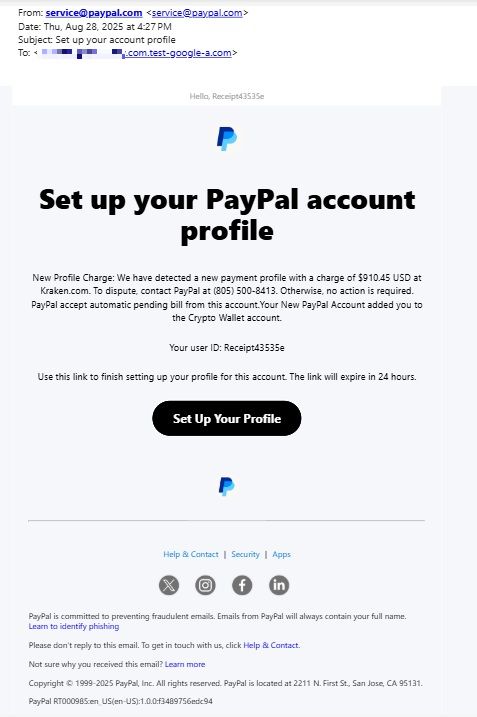
This new scam starts with an email, reproduced below that apears to come from a legitimate PayPal email address. Often scammers use botnets of infected computers to send out such phishing emails so that the email address of the sender clearly shows it is not coming from the real company the scammer is posing as. However, in this instance the scammers use special software programs that allow them to “spoof” a legitimate PayPal email address even though the phishing email is not coming from PayPal. The subject line indicates “Set up your account Profile” while the email itself refers to a charge that you have not made. Often PayPal phishing scams provide fake links and telephone numbers to use to dispute phony claims with the intention of gathring information from you to facilitate access to your account.
In this case, if you click on the link to set up your profile, it actually takes you to PayPal, but not to set up your profile, but rather to provide information to add the scammer as a secondary user of your account, thereby allowing them to utilize your account
TIPS
Fortunately, this particular scam is easy to avoid. You should start out by being aware that this scam is active and remembering my motto, “BS – Be skeptical.” The easy way to avoid this scam is to never log into your PayPal account through a link in an email because to do so may merely take you to fake email account. Always access your PayPal account independently through your browser. There you can find any legitimate communications from PayPal.
Another indication that this is a scam is that it is sent to you as part of a bulk mailing and is not sent to your email address solely.
Legitimate emails from a company with which you do business would include the last four digits of your account and include your name rather than just your email address. This email had neither.
Set up dual factor authentication for your PayPal account will help prevent scammers from accessing your accounts and is something you definitely should do.
If you are not a subscriber to Scamicide.com and would like to receive free daily emails with the Scam of the day, all you need to do is to go to the bottom of the initial page of http://www.scamicide.com and type in your email address on the tab that states “Sign up for this blog.”