
Scam of the Day
Scam of the day – November 26, 2025 – Online Shopping Safety Tips: How to Avoid Scams and Protect Your Data
Every year, the number of people shopping online and the money spent through online shopping grows significantly. And why not? The convenience alone of being able to shop from the comfort and privacy of your home is reason enough for many of us to shop online. But how safe is it? According to the FTC, online shopping scams were the second most common scams following imposter scams. However, following some basic precautions can go a long way in protecting you from being scammed when shopping online.
TIPS
Here is a list of some online shopping tips:
1. Make sure that the computer, laptop, tablet or phone you use is equipped with the anti-virus and anti-malware software and that you have updated the software with the latest security patches.
2. As with shopping at brick and mortar stores, don’t use a debit card for online purchases, as well. In the event of a data breach, the consumer protection laws in regard to fraudulent use of your debit card are not as protective as those that apply when your credit card is fraudulently used.
3. Don’t supply your credit card number unless the address of the website is preceded by the letters “https.” That additional letter “s” indicates that the transmission of your data is encrypted and secure.
4. Don’t leave your credit card number on record with the online retailers you use for the sake of convenience. Doing so only makes you more likely to become a victim of identity theft if the company suffers a data breach (and many of them will).
5. Don’t click on coupons or ads that you may receive by way of an email or text message regardless of how good they appear. They may be loaded with malware that will be downloaded on to your computer, tablet or phone if you click on the link. That malware can steal all of your personal information and lead to your becoming a victim of identity theft. Any legitimate coupon you might receive through an email or a text message will also be available on the website of the company where you want to shop.
6. Limit your online shopping to companies that you know and trust. Merely because a company comes up high on a Google search does not mean that the company is legitimate. Any company offering a price that appears too good to be true, should be particularly suspect. You can use the site whois.com to see who actually owns an online shopping site you are considering using. Scammers create phony shopping sites and often make them appear to be sites of legitimate retailers with which you are familiar. If using whois.com you find that the Walmart site you are considering using was only created a month ago and it was created by someone in Nigeria, you can be confident that it is a scam. You also can use sites such as trustpilot.com and resellerratings.com to check and see if a site you are considering is phony.
7. Use distinct and complex passwords for each online company with which you shop and use dual factor authentication whenever possible.
If you are not a subscriber to Scamicide.com and would like to receive daily emails with the Scam of the day, all you need to do is to go to the bottom of the initial page of http://www.scamicide.com and type in your email address on the tab that states “Sign up for this blog.”
Scam of the day – November 25, 2025 – Holiday Coupon Scams: How Fake Deals on Social Media Steal Your Data
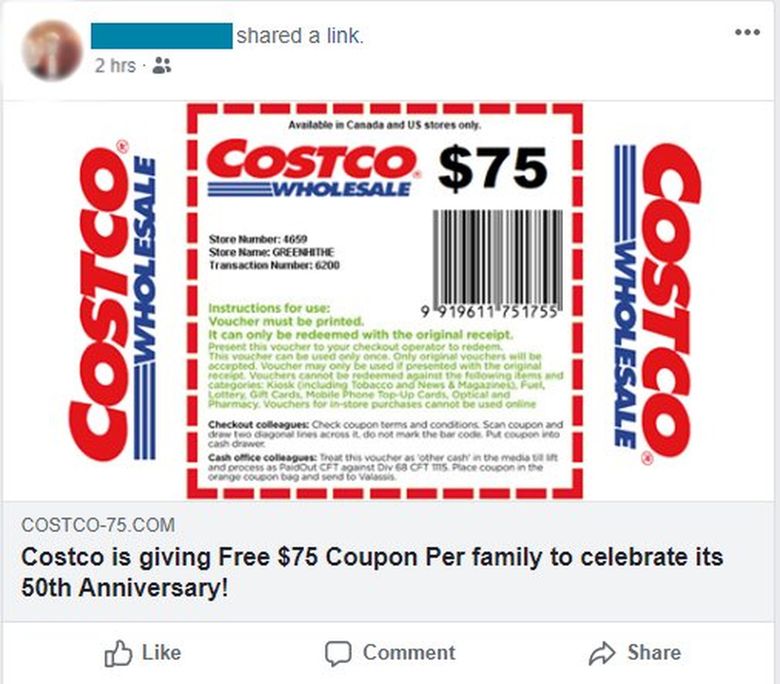
Everyone loves coupons, particularly during the holiday shopping season. Like many things in our lives, coupons which used to be found commonly in newspapers and magazines have migrated online. In recent years scammers have been perpetrating phony coupon scams on social media. Among the companies affected by these phony coupons were Bath and Body Works, Costco, Aldi, Starbucks and Trader Joe’s. As I have warned you many times in the past, Facebook has become a hotbed for phony online coupons. The phony coupons looks quite legitimate which means nothing because it is very easy to copy the company logos and make the coupons appear to be genuine.
The way that many phony coupon scams work is that in order to qualify for the coupon, you must complete a survey in which you are required to provide much personal information that is used to make you a victim of identity theft. In other versions of the scam, the scammer actually asks for your credit card numbers. In yet another version of the scam you are required to buy many costly items in order to claim your “free” coupon. Many of the coupon scams also require you to forward the coupon to friends which make the phony coupons appear more trustworthy when they are received by your friends. Ultimately, in all of these scams, the coupons are worthless and you get nothing but the opportunity to become a victim of identity theft. Here is a copy of a phony coupon appearing online. It was provided by the Identity Theft Resource Center.
TIPS
If the coupon appears too good to be true, it usually is a scam. No company could cover the cost of giving away vast numbers of $75 coupons although sometimes, participants in legitimate surveys are promised a chance to win a prize in a drawing. Facebook is a favorite venue for scammers perpetrating this type of scam because often unwary victims will unwittingly share the scam with their friends. One way to determine if a coupon is legitimate is to look for the expiration date found on most coupons. The phony Costco coupon shown above like most phony coupons does not carry an expiration date. The best place to go to find out if a coupon is legitimate is to go to the company’s website to see what real coupons are being offered.
If you are not a subscriber to Scamicide.com and would like to receive free daily emails with the Scam of the day, all you need to do is to go to the bottom of the initial page of http://www.scamicide.com and type in your email address on the tab that states “Sign up for this blog.”
Scam of the day – November 24, 2025 – Black Friday Scams: How to Shop Safely and Avoid Skimmers
This coming Friday is Black Friday, the unofficial start of the holiday shopping season although I have been seeing holiday shopping displays since Halloween. The fact that Black Friday is such a huge shopping day is not lost on scammers who will be as pervasive as ever. Over the next few weeks, I will be focusing the Scams of the day on the many holiday season scams about which we should all be aware.
If you are shopping in a brick and mortar store Friday or any other day throughout the year, you should use a credit card rather than a debit card because of the possibility of skimmers which are small devices being used by criminals working as sales clerks that will capture your credit card number which will then be used to make fraudulent purchases. As for using your credit card rather than your debit card, it is important to remember that while your liability for fraudulent use of your credit card is limited by federal law to no more than $50, your liability for fraudulent use of your debit card which is tied to your bank account is unlimited if you do not promptly discover and report the fraud which is why you should always use your credit card for shopping rather than your debit card.
I will be discussing safe practices for online shopping in a future Scam of the day, but in the last couple of years the problem of what the FBI calls E-skimming has become more serious. E-skimming occurs when criminals infect the websites of numerous retailers in a manner that they are able to capture your credit card or debit card information when you enter it into the website. It is important to note that while your chip card will protect you if you use your chip card to make purchases at a brick and mortar store that has updated its credit card processing equipment to handle chip credit cards, you cannot use your chip for online purchases. However, as I indicated in the previous paragraph, the most you are responsible for if your credit card is used fraudulently is $50 and quite frankly I have never seen a credit card company even charge its customers that amount.
TIPS
For the reasons discussed above, try to use your credit card as a chip card whenever possible and always watch your credit card when it is being processed at a brick and mortar store. Don’t let it out of your sight because that is when you run the risk of a rogue clerk running it through a portable skimmer, which will steal the number of your card. Refrain from using your debit card except as an ATM card. Finally, in regard to the E-skimming threat, you should regularly monitor your credit card statement online rather than waiting for a monthly paper bill to be delivered to you so that if your credit card was compromised and your data stolen, you will be able to discover and report the problem to your credit card issuer quickly and avoid more problems.
If you are not a subscriber to Scamicide.com and would like to receive daily emails with the Scam of the day, all you need to do is to go to the bottom of the initial page of http://www.scamicide.com and type in your email address on the tab that states “Sign up for this blog.”
Scam of the day – November 23, 2025 – Gift Card Scams: How Hackers Trick You Through Fake Emails
Scammers are big fans of gift cards because they are easy to purchase, easy to send to the scammer and impossible to trace to the scammer. It is not even necessary for the scammer to be in possession of the actual gift card to use it. Sending the gift card numbers or taking a picture on your phone and transmitting it to the scammer is sufficient for the scammer to use the gift card to quickly buy things that can then be sold and converted into cash. In a current gift card related scam, people are reporting receiving emails from friends who for one reason or another need you to send them gift cards to cover some necessary expenses. Unfortunately, the email is sent to people on the contact list of a person whose email account was hacked so even though the email is coming from your friend’s email address, it was not sent by your friend, but by a scammer. Anyone providing the gift card numbers to the scammer, as requested, soon becomes aware that he or she has been scammed and lost the gift card funds forever.
Here is an email I received this week that appeared to come from someone I know.
“I need you to get an Apple E-gift card for a friend who is down with Liver Cancer, it’s her birthday today. I tried purchasing them myself but my card got declined. I contacted my bank and they told me it would take a couple of days to get it sorted and the stores around here are all out of stock, Could you get them on Amazon or Walmart and have them sent to her email address for delivery today? I ‘ll reimburse you once my bank sorts the issue out. I am just trying to put a smile on her face in this trying times. Let me know so I can provide you with her email address and the amount needed on them.”
TIPS
The key to protecting yourself from this scam is to be skeptical whenever you get a request to wire money or make a payment through gift cards because once money has been wired, it is gone forever which is why it is a favorite method of payment for scammers. As for gift cards, once you provide the numbers from the gift cards, the scammers utilize the gift cards to quickly make purchases that they then sell in order to get cash. Always confirm with a phone call the legitimacy of any request for you to send funds before you send anything. Finally, anytime anyone approaches you with a business transaction in which you are asked to pay through gift cards, you can be confident that it is a scam. The IRS has even had to post on its website that it does not accept gift cards as payments.
If you are not a subscriber to Scamicide.com and would like to receive daily emails with the Scam of the day, all you need to do is to go to the bottom of the initial page of http://www.scamicide.com and click on the tab that states “Sign up for this blog.”
Scam of the day – November 22, 2025 – Thanksgiving Scam Alert: Beware of Fake E-Greeting Cards and Malware
Thanksgiving is just a few days away and I want to wish everyone a happy and scam-free Thanksgiving..
Electronic greeting cards have become very popular and with good reason. Even if you don’t remember a birthday or delay sending a holiday card until the last minute, you can send an electronic greeting card, often for free, and have it delivered immediately. Many electronic greeting cards are quite creative with videos and music Unfortunately, you can always count on scam artists and identity thieves to try to spoil anything and electronic greeting cards are no exception. The scam starts when you get a phony electronic greeting card that requires you to click on a link to read the card. If you click on one of these phony greeting cards, you may end up downloading a keystroke logging malware program that will steal all of the information from your computer and end up with you becoming a victim of identity theft or alternatively you may download dangerous malware such as ransomware.
TIPS
One of the first things to notice when you receive an e greeting card is who is indicated as the person sending the card. If it states that the card is being sent by “a friend” or “an admirer,” you can be pretty sure that it is a phony card. However, even if the card uses the name of someone you know, it still is risky to open the card without confirming with an email or a phone call that your friend actually did send you the card. Remember, even paranoids have enemies. Scammers may pick a common name to use as the sender or may even have researched who your friends and family are and use their names..
It is also important to keep your security software including anti-virus software and anti-malware software installed and up to date at all times which can help if you unwittingly download malware. However, it is important to remember that even the most up to date security software is always at least thirty days behind the latest strains of malware often referred to as those that exploit “zero day defects.”
If you are not a subscriber to Scamicide.com and would like to receive daily emails with the Scam of the day, all you need to do is to go to the bottom of the initial page of http://www.scamicide.com and type in your email address on the tab that states “Sign up for this blog.”
Scam of the day – November 21, 2025 – Most Dangerous Celebrities Online: How Hackers Exploit Taylor Swift and Others
Each year, computer security company, McAfee releases a list of the most dangerous celebrities on the Internet. These are people whose popularity is exploited by identity thieves and hackers who lure unsuspecting people through links in emails, social media, deepfakes and text messages relating to these celebrities to malware filled websites where their victims unknowingly download ransomware or keystroke logging malware that enables the identity thieves to steal all of the personal information from the victim’s computer, laptop, smartphone or other electronic device and use that information to make the person a victim of identity theft. This year’s list not surprisingly is led by Taylor Swift followed by Scarlett Johansson, Jenna Ortega, Sydney Sweeney, Tom Cruise, Alexandra Ocasio-Cortez, Sabrina Carpenter, Lebron James, Kim Kardashian and Zendaya.
TIPS
It is important to remember that merely because a celebrity website turns up high on a Google search does not mean that it is legitimate. Google doesn’t check out websites for legitimacy in ranking sites. The ranking is done by secret algorithms that some identity thieves are adept at manipulating. A good practice is to check out the actual URL of any celebrity website with which you are unfamiliar with whois.com which will let you know who actually owns the particular website. This can help identify one that may have been set up by cybercriminals.
Also, as I constantly warn you, never click on links or download attachments unless you are absolutely sure that they are legitimate. It is also important to remember with some types of malware, merely going to an infected website will download dangerous malware so you need to be very careful. Merely because it appears that a friend is passing them on to you does not make them legitimate. As for celebrity videos and photos, you should have a healthy mistrust of websites with which you are not entirely familiar. For gossip, http://www.tmz.com is a good place to go. They always have the latest gossip and they are legitimate. Finally make sure that you keep all of your electronic devices secure with anti-malware and anti-virus software and keep your security software current with the latest security patches.
Don’t trust celebrity social media posts as they are often cloned by scammers. Always confirm any offers you see on social media purporting to be from celebrities with their official websites.
If you are not a subscriber to Scamicide.com and would like to receive daily emails with the Scam of the day, all you need to do is to go to the bottom of the initial page of http://www.scamicide.com and click on the tab that states “Sign up for this blog.”
Scam of the day – November 20, 2025 – DoorDash Data Breach October 2025: What Happened, Risks, and How to Protect Yourself
Doordash suffered a major data breach on October 25th, but took 19 days before it notified by email millions of its customers that personal information of theirs had been compromised. The information consisted of names, addresses, phone numbers and email addresses and while this information is not as sensitive as Social Security numbers or credit card numbers, it still puts victims of the data breach in danger of spear phishing emails that can lure them into becoming scam victims. The data breach was not the result of a computer hacking, but rather social engineering in which a psychologically skilled scammer convinced a DoorDash employee into giving him access to the company’s data.
Fool me once, shame on you, fool me twice, shame on me. This is the third major data breach suffered by DoorDash since 2019 and is a good indication that its cybersecurity is lacking.
TIPS
As for the victims of these data breaches, the first thing they should do is freeze their credit if they have not already done so. Freezing your credit is actually something everyone should do. It is free and easy to do. In addition, it protects you from someone using your identity to obtain loans or make large purchases even if they have your Social Security number. If you have not already done so, put a credit freeze on your credit reports at each of the major credit reporting agencies. Here are links to each of them with instructions about how to get a credit freeze:
https://www.transunion.com/credit-freeze
https://www.experian.com/freeze/center.html
If you are not a subscriber to Scamicide.com and would like to receive daily emails with the Scam of the day, all you need to do is sign up for free using this link. https://scamicide.com/scam-of-the-day/
Scam of the day – November 19, 2025 – FTC Amazon Prime Settlement: $1.5 Billion Refund Program Explained and How to Avoid Scams
The Federal Trade Commission (FTC) recently settled a lawsuit it brought against Amazon in 2023 related to Amazon enrolling millions of customers as Amazon Prime members and then making it difficult for those customers to cancel their Amazon Prime subscriptions. As a result of the settlement, Amazon is required to pay a $1 billion civil penalty to the FTC and pay an addition $1.5 billion in refunds to affected customers. Anyone in the United States who enrolled in Prime between June 23, 2019 and June 23, 2015 through what the FTC referred to as “challenged enrollment flows” or who tried unsuccessfully to cancel their Prime membership during that time is eligible for a refund capped at $51. No action need be taken by affected customers to receive their refund. Eligible Prime customers will receive an email between November 12th and December 24th informing the customers of the choice to get their refund by PayPal or Venmo. Customers who would prefer a check can merely ignore the email and a check will be sent to the default shipping address on their Prime subscription.
TIPS
As always, scammers will be taking advantage of the refund program and contacting people posing as Amazon asking for a cash payment in order to receive their refund or asking for username and passwords for your Amazon account. The real refund program does not require any payment to be made in order to be eligible for or apply for the refund. Nor will you be asked for your username and password. Only scammers will do so. Providing that information to a scammer will result in the scammer being able to access your Amazon account. This is probably a good time, if you have not done so already, to sign up for dual factor authentication for your Amazon account so that even if a scammer obtained your Amazon username and password, they would not be able to access your account.
If you are not a subscriber to Scamicide.com and would like to receive free daily emails with the Scam of the day, all you need to do is sign up for free using this link. https://scamicide.com/scam-of-the-day/
Scam of the day – November 18, 2025 – Money Mule Scams: How Criminals Launder Funds Through Work-at-Home and Romance Schemes
Laundering money derived from a scam is an essential element of many scams. Scammers can be extremely clever at distancing themselves from their scams in order to avoid detection. The people they enlist either as willing or unknowing participants in the laundering of the proceeds of a scam are called money mules. Scams in which innocent people are lured into being unknowing money mules are numerous. One of the more common of these involves work at home scams where your job is to receive goods, often electronics that have been shipped to you, inspect them and then reship them to an address provided to you by your new employer.
The problem is that these goods have been purchased with stolen credit cards and you have just become an accomplice to the crime when you ship them to someone else who will then sell them to turn the merchandise into cash. Other times the scammers will say that your job is to receive funds sent to you by the scammer, deposit the funds in your own bank account and wire the funds to people who the scammers tell you are either clients or suppliers of the scammers’ phony company. Finally, money mules are also used is in a variation of the romance scam where you are asked by your romantic partner to wire funds to someone on behalf of the scammer under a variety of pretenses.
Many times the scammers will use the names of legitimate businesses when attempting to lure people into the reshipping scam.
TIP
As always, if it sounds too good to be true, it usually is. Check out work at home scams with the big two – your local attorney general and the FTC. And, as always, you can Google the name of the particular company offering you the work at home program with the word “scam” next to it and see what turns up.
As for reshipping goods as a work at home job, it is important to remember that there are no such legal jobs for reshippers. They are always a scam and you should steer clear of them. You also should never use your own bank account to transfer funds for an employer. Finally, you should always be skeptical of someone with whom you have recently established an online romantic relationship who either asks you for money (the most common scam) or asks you to pass on money to a third party as directed by the scammer.
If you are not a subscriber to Scamicide.com and would like to receive free daily emails with the Scam of the day, all you need to do is sign up for free using this link. https://scamicide.com/scam-of-the-day/
Scam of the day – November 17, 2025 – Publishers Clearing House Scam Alert: How to Spot Fake Prize Calls and Letters
In the last few years there has been an increase in reports of scammers calling people on the telephone and telling them that they have won one of the Publishers Clearing House lotteries, but that they have to pay fees or taxes before being able to claim their prize. In addition there are reports of targeted victims receiving phony notifications by regular mail that they have won a Publishers Clearing House lottery, but that again they must pay fees or taxes before being able to receive their prize.
It is hard to win any lottery. It is impossible to win one that you have not even entered and yet scam artists have found that it is extremely lucrative to scam people by convincing them that they have won various lotteries. With so many people entered into the Publishers Clearing House lotteries, it is easier for scammers to convince people that they have won. Manny Guerrero of Las Vegas lost $180,000 to scammers posing as Publishers Clear House who called him on the telephone and convinced him that he had won a multi-million dollar prize, but that he needed to pay $180,000 to the scammers for tax owed on the winnings before he could claim his prize.
Most lottery scams involve the victim being told that they need to pay taxes or administrative fees directly to the lottery sponsor; however no legitimate lottery requires you to do so. As with many effective scams, the pitch of the scammer may seem legitimate. Income taxes are due on lottery winnings, but with legitimate lotteries they are either deducted from the lottery winnings before you receive your prize or you are responsible for paying the taxes directly to the IRS. No legitimate lottery collects taxes on behalf of the IRS from lottery winners. Other times, the scammer tell the “winners” that in order to collect their prizes, they need to pay administrative fees. Often, the victims are told to send the fees back to the scammer by gift cards. Gift cards are a favorite of scammers because they are the equivalent of sending cash.
After years of declining revenues Publishers Clearing House filed for bankruptcy in April and its assets were sold to ARB Interactive who are now operating the company as PCH Digital LLC.
TIPS
Fortunately, there is an easy way to know, when you are contacted by Publishers Clearing House by phone, email or text message informing you that you have won one of its major multi-million dollar prizes, whether you have been contacted by the real Publishers Clearing House. Publishers Clearing House only contacts major prize winners in person or by regular mail. They do not contact winners by phone, email or text message so if you do receive a notification of your winning one of their major multi-million dollar prizes by those means of communication you know it is a scam.
Even if the Caller ID on your phone indicates the call is from Publishers Clearing House, it is very easy for a scammer to use a technique called “spoofing” to make it appear that the call is coming from Publishers Clearing House rather than the scammer who is really making the call. Trust me, you can’t trust anyone.
In addition, no winners of the Publishers Clearinghouse sweepstakes are ever required to make a payment of any kind to claim their prize so if you are told that you have won, but are required to make any kind of payment before you can claim your prize, you can be sure that it is a scam. As for other lotteries, remember, you can’t win a lottery you haven’t entered and no legitimate lottery asks you to pay them administrative fees or taxes.
Also, as I often tell you, it is always a red flag that you are involved with a scam when you are asked to pay for anything with gift cards. Gift cards are a favorite method of payment for scammers because they are easy to convert into cash and impossible to trace.
If you are not a subscriber to Scamicide.com and would like to receive free daily emails with the Scam of the day, all you need to do is sign up for free using this link. https://scamicide.com/scam-of-the-day/