
Scam of the Day
Scam of the day – May 24, 2020 – Memorial Day Scams
As we honor our veterans tomorrow on Memorial Day, it is important to remember that scammers take Memorial Day as just another opportunity to scam veterans and others. In the case of Memorial Day, you can expect to be solicited by scammers by phone (remember legitimate charities can call you by phone even if you have enrolled in the Do Not Call List because it exempts charities), email or letters asking for your money for various veterans causes or charitable ventures tied to Memorial Day.
Another common scam used against veterans starts with a telephone call in which the veteran is told that in order to continue to receive various benefits, it is necessary to verify personal information such as the veteran’s birth date, Social Security number or bank account information. Of course, the call is not from the Veterans Administration and the call is not to verify information, but rather to gain information to be used to make the veteran a victim of identity theft.
TIPS
You never know who is on the other line of a telemarketing call, so never trust them. If you are at all interested in what they are selling or soliciting, ask them to send you written materials that you can then check out to see if it is legitimate. When it comes to charities, a good place to go is www.charitynavigator.org where you can see if a charity is legitimate or a scam as well as actually see how much of the money they collect goes toward their charitable purposes and how much towards salaries and administrative costs.
As for calls purporting to be from the Veterans Administration, they do not call you on the phone to verify information. If you receive such a call, you can never be sure who is really calling because clever identity thieves are able to use a technique called “spoofing” to make it appear on your Caller ID as if the call from the identity thief is coming from the VA. Since you cannot be sure who is calling you when you receive a call asking for personal information, you should never give that information out in response to a phone call, text message or email. Instead if you have the slightest thought that the communication may be legitimate, you should contact the real entity, in this case, the VA at a phone number that you know is accurate to inquire where you will learn that the initial contact was a scam.
For those of you receiving the Scam of the day through an email, I just want to remind you that if you want to see the ever increasing list of Coronavirus scams go to the first page of the http://www.scamicide.com website and click on the tab at the top of the page that indicates “Coronavirus Scams.”
If you are not a subscriber to Scamicide.com and would like to receive daily emails with the Scam of the day, all you need to do is to go to the bottom of the initial page of http://www.scamicide.com and click on the tab that states “Sign up for this blog.”
Scam of the day – May 23, 2020 – FTC Notifies 50 More Companies to Stop Marketing Phony Coronavirus Products
The Federal Trade Commission (FTC) recently announced that it had sent out 50 more warning letters to companies marketing phony cures and treatments for the Coronavirus. This brings the total number of companies who have received such cease and desist letters to 170 and this number most likely represents only a small number of the companies trying to foist worthless cures and treatments on a public eager to find some defense to this pandemic. The most recent letters sent by the FTC focused on companies marketing nebulizers, naturopathic, and homeopathic treatments, hydrotherapy and even freeze-dried horse milk as cures or treatments for the Coronavirus. Here is link to a list of the companies receiving the most recent warning letters sent by the FTC and the FDA demanding them to stop making claims that their products can treat or cure the Coronavirus. https://www.ftc.gov/news-events/press-releases/2020/05/ftc-sends-letters-warning-50-more-marketers-stop-making?utm_source=govdelivery
Companies not complying with the FTC’s demands within 48 hours are subject to legal action by the FTC.
According to FTC Chairman Joe Simons, “There is a high level of anxiety over the potential spread of Coronavirus. What we don’t need in this situation are companies preying on consumers by promoting products with fraudulent prevention and treatment claims. These warning letters are just the first step. We’re prepared to take enforcement actions against companies that continue to market this type of scam.”
TIPS
As for healthcare products in general, you should be skeptical about companies that promise miraculous cures to illnesses and medical conditions. The world is full of snake oil salesmen. You should also be wary of any healthcare product that is sold exclusively either over the Internet or through mail-order advertisements. The best course of action is to ask your physician about the effectiveness of a particular product or program before you buy it. As for the Coronavirus specifically, the best places to get reliable information are the World Health Organization https://www.who.int/health-topics/coronavirus or the Centers for Disease Control https://www.cdc.gov/
For those of you receiving the Scam of the day through an email, I just want to remind you that if you want to see the ever increasing list of Coronavirus scams go to the first page of the http://www.scamicide.com website and click on the tab at the top of the page that indicates “Coronavirus Scams.”
Scam of the day – May 22, 2020 – Phony Coupons Appearing on Social Media
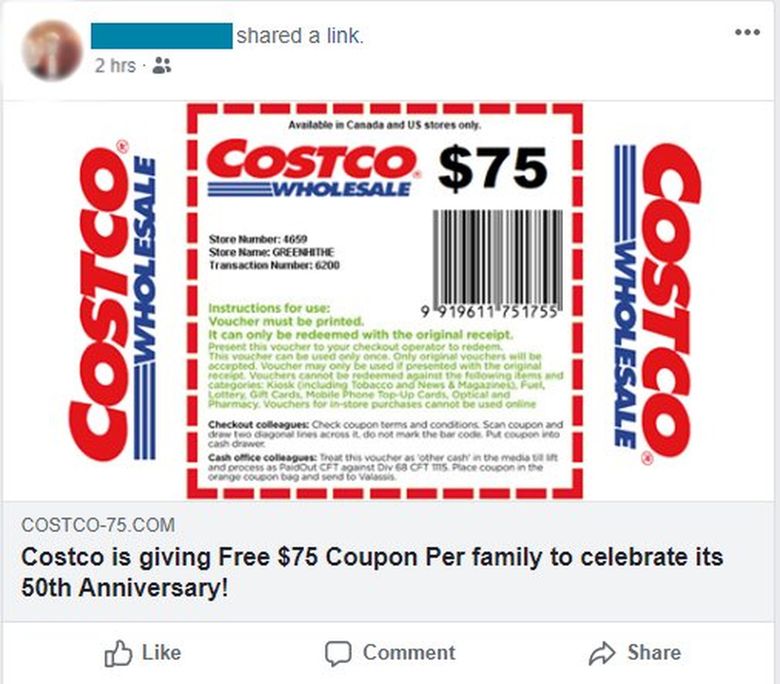
Everyone loves coupons and like many things in our lives, coupons which used to be found commonly in newspapers and magazines have migrated online. The Better Business Bureau has issued a warning about phony coupons appearing on social media. Among the companies affected by these phony coupons are Bath and Body Works, Costco, Aldi, Starbucks and Trader Joe’s. The particular coupon scam about which I am warning you today is a phony Costco $75 coupon that is turning up on Facebook and other social media. As I have warned you many times in the past, Facebook has become a hotbed for phony online coupons. The coupon looks quite legitimate which means nothing because it is very easy to copy the Costco logo and make the coupon appear to be genuine. The way that many phony coupon scams work is that in order to qualify for the coupon, you must complete a survey in which you are required to provide much personal information that is used to make you a victim of identity theft. In other versions of the scam, the scammer actually asks for your credit card numbers. In yet another version of the scam you are required to buy many costly items in order to claim your “free”coupon. Many of the coupon scams also require you to forward the coupon to friends which make the phony coupons look more legitimate when they are received by your friends. Ultimately, in all of these scams, the coupons are worthless and you get nothing, but the opportunity to become a victim of identity theft. Here is a copy of the coupon appearing online. It was provided by the Identity Theft Resource Center.
TIPS
If the coupon appears too good to be true, it usually is a scam. No company could cover the cost of giving away vast numbers of $75 coupons although sometimes, participants in legitimate surveys are promised a chance to win a coupon in a drawing. Facebook is a favorite venue for scammers perpetrating this type of scam because often unwary victims will unwittingly share the scam with their friends. One way to determine if a coupon is legitimate is to look for the expiration date found on most coupons. The phony Costco coupon like most phony coupons does not carry an expiration date. The best place to go to find out if a coupon is legitimate is to go to the company’s website to see what real coupons are being offered. Here is the link to the section of Costco’s website where all its legitimate coupons appear. https://www.costco.com/online-offers.html?COSTID=MVM_header
For those of you receiving the Scam of the day through an email, I just want to remind you that if you want to see the ever increasing list of Coronavirus scams go to the first page of the http://www.scamicide.com website and click on the tab at the top of the page that indicates “Coronavirus Scams.”
If you are not a subscriber to Scamicide.com and would like to receive daily emails with the Scam of the day, all you need to do is to go to the bottom of the initial page of http://www.scamicide.com and click on the tab that states “Sign up for this blog.”
Scam of the day – May 20, 2020 – Invitation to Free Coronavirus Scams Webinar
The pandemic of scams related to the Coronavirus pandemic is overwhelming for many people. Here at Scamicide, our purpose is to keep you informed about all of the latest scams and advise you as to how to avoid those scams. I will be presenting a free Webinar on Friday, May 22nd at 12:30 p.m. Eastern Time sponsored by Margolis and Bloom, the law firm with which I am affiliated. In this Webinar I will be telling you about the many Coronavirus related scams, how to recognize them and how to avoid being scammed. I hope many of you can join me.
Here is information about registering to attend the seminar.
Scam of the day – May 20, 2020 – Free Credit Reports for the Next Year
Your credit report is an important document that can affect not only your ability to get a loan, but even your ability to get a job, an apartment or insurance. Indications of identity theft often first turn up on your credit report where you can find out if someone has used your name to commit financial crimes which is why it is very important to regularly monitor your credit report. Federal law has long provided for you to be able to get a free copy of your credit report from each of the three major credit reporting agencies annually. This is an important thing for everyone to do to make sure their credit report is accurate and that you have not become a victim of identity theft which is often first noticed on your credit report.
Now in response to the Coronavirus pandemic, the three major credit reporting agencies, Equifax, Experian and TransUnion have agreed to provide weekly free credit reports to everyone through April of 2021.
Scammers use the free credit report law to scam you in two ways. “Legitimate” companies may offer you a free credit report, but if you read the fine print, you will learn that you also have signed up for services that you may not wish to have that the companies charge you for each month. True scammers will set up realistic looking websites that appear to offer a free credit report, but when you input the necessary information to obtain your free credit report, such as your Social Security number, you actually are providing it to an identity thief who uses the information to steal your identity.
TIP
Criminals often flunked grammar so one thing to look for to determine if you are on the legitimate website to obtain your free credit report is to look for misspellings and grammatical errors that scammers often make. Although the domain names for websites offering what appear to be free credit reports appear to be legitimate, the actual official free credit report website address where you can now get your free weekly credit reports through April of 2021 is https://www.annualcreditreport.com/requestReport/landingPage.action
I urge you to get your free credit reports and review them regularly.
For those of you receiving the Scam of the day through an email, I just want to remind you that if you want to see the ever increasing list of Coronavirus scams go to the first page of the http://www.scamicide.com website and click on the tab at the top of the page that indicates “Coronavirus Scams.”
If you are not a subscriber to Scamicide.com and would like to receive daily emails with the Scam of the day, all you need to do is to go to the bottom of the initial page of http://www.scamicide.com and click on the tab that states “Sign up for this blog.”
Scam of the day – May 19, 2020 – US Tech Support Phishing Email
US Tech Support is a real company that provides tech support for your computer, however the email reproduced below which was sent to us by a Scamicide reader is not from US Tech Support, but instead is a phishing email designed to make you believe that there is an emergency that requires your immediate attention. Anyone receiving this email who was not a customer of US Tech Support would be tempted to call the telephone number found in the email to cancel. If you call the phone number listed in the email, which, by the way, is not a telephone number used by US Tech Support, you will be asked for personal information that will be used to make you a victim of identity theft. Here is a copy of the email presently being circulated. the email address from which it was sent and the telephone number you are urged to call have both been altered for security purposes.
| Subject: | Friendly Reminder |
|---|---|
| Date: | Thu, 14 May 2020 12:31:54 -0000 |
| From: | US Tech Support <**********@gmail.com> |
Auto Renewal Reminder
Dear Member,
Your US Tech Support Protection Plan Membership is set to renew on May 14 2020.
Because your account is set to auto-renew, we will automatically process charge on May 15 2020.
You do not need to take any action, we just wanted to let you know.
Thanks for your continued support and have a great day.
To cancel please reach us at 786 633 **** to discontinue.
Note:- THIS IS SYSTEM GENERATED EMAIL. ANY REPLY TO THIS EMAIL WILL NOT CANCEL YOUR MEMBERSHIP. PLEASE REACH US TO CANCEL.
Kind Regards,
US Tech Support
Customer Service
Phone – 786 633 ****
Mon-Sat : 10:00 AM – 04:00 PM (EST)
Sunday Closed
@Copyright Reserved US Tech Support LLP
TIPS
While it can often be difficult to determine whether an email is legitimate or a phishing email, this particular phishing email has a large number of indications that it is phony starting with the email address from which it was sent. The email address of the sender has no relation to US Tech Support and is most likely the email address of someone whose computer was hacked and made a part of a botnet of zombie computers used to send out spam and phishing emails such as this. Another indication that this is a scam is that the email neither refers to the person receiving the email by name nor does it contain an account number. These are both indications that the email is one that is being sent to vast numbers of people. The phone number listed is not that of US Tech Support. This was ascertained by going to the website of the real US Tech Support.https://www.ustechsupport.com/customer-support.html It is also curious that a company based in California would list its hours specifically in Eastern Time. Finally, the copyright notice is incorrect. US Tech Support is the registered trademark of Real Defense LLC. There is no US Tech Support LLP.
If you ever receive an email similar to this, you should not trust it. If you think it might be legitimate, merely go to the real company’s website where you can find contact information you can use to determine if the communication you received was a scam.
For those of you receiving the Scam of the day through an email, I just want to remind you that if you want to see the ever increasing list of Coronavirus scams go to the first page of the http://www.scamicide.com website and click on the tab at the top of the page that indicates “Coronavirus Scams.”
If you are not a subscriber to Scamicide.com and would like to receive daily emails with the Scam of the day, all you need to do is to go to the bottom of the initial page of http://www.scamicide.com and click on the tab that states “Sign up for this blog.”
Scam of the day – May 18, 2020 – Secret Service Uncovers Massive Unemployment Compensation Scam Ring
Even before the Coronavirus pandemic, unemployment benefit scams were already a major problem costing the states and federal government billions of dollars each year. Part of the problem is that the federal government requires the states to pay claims within a few weeks even if the employer has not responded to confirm that the applicant for unemployment benefits is indeed eligible for those benefits. As with so many identity theft crimes, this one starts with the theft of someone’s Social Security number. Armed with that ammunition, the identity thief then applies on line for unemployment benefits, which are often paid before the legitimacy of the claim is confirmed. In this way, this crime is similar to income tax identity theft where the IRS often pays out bogus refunds before comparing the W-2s and 1099s submitted by employers with the information submitted by the identity thief filing the phony tax return. The payments are generally made by debit cards or direct deposit into bank accounts controlled by the identity thieves which make this crime simple to accomplish.
More than thirty- six million people have recently lost their jobs due to the Coronavirus pandemic leaving state unemployment offices often overwhelmed in dealing with new applications. Many states do not have the proper controls in place to properly screen applications and other states may be not be as stringent in following their own rules in an effort to speed up the sending of funds to needy applicants for benefits. A recent private memorandum from the Secret Service indicates that a sophisticated fraud ring based in Nigeria is using stolen Social Security numbers and other personal information to file phony applications for unemployment benefits in large numbers in Washington, Florida, Massachusetts, North Carolina, Oklahoma, Rhode Island and Wyoming and it can be expected that this scam will be spreading to other states as well. According to the Secret Service, “a substantial amount of the fraudulent benefits submitted have used Personal Identifying Information (PII) from first responders, government personnel and school employees.” The potential losses to this scam are estimated to already be in the hundreds of millions of dollars. In many instances, according to the Secret Service, the scammers are having the unemployment payments sent to the accounts of “mules” who are people acting as intermediaries who then forward the funds to the scammers as a way of laundering the illegally obtained funds. Sometimes the mules may be unwitting accomplices who are victims themselves of romance scams and forwarding the money to people they think they are having a relationship with. Other times the mules may have answered an advertisement for a work at home job in which they are told a part of their job is to forward funds sent to them.
TIPS
If you are still employed, but have received letters or other communications from your state’s unemployment office, your identity may have been used in this scam and you should report this to your state’s unemployment office right away. Additionally, if you have been a victim of this scam, your Social Security number is in the hands of a criminal. It may be used for other criminal purposes so you should get a copy of your credit report from each of the three credit reporting agencies to look for any irregularities and you should freeze your credit if you have not already done so.
Here is the link to use to get a free copy of your credit reports https://www.annualcreditreport.com/index.action
To get the maximum protection from identity theft, it is important to freeze your credit at each of the three major credit reporting agencies. Here are links to each of them with instructions about how to get a credit freeze:
https://www.freeze.equifax.com/Freeze/jsp/SFF_PersonalIDInfo.jsp
https://www.transunion.com/credit-freeze/place-credit-freeze
https://www.experian.com/freeze/center.html
Once you have frozen your credit, be sure to keep the PIN and information on how to unfreeze your credit report in a safe place.
I also urge you to regularly go to the website https://haveibeenpwned.com/ where you can insert your email address and find what data breaches may have compromised your information.
In addition, don’t unwittingly become an accomplice to this crime. Work at home scams in which you are asked to receive money and send it on to someone else are always money laundering scams.
For those of you receiving the Scam of the day through an email, I just want to remind you that if you want to see the ever increasing list of Coronavirus scams go to the first page of the http://www.scamicide.com website and click on the tab at the top of the page that indicates “Coronavirus Scams.”
If you are not a subscriber to Scamicide.com and would like to receive daily emails with the Scam of the day, all you need to do is to go to the bottom of the initial page of http://www.scamicide.com and click on the tab that states “Sign up for this blog.”
Scam of the day – May 17, 2020 – Nursing Homes Improperly Taking CARES Act Stimulus Checks
Recently, the Treasury Department announced that it had electronically sent more than 200 billion dollars of CARES Act stimulus payments to approximately 130 million Americans in the program’s first four weeks. Payments under the CARES Act are determined in the vast majority of instances by the information contained on your 2019 income tax return or if you have not filed a 2019 income tax return yet, by your 2018 income tax return. These tax returns are being used to determine both the amount of the stimulus check that you shall receive, which can be as much a $1,200 per person, as well as to where the stimulus payment will be made. People who had provided their bank account number and bank’s routing number to the IRS as a part of their federal income tax return had their payments sent to their bank accounts electronically. After May 13th the federal government began sending paper checks to those people qualifying for the stimulus checks that did not provide bank account information to the IRS. It is expected that people will be receiving their paper checks in the mail beginning in late May and into June.
Two days ago the Federal Trade Commission (FTC) issued an alert informing people that some nursing homes and assisted living facilities around the country have been requiring their residents who are on Medicaid to turn over their CARES Act stimulus checks to the nursing home or assisted living facility. These facilities argue that these payments are countable resources under Medicaid rules and must be applied toward the cost of the resident’s nursing home or assisted living services. This is categorically false. As the FTC has indicated, the stimulus checks are considered as tax credits which are not countable resources under Medicaid rules.
TIPS
If a family member of yours is a Medicaid recipient in a nursing home or assisted living facility and has had his or her check taken by the facility you should demand that the funds be returned. If the facility resists returning the money, contact your state Attorney General for assistance. They are ready to help. Here is a link to how you contact your state’s attorney general. https://www.naag.org/naag/attorneys-general/whos-my-ag.php
As for other scams related to your CARES Act stimulus payment, be aware that scammers are still quite active in using the CARES Act stimulus payments as a basis for many scams. Trust me, you can’t trust anyone. Whenever you are contacted on the phone, by email or text message, you cannot be sure who is really contacting you. Even if your Caller ID indicates the call is from a legitimate federal agency such as the Treasury Department, it is easy for a scammer to “spoof” that number and make it appear on your Caller ID as if the call is legitimate when it is not. Neither the IRS, the Treasury Department or any other federal agency will be contacting you by phone, email or text message about the stimulus checks. Anyone contacting you by phone, email or text message indicating that he or she is a federal employee is a scammer. Also, if you are going to use the Get My Payment portal to check on the status of your payment, make sure that you are using the correct portal. Scammers are adept at constructing websites that look identical to the Get My Payment portal in order to steal your personal information and use it to make you a victim of identity theft.
Another good indication that you are being contacted by a scammer in regard to your CARES Act payment is that the official name of the payment is your Economic Impact Payment. Any communication purporting to be from the federal government that refers to the payment by any other name is an obvious scam.
For those of you receiving the Scam of the day through an email, I just want to remind you that if you want to see the ever increasing list of Coronavirus scams go to the first page of the http://www.scamicide.com website and click on the tab at the top of the page that indicates “Coronavirus Scams.”
If you are not a subscriber to Scamicide.com and would like to receive daily emails with the Scam of the day, all you need to do is to go to the bottom of the initial page of http://www.scamicide.com and click on the tab that states “Sign up for this blog.”
Scam of the day – May 16, 2020 – Coronavirus Meets Nigerian Email Letter
Today’s Scam of the day is another version of the Nigerian email scam that continues to plague the online community. Although it may seem that the Nigerian email scam began in the era of the Internet, the basis of the scam actually goes back to 1588 when it was known as the Spanish Prisoner Scam. In those days, a letter was sent to the victim purportedly from someone on behalf of a wealthy aristocrat who was imprisoned in Spain under a false name. The identity of the nobleman was not revealed for security reasons, but the victim was asked to provide money to obtain the release of the aristocrat, who, it was promised, would reward the money-contributing scam victim with a vast reward that included, in some circumstances, the Spanish prisoner’s beautiful daughter in marriage.
In the most common version of this scam, you are promised great sums of money if you assist a Nigerian or someone elsewhere in his effort to transfer money out of his country. Variations include the movement of embezzled funds by corrupt officials, a dying gentleman who wants to make charitable gifts or a minor bank official trying to move the money of deceased foreigners out of his bank without the government taking it. The example below of the email recently received by a Scamicide reader involves a gift from the Qatar Foundation International to the “lucky” beneficiary of a payment to help “ease the financial burden caused by the COVID-19 (Coronavirus) global pandemic.” In all the variations of this scam, although you are told initially that you do not need to contribute anything financially to the endeavor, however, you soon learn that it is necessary for you to contribute continuing large amounts of money for various reasons, such as fees, bribes, insurance or taxes before you can get anything. Of course, the victim ends up contributing money to the scammer, but never receives anything in return. This particular version of the scam email contains numerous indications that it is a scam. It is not addressed to you by name and while the Qatar Foundation International is a legitimate organization, it has absolutely nothing to do with the type of payments described in the email. Unfortunately, some people allow their greed to overcome their good sense and become victims of this scam.
Here is a copy of the email presently being circulated:
Dear Beneficiary
This is to inform you that you have been picked as one of the lucky beneficiaries to receive a financial relief fund/payment from the Qatar Foundation International to help ease the financial burden caused by the COVID-19 (Coronavirus) global pandemic
To collect the funds allocated to you, kindly send an email to alliancexxxxxx@xxxxx.com for more information. Congratulations
Yours Sincerely,
Dr. Sheikha Moza bint Nasser.
President
Qatar Foundation.
5825 Al Luqta Street
TIPS
This is a simple scam to avoid. It preys upon people whose greed overcomes their good sense. If you receive such an email, the first thing you should ask yourself is how does this possibly relate to you and why would you be singled out to be so lucky to be asked to participate in this arrangement. Since there is no good answer to either question, you should merely hit delete and be happy that you avoided a scam. Often, as in this case, the emails are sent from an email address that has no relation to the purported sender which is an indication that the email is being sent through a botnet of hacked computers. In addition, it is important to note that nowhere in this particular version of the scam email is your name mentioned. The scam email is obviously being sent out as a mass mailing.
Many people wonder why cybercriminals and scammers send out such ridiculously obvious scam letters that anyone with an ounce of sense would recognize as a scam, but that may be intentional on the part of the scammer because if someone responds to such an email, they are more likely to fall prey to the scam without much effort by the scammers.
For those of you receiving the Scam of the day through an email, I just want to remind you that if you want to see the ever increasing list of Coronavirus scams go to the first page of the http://www.scamicide.com website and click on the tab at the top of the page that indicates “Coronavirus Scams.”
If you are not a subscriber to Scamicide.com and would like to receive daily emails with the Scam of the day, all you need to do is to go to the bottom of the initial page of http://www.scamicide.com and click on the tab that states “Sign up for this blog.”