
Scam of the Day
Scam of the day – December 6, 2025 – Utility Bill Scams Surge: Dominion Energy Issues Warning Amid Cold Weather
With the return of cold weather throughout much of the United States there has been a dramatic increase in telephone scams involving scammers posing as utility company customer service representatives demanding payments and threatening to turn off electrical power if a payment is not made immediately. Scams involving utility bills for electric, water, oil or gas services have long been popular with scammers. These scams have multiple variations.
Recently Dominion Energy, a Virginia utility company that provides electricity and natural gas issued a warning about these scams.
In one common utility scam, potential victims receive telephone calls purportedly from their utility company informing them of a special company promotion for which they are eligible. They just need to provide some personal information. This, of course leads to identity theft.
In another version of the utility scam, potential victims are called on the phone and told that their utility service will be terminated for non-payment unless they pay by credit card, debit card. Zelle, Venmo or gift cards. A demand for payment by way of a gift card is a good sign that you are dealing with a scammer since legitimate utility companies never require payments or accept payments through git cards. You also should never pay for a business bill through Zelle or Venmo because of the lack of protections from fraud.
In a third version of this scam, potential victims receive an email that has a link to take them to their bill, but if you click on the link, you either download malware or are prompted to provide information that will be used to make you a victim of identity theft.
TIPS
You can never be sure when you get an email, text message or a telephone call if it is really from a legitimate source. Email addresses can be hacked to appear legitimate and even if you have Caller ID, a scammer can use a technique called “spoofing” to make it appear that the call is from a legitimate caller. Trust me, you can’t trust anyone. Never provide personal or financial information to anyone in response to a telephone call, text message or email until you have independently confirmed that the communication was legitimate.
In the case of a utility bill, merely call the number on the back of your bill and you will be able to confirm whether or not the communication was legitimate. Also, never click on links unless you have confirmed that they are legitimate. The risk is too great. It is also important to remember that no legitimate utility company will require you to immediately pay your bill over the phone through a gift card or ask you to pay by cryptocurrencies.
If you are not a subscriber to Scamicide.com and would like to receive free daily emails with the Scam of the day, all you need to do is sign up for free using this link. https://scamicide.com/scam-of-the-day/
Scam of the day – December 5, 2025 – FBI Warns of Gold Bar Scams and Rising Fraud Cases
Earlier this Fall, I told you that the Boston office of the FBI had issued a warning scams involving people lured under false pretenses to cash in their savings, buy gold bars and deliver the gold to scammers. Also earlier this year ABC News did a story entitled “Gold Grifters” also exposing these scams. I have been warning people about this scam since I described it in the Scam of the day for May 7 2024 when I told you about Ravinkle Mathon who was convicted in Maryland of attempting to scam an elderly man out of $200,000 in an elaborate scam that has increased dramatically in the last year. The scam began with a phone call from Mathon to an elderly man in which Mathon posed as a federal agent telling the targeted victim that his identity had been stolen and that he needed to protect his savings by withdrawing all of his funds, purchasing gold with the funds and then turn the gold over to the alleged scammer for safe keeping. Fortunately, a family member of the targeted victim became aware of the scam and notified police who set up a sting and arrested Mathon when he came to collect the gold..
Now two men in Wisconsin have been charged with operating a similar scam in which they convinced an elderly woman that her bank account had been hacked and used for criminal purposes and that she needed to cash in her life savings, use it to purchase gold and turn it over to the scammers who posed as federal agents.
With the value of gold increasing, scammers have increasingly turned to this type of scam which according to the FBI resulted in losses of $126 million in 2024. According to the FBI, many of the perpetrators of this crime are foreigners who have little difficult leaving the country with gold bars.
TIPS
The primary thing to keep in mind in order to avoid this scam is to remember that no government agency or legitimate business will ever request that you purchase gold or other precious metals for any purpose and certainly not to protect them from criminals nor will they tell you that you need to provide the gold to government agents for safekeeping.
If you are not a subscriber to Scamicide.com and would like to receive free daily emails with the Scam of the day, all you need to do is to go to the bottom of the initial page of http://www.scamicide.com and insert your email address where it indicates “Sign up for this blog.”
Scam of the day – December 4, 2025 – Holiday Toy Scams: How to Avoid Fake Online Deals and Protect Your Money
The holiday shopping season is in full swing and every year there are a few toys that are in especially high demand. Often it is difficult to find these toys and the prices when you do manage to find them can be pretty expensive which is why so many people are susceptible to being scammed by criminals offering to sell these desirable toys on line at bargain prices. People falling for this scam end up both not getting the toy that they thought they ordered and losing their money in the process. This year’s most sought after toys include Po the AI Story Bear an AI powered plush toy that tells stories. Scammers are setting up phony retail websites and social media ads to lure people into this scam. Often scammers target people by using AI to track their search behavior to find vulnerable scam victims.
TIPS
As always, if it sounds too good to be true, it usually is, so you should be particularly skeptical when you find an online seller of a highly in demand toy for a dramatically discounted price. Always use a credit card when you buy anything online or in a brick and mortar store because of the strong consumer protection laws that protect you from liability in the event of a scam. When you use your debit card, you do not get the same strong protections from fraud. Scammers also often require payment through cryptocurrencies or wired funds which is a red flag for a scam.
You are better off dealing with reputable retailers with which you are familiar, but even then you should make sure when you buy anything online that you are dealing with the real retailer and not a counterfeit website set up by a scammer. You can confirm whether or not the website is legitimate by going to the website whois.com where you can find out who owns the particular website. If you find that the website which appears to be WalMart is owned by someone in Nigeria, for example, you can be sure that it is a scam. It is important to remember that even if you get the URL for a popular retailer’s website through a Google or other search engine search, it does not mean that the website they are sending you to is a legitimate site. Sophisticated scammers can manipulate the algorithms used by search engines to enable their phony websites to be ranked high in a search.
Don’t click on social media ads even if they appear to be ads from legitimate retailers with which you are familiar. The risk of the ad being from a scammer is too great. Instead go to the website of the real retailer.
If you are not a subscriber to Scamicide.com and would like to receive daily emails with the Scam of the day, all you need to do is to go to the bottom of the initial page of http://www.scamicide.com and type in your email on the tab that states “Sign up for this blog.”
Scam of the day – December 2, 2025 – Holiday Job Scams: How to Spot Fake Job Ads and Protect Your Identity
Phony advertisements for non-existent jobs that lure people into either giving the scammer money or personal information that can be used for purposes of identity theft have been a common scam for many years, but particularly during the holiday season when many companies are looking for seasonal workers, the scam gets worse. Scammers use ads on job sites, social media, newspapers and even television and radio, the same platforms used by legitimate employers to attract their victims. Sometimes the scammers use the names of legitimate companies and sometimes they make up phony companies just for the purpose of offering phony jobs through these companies.
According to the FBI, which has warned about the increasing frequency of job scams, the scammers often first set up a phony website that appears to be that of a legitimate company with which you might be familiar. They then post the phony job opportunity on legitimate job sites and direct the job applicants to the phony website These scammers will do interviews of prospective employees in much the same way that real companies do to make their scam appear legitimate, however, unlike legitimate job interviews, the interviews done by scammers are generally relatively short and don’t require repeated interviews before the targeted victim of the scam gets “hired.” At that point, the scammer then requests personal information such as your Social Security number which a legitimate employer would also do which is one reason this scam is so dangerous. They also may ask for money or your credit card number to pay for background investigations or equipment for the company which legitimate businesses do not do.
TIPS
Although LinkedIn, Indeed and other websites that carry job postings try to identify and either prevent or remove phony ads from appearing on their websites, you cannot depend on these companies to fully protect you. Trust me, you can’t trust anyone. Certainly a little skepticism helps when you see a job posting for a job that sounds too good to be true. Ads that ask for you to pay upfront costs for any reason should be considered to be a scam as well as any company that requests your credit card information for any reason whatsoever.
To check on the legitimacy of photographs in these ads you can do a reverse image search using Google or websites such as tineye.com. You can also check to see if the wording of the advertisement has been used elsewhere by merely copying a substantial amount of the text into your search engine and see what comes up. Also, research the company itself to determine if it is a legitimate company. Check out the website of the company supposedly offering you a job to see if the legitimate company is offering such a job. Make sure you are using a domain name that you have confirmed is legitimate and not just the one contained in the email sent to you by the scammer. If the job doesn’t appear on the real company’s website, you know it is a scam. It also is a good idea to confirm any job offer you might receive with the HR department of the real company before providing personal information such as your Social Security number.
If you are not a subscriber to Scamicide.com and would like to receive daily emails with the Scam of the day, all you need to do is sign up for free using this link. https://scamicide.com/scam-of-the-day/
Scam of the day – December 1, 2025 – Porch Pirates and Package Theft: How to Protect Your Deliveries This Holiday Season
The popularity of online shopping has brought a dramatic increase in the number of packages delivered by companies such as UPS and Federal Express. The popularity of online shopping has also resulted in a new term entering the lexicon in recent years, namely, “porch pirate,” which is the name given to criminals who cruise through neighborhoods looking for packages to steal that have been left on the doorsteps of homes by delivery services. It has been estimated that more than 104 million packages will be stolen from their front doorsteps this year Fortunately, there are a number of steps you can take to protect yourself from becoming a victim of this crime.
TIPS
If you are not going to be home at the expected time of a delivery, an easy solution is to either have the package delivered to your place of work or have a neighbor who will be home be on the lookout for deliveries to your home. You also can request that all deliveries require a signature, although this can slow down the delivery process if you aren’t home and end up requiring you to drive to a distribution center if repeated attempts at delivery are thwarted because no one is home to sign for the package.
Another option for protecting yourself is renting a locker at a local package receiving center. These can be found in most big cities. One of the companies that provide this service in New York City is https://www.golocker.com/ You also can rent an Amazon Locker where your Amazon deliveries can be sent. https://www.amazon.com/gp/help/customer/display.html?nodeId=GXCWH4CXLKJD8Z52
Amazon Prime also offers Key In-Garage Delivery which is a simple and secure way to have Amazon deliveries delivered to your garage if you are not home. Here is a link with more information:https://bit.ly/49F58UQ
If you are not a subscriber to Scamicide.com and would like to receive daily emails with the Scam of the day, all you need to do is to go to the bottom of the initial page of http://www.scamicide.com and type in your email address on the tab that states “Sign up for this blog.”
Scam of the day – November 30, 2025 – Holiday Charity Scams: How to Spot Fake Police and Fire Department Solicitations
The holiday season is now in full swing. This is a time when many people give to charities. In particular, you will most likely be contacted by numerous people soliciting charitable contributions on behalf of organizations purporting to support the brave men and women who make up our police and fire departments. Unfortunately, many of those solicitations will be from scammers merely looking to steal money under false pretenses. Whenever you are solicited by email or phone, you can never be sure who is really contacting you. In addition, even if you are on the Federal Do No Call List, the law permits charities to call you, however, unfortunately you can never be sure when you receive a call that purports to be from a charity whether the call is legitimate or not. Similarly when you receive a text message or email solicitation for a charity, you have no way of knowing if the solicitation is from a scammer or a legitimate charity.
TIPS
Whenever you get an email, call or a text message, you can’t be sure as to who is really contacting you. Even if the call appears to come from your local police department, scammers can manipulate your Caller ID through a technique called “spoofing” to make it appear that the call is legitimate when it is not and email addresses used by scammers can also appear legitimate. If you think the email, call or text message may be legitimate, merely contact your local police department at a telephone number you know is legitimate to determine whether or not the email, call or text message was a scam.
Phony charities often have names that sound legitimate and it is difficult to know merely from a solicitation whether or not the charity is a fake. Other times, scammers will use the name of a legitimate charity when they solicit you by phone, email or text message and you can never be sure when you are contacted by email or text message whether or not the solicitation is legitimate. Prior to giving to any charity, I suggest you first look into whether indeed the charity is legitimate or not and the best way I know to do that is to go to http://www.charitynavigator.org where not only can you find out whether the charity is a scam, but also whether or not your donation will be tax deductible, how much of your donation goes toward the charitable purposes of a legitimate charity and how much goes toward salaries, administrative costs and fund raising. Charitynavigator.org will also give you access to the websites and phone numbers of legitimate charities you may wish to consider giving to so you can feel confident when you make a gift that it is going to the right place.
If you are not a subscriber to Scamicide.com and would like to receive daily emails with the Scam of the day, all you need to do is sign up for free using this link. https://scamicide.com/scam-of-the-day/
Scam of the day – November 29, 2025 – Beware Holiday Delivery Scam Emails: How to Spot Fake Refund Offers
The holiday shopping season is in full swing and many people are doing their shopping online which means that their packages will be delivered by the United States Postal Service, Federal Express, UPS or Amazon. With so many packages being delivered at this time of year, it is inevitable that some packages will be delayed. In this case, scammers, posing as the United States Postal Service, Federal Express and UPS and Amazon are contacting people apologizing for the delay in receiving their orders and offering a refund of their money. The emails contain a link for you to click on to process your claim for a refund, but unfortunately, if you click on the link either you will automatically download harmful malware or you will be prompted to provide information that will be used to make you a victim of identity theft.
TIPS
As always, the first thing you should look at when you get such an email is the address from which it was sent. In many instances the email address of the sender has no relation to the United States Postal Service, Federal Express, UPS or Amazon. Often the email is that of someone whose email account has been hijacked by the scammer and made a part of a botnet of zombie computers used to send out such phishing emails. However, in other instances, the email address may appear legitimate. But remember my motto, “trust me, you can’t trust anyone.” Even if the email address of the sender looks legitimate, you should never click on a link unless you have absolutely confirmed that the email is legitimate. In this case it is important to remember that none of these companies are contacting people by email or text messages offering refunds.
For information about refunds for late deliveries of UPS use this link https://www.ups.com/no/en/support/shipping-support/legal-terms-conditions/ups-service-guarantee.page
For information about refunds for late deliveries of Federal Express use this link https://www.fedex.com/en-us/service-guide/money-back-guarantee.html
For information about refunds for late deliveries of Amazon use this link https://www.amazon.com/gp/help/customer/display.html?nodeId=GZ5R2Y8QHENSLW75
If you are not a subscriber to Scamicide.com and would like to receive daily emails with the Scam of the day, all you need to do is sign up for free using this link. https://scamicide.com/scam-of-the-day/
Scam of the day – November 28, 2025 – How to Protect Your Cryptocurrency Wallet from Scams: Essential Security Tips
I have been writing about cryptocurrency scams for years. There a variety of scams that attempt to steal your cryptocurrencies from you. One of the most important decisions anyone should make when deciding whether to invest in cryptocurrencies is what kind of a wallet they will hold their investment in. Many cryptocurrency scams involve people being tricked into turning over access to their cryptocurrency wallets and losing all of their funds.
Your digital wallet is where the key that allows you to access your cryptocurrency account is found. If your key falls into the hands of a hacker, you can easily lose all of your cryptocurrency account so it is of paramount importance to secure your digital wallet. Digital wallets can either be hot wallets or cold wallets. Hot wallets are connected to the Internet which makes them more susceptible to being hacked which is why a cold wallet which is not connected to the Internet, but rather is is kept in a portable hard drive is your best bet.
TIPS
When doing cryptocurrency transactions online, use a Virtual Private Network (VPN) to provide encryption for your communications which will make the transactions more secure and refrain from using public WIFI for cryptocurrency transactions. Use a strong, complex password for your account and consider using a password manager or store your password on a portable hard drive that you keep in a secure spot.
Use dual factor authentication for your account for additional security, however, it is important to note that many cryptocurrency thefts have occurred when hackers were able to defeat dual factor authentication through SIM swapping whereby they contact the cell phone service provider of their victim, answer a security question and manage to get the cell phone service provider to switch the phone number of the victim to a phone controlled by the criminal thus defeating the dual factor authentication.
The best thing you can do to protect your SIM card from being swapped is to set up a PIN or password to be used for access to your mobile service provider account. This will help prevent a criminal from calling your carrier posing as you and convincing your mobile carrier to swap your SIM card to the criminal’s phone merely by providing personal identifying information or answering a security question.
Finally, I strongly urge anyone considering investing in cryptocurrencies as well as any investment to research the investment thoroughly before investing. No one should ever invest in anything they do not fully understand.
If you are not a subscriber to Scamicide.com and would like to receive daily emails with the Scam of the day, all you need to do is sign up for free using this link. https://scamicide.com/scam-of-the-day/
Scam of the day – November 27, 2025 – Does the Social Security Administration Suspend Your SSN? The Truth About SSA Scams
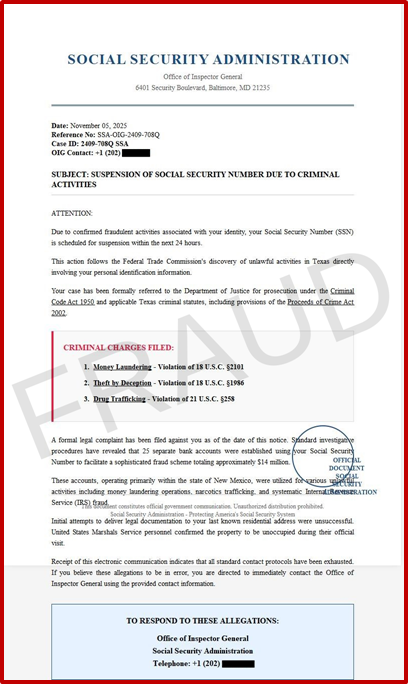
The Social Security Administration has issued a warning about an imposter scam presently circulating in which scammers receive an email with the subject line of “Alert: Social Security Account Issues Detected” with an attachment such as the one appearing below which purports to inform the targeted victim that his or her Social Security number will be suspended within 24 hours and their case referred for criminal prosecution. The letter provides a phone number to call to remedy the situation. If you call the number, a scammer posing as a Social Security representative will answer and require you to provide personal information and make a payment to resolve the situation.
Unfortunately, using AI it is a simple matter for a scammer to create an official appearing letter such as the one reproduced below.
TIPS
The first thing to note is that the Social Security Administration never suspends a Social Security number so immediately you can recognize this email as a scam. The Social Security Administration will never call, email or text you to threaten suspension of your Social Security number and they do not demand immediate payment for purported offenses. Nor, unlike scammers, do they demand payment by gift cards, wire transfers or cryptocurrencies. Only scammers demand payment by these methods.
If you are not a subscriber to Scamicide.com and would like to receive daily emails with the Scam of the day, all you need to do is to go to the bottom of the initial page of http://www.scamicide.com and type in your email address on the tab that states “Sign up for this blog.”