
Scam of the Day
Scam of the day – October 10, 2020 – FTC Chairman Impostor Emails
Impostor scams have long been among the most lucrative for scammers. While there are many variations of this scam, the most common variations have involved scammers calling their intended victims on the telephone posing as some governmental agency such as the IRS or the Social Security Administration. The scammer then, under a wide variety of pretenses, demands an immediate payment by gift cards, credit card or wired funds. Being asked to pay by gift cards is a definite indication that the call is a scam since no governmental agency requests or accepts payments by gift cards. Alternatively, the scammer demands the victim supply the phony governmental agent with personal information such as your Social Security number which will then be used for identity theft purposes.
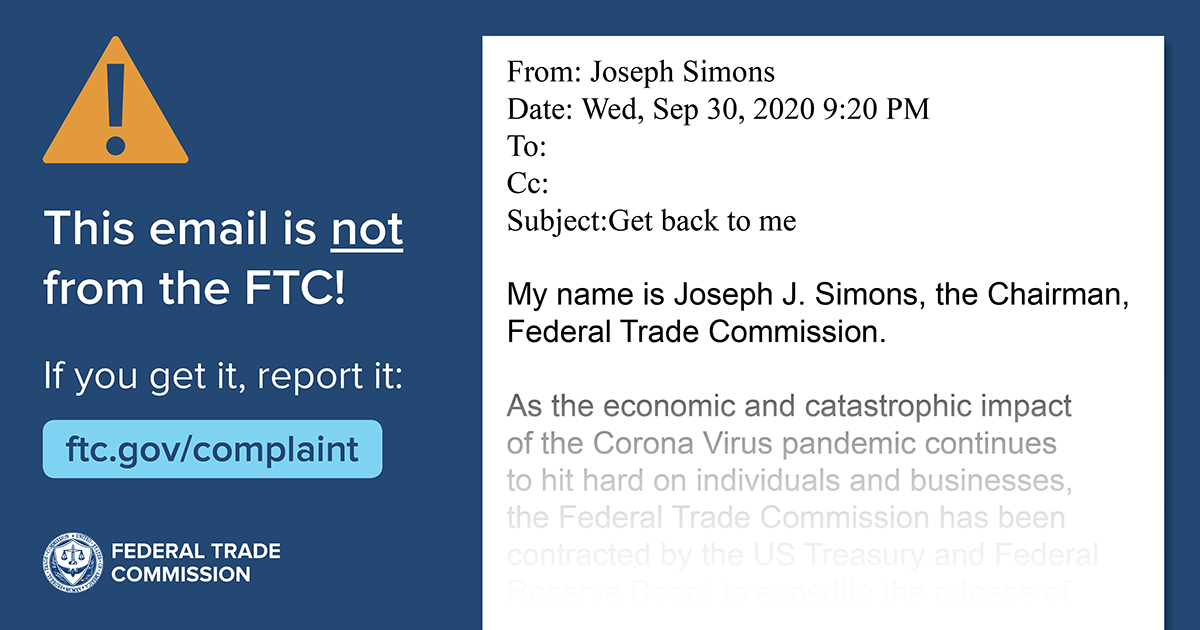
Recently, the Federal Trade Commission (FTC) warned people to be wary of emails that are being sent that appear to come from Joseph Simons, the Chairman of the FTC in which you are told that the fTC has relief funds for you related to the Coronavirus pandemic. You are asked to provide personal informaiton such as your birth date, home address or Social Security number that the criminal posing as Chairman Simons will use to make you a victim of identity theft.
Here is a copy of a recent email purporting to be from FTC Chairman Simons:
TIPS
As I have often reminded you, through the simple technique of “spoofing” it is very easy for a scammer to manipulate your Caller ID to make a call coming to you appear legitimate when it is not. Therefore you can never truly trust your Caller ID. Trust me, you can’t trust anyone. Never provide personal information to anyone who calls you unless you have absolutely confirmed that it is legitimate. In regard to the scam emails that appear to come from the FTC chairman, it is important to remember that the FTC will never send you an email asking for personal information such as your bank account, credit card number or Social Security number. The FTC also won’t ask you for your birth date or cell phone number and they will never contact you by phone, email, text message or letter asking you to pay for anything.
For those of you receiving the Scam of the day through an email, I just want to remind you that if you want to see the ever increasing list of Coronavirus scams go to the first page of the http://www.scamicide.com website and click on the tab at the top of the page that indicates “Coronavirus Scams.” Scamicide was recently cited by the New York Times as one of three top sources for information about Coronavirus related scams.
If you are not a subscriber to Scamicide.com and would like to receive daily emails with the Scam of the day, all you need to do is to go to the bottom of the initial page of http://www.scamicide.com and click on the tab that states “Sign up for this blog.”
Scam of the day – October 9, 2020 – Dangers in the Unsubscribe Tab
It you are like me, you probably are receiving a lot of emails that you don’t wish to read and which merely clutter your inbox. An easy way to reduce the amount of emails you receive is to merely click on the Unsubscribe tab in newsletters and other communications sent to you by companies with which you have done business and doing so is safe to do. However, when you receive an email from a company or some other entity that you have not done business with or agreed to have send you material, clicking on the unsubscribe tab they provide could lead to a lot of problems. A long, long time ago in a galaxy far away (Yes, a Star Wars reference) spammers would send you unsolicited communications and provide an unsubscribe tab in an effort to get you to confirm that yours was a legitimate email address. They would then sell your email address to other spammers and your unwanted emails would dramatically increase. Now, however, the problems that you can get into by clicking on an unsubscribe tab sent by a cybercriminal can be much worse. If the unsubscribe tab takes you to a website to provide information in order to unsubscribe you may unwittingly be providing the cybercriminal with a variety of information that he or she can use to make you a victim of many scams. Information such as your location, what typeof browser you are using and the operating system of your computer or other electronic device can be used by cyberiminals to fashion spear phishing emails to lure you into clicking on links and downloading a wide variety of malware such as ransomware or keystroke logging malware that can lead to your becoming a victim of identity theft. Even worse, in some instances, merely clicking on the link to unsubscribe may itself download malware on to your computer, tablet or phone.
TIPS
Remember my motto, “trust me, you can’t trust anyone.” While it is safe to click on the “unsubscribe” tab in a newsletter or other communication sent to you by a legitimate company you have done business with, the risk of clicking on a link to unsubscribe in the email of someone or some company with which you are not familiar is too great. Fortunately, there is an easy way to rid yourself of these unwanted emails. Instead of clicking on the link to unsubscribe, mark the message as spam in your email program. This will cause future messages from the same sender being automatically sent to your spam folder.
For those of you receiving the Scam of the day through an email, I just want to remind you that if you want to see the ever increasing list of Coronavirus scams go to the first page of the http://www.scamicide.com website and click on the tab at the top of the page that indicates “Coronavirus Scams.” Scamicide was recently cited by the New York Times as one of three top sources for information about Coronavirus related scams.
If you are not a subscriber to Scamicide.com and would like to receive daily emails with the Scam of the day, all you need to do is to go to the bottom of the initial page of http://www.scamicide.com and click on the tab that states “Sign up for this blog.”
Scam of the day – October 8, 2020 – Anthem Pays 39.5 Million Dollars to Settle State Attorneys General Claim
I first reported to you about the huge data breach at Anthem, a major health care company in February of 2015 when it was initially discovered. The data breach affected 78.8 million patients and employees. The data stolen included birth dates, Social Security numbers and other information putting the victims in extreme danger of identity theft. In response to the data breach Anthem offered free identity theft repair and credit monitoring services to current or former members of Anthem plans going back to 2004. A class action filed by people affected by the data breach was settled and approved by a judge in 2018. Here is a link to helpful information about the settlement if you were one of the victims of the data breach. https://www.databreach-settlement.com/
In 2019 two Chinese citizens, Wang Fujie and another whose name was not specified in the charges were charged with crimes related to the data breach. Both men are in China and are not expected to be extradited to the United States. The indictments state that the defendants used common spear phishing techniques to accomplish the hacking. Spear phishing is the name for specifically crafted emails that lure you into clicking on links that download malware on to your computer. This is the way that almost all major data breaches occur and it is also the technique used against individuals to lure them into downloading malware used in many scams such as ransomware or identity theft.
Now Anthem has agreed to pay 39.5 million dollars to a group of state attorneys general who also sued Anthem in regard to its lax security and failure to protect the data of its customers. In addition to the payment, the settlement also requires Anthem to improve its security protocols by implementing a comprehensive information security program that will include segmentation, monitoring, enctryption and employee training. Anthem will also be subject to third party security assesments and audits for three years.
To date, it appears none of the stolen information has either been used for purposes of identity theft or appeared for sale on the Dark Web to be sold to individual criminals who use the information for purposes of identity theft. This is not surprising because the massive data breaches accomplished by Chinese hackers are most commonly done on behalf of the country’s national security efforts and not for profit.
TIPS
The Anthem data breach was just another example of the fact that you are only as safe as the places with the weakest security that hold your personal information. As much as possible, you should limit the amount of personal information that you provide to companies and institutions with which you do business. Your doctor may ask for your Social Security number as a means of identification, but he or she has no legal need for it. Also, you should protect your own personal electronic devices, such as your computer and cell phone by always promptly updating all of the programs you use when new updates or security patches become available. Don’t use your debit card for online purchases because the liability protections for fraudulent use of your debit card are not as strong as those for credit cards. Use strong unique passwords for all of your accounts so that if your password is compromised at one company, all of your accounts are not in jeopardy. Also, use dual factor authentication whenever you can for added security.
A helpful website that tracks data breaches and whether you have been affected by them is Have I Been Pawned where you can to and find out if your information was affected by recent data breaches. Here is a link to their website. https://haveibeenpwned.com/
For those of you receiving the Scam of the day through an email, I just want to remind you that if you want to see the ever increasing list of Coronavirus scams go to the first page of the http://www.scamicide.com website and click on the tab at the top of the page that indicates “Coronavirus Scams.” Scamicide was recently cited by the New York Times as one of three top sources for information about Coronavirus related scams.
If you are not a subscriber to Scamicide.com and would like to receive daily emails with the Scam of the day, all you need to do is to go to the bottom of the initial page of http://www.scamicide.com and click on the tab that states “Sign up for this blog.”
Scam of the day – October 7, 2020 – Paying a Ransomware Ransom Can Result in Government Penalties
I have been warning you about the dangers of ransomware for five years, but today’s development is something we have never encountered before. Ransomware is the name for malware that once installed on a computer, often unwittingly through clicking on links in spear phishing emails, encrypts and locks all of the victim’s data. The cybercriminal who sent the ransomware then threatens to destroy the data unless a bounty is paid. Ransomware attacks have been made against government agencies, companies and individuals. Like all forms of malware, ransomware must be downloaded on to your computer in order to cause problems. This is generally done by luring people to click on links or download infected attachments contained in spear phishing emails.
Last week the U.S. Treasury’s Office of Terrorism and Financial Intelligence issued two advisories in which they warned victims of ransomware that paying ransoms will put them at risk of significant penalties for violating federal sanctions and for violating money laundering laws. The Treasury specifically mentioned concerns about payments to groups such as Russia’s Evil Corp and North Korea’s Lazarus Group which both are active perpetrators of ransomware attacks.
For the last five years protection from ransomware has focused on backing up your data daily so that if you do become a ransomware victim, you do not feel compelled to pay the ransom because your data has been protected. However, recently, some cybercriminals have changed their tactics in regard to ransomware. Recently, the University of Utah announced that it had paid $457,059 to cybercriminals who used ransomware to attack the University’s computers and encrypt its data. What was unusual about this was the fact that the University of Utah had backed up all of its data and was in no danger of losing the data if it did not pay the ransom. However, in a relatively new tactic that has been employed against law firms and others recently, the cybercriminals threatened to make public the sensitive information they stole if a ransom was not paid. We are now seeing about 10% of ransomware attacks involve the making public of data accessed by the cybercriminals.
TIPS
Because ransomware attacks as well as most other types of malware attacks are spread through phishing emails that lure unsuspecting people into clicking on malware infected links or downloading attachments tainted with malware, you should never click on links in emails or download attachments unless you have absolutely confirmed that the email is legitimate. Ransomware attacks are not limited to cities and large institutions. They are also used to attack individuals and extort money from them so everyone should be wary of these attacks.
You also should update all of your electronic devices with the latest security updates and patches as soon as they become available, preferably automatically. Many past ransomware attacks exploited vulnerabilities for which patches had already been issued. The No More Ransom Project has a website that provides decryption tools for some of the older versions of ransomware that are still being used. Here is a link to their website https://www.nomoreransom.org/en/decryption-tools.html It is important, however, to remove the ransomware before downloading and using the decryption tools. This can be done using readily available antivirus software. It is also important to remember that even if you have the most up to date security software on your computer and phone, it will not protect you from the latest zero day defect malware which is malware that exploits previously undiscovered vulnerabilities.
Another precaution you should follow is to regularly back up all of your data on at least two different platforms, such as in the Cloud and on a portable hard drive. However, this will not protect you from a ransomware attack that threatens to make public your data, so everyone should truly focus on not just protecting data in the event of a ransomware attack, but on preventing such attacks through security software and training to recognize phishing and spear phishing emails.
For those of you receiving the Scam of the day through an email, I just want to remind you that if you want to see the ever increasing list of Coronavirus scams go to the first page of the http://www.scamicide.com website and click on the tab at the top of the page that indicates “Coronavirus Scams.” Scamicide was recently cited by the New York Times as one of three top sources for information about Coronavirus related scams.
If you are not a subscriber to Scamicide.com and would like to receive daily emails with the Scam of the day, all you need to do is to go to the bottom of the initial page of http://www.scamicide.com and click on the tab that states “Sign up for this blog.”
Scam of the day – October 6, 2020 – New iPhone Scam
There is a lot of excitement about the release of the new iPhone 12 which is expected to be available beginning October 13th. As always, however, whenever the public is enthusiastic about something, so are the scam artists who are ready to exploit the public’s interest. A scam is appearing on Facebook and other social media where you are asked to “like” a promotion found on your Facebook page where you are told that merely by completing a survey and sharing a link with your friends, you will receive a free iPhone12. Of course, you are not going to get a free iPhone 12 in exchange for merely completing a survey and sharing a link with your friends. What you are going to get when you complete this particular survey, which requires you to provide your cell phone number, is a cramming charge on your cell phone bill for a text messaging service for which you have unwittingly signed up. As for your friends, if they click on the link that you have enabled them to receive, they will end up being defrauded as well.
TIPS
The old saying, “if it sounds too good to be true, it isn’t true” still stands. No one is giving away free iPhones to everyone who merely completes a survey. Legitimate companies do ask their customers to complete surveys and sometimes they will even provide an inducement for completing the survey, but generally, your reward is to be enrolled in a lottery for a particular prize. Everyone who completes the survey does not get a valuable prize. On the other hand, scammers are constantly sending out surveys that either, within the fine print, sign you up for an expensive services that is often added to your phone bill through a scam called “cramming” or they take the personal information you provide and use it to make you a victim of identity theft. As difficult as it sometimes may be, everyone should carefully examine their phone bill each month to make sure that no fraudulent cramming charges are included on the bill. If you find one or more, you should contact your phone service provider and instruct them to have the charges removed. Also, be wary of providing personal information to anyone even if they seem legitimate. Think about whether that information that you are asked to provide could be used against your best interests.
For those of you receiving the Scam of the day through an email, I just want to remind you that if you want to see the ever increasing list of Coronavirus scams go to the first page of the http://www.scamicide.com website and click on the tab at the top of the page that indicates “Coronavirus Scams.” Scamicide was recently cited by the New York Times as one of three top sources for information about Coronavirus related scams.
If you are not a subscriber to Scamicide.com and would like to receive daily emails with the Scam of the day, all you need to do is to go to the bottom of the initial page of http://www.scamicide.com and click on the tab that states “Sign up for this blog.”
Scam of the day – October 5, 2020 – Identity Thief of Deceased People Sentenced to 17 Years
James Jackson was sentenced to 17 years in prison for stealing the identities of recently dceased people and taking over their credit card accounts, savings accounts and brokerage accounts. Jackson gathered information from obituariesand used that information to take over the various accounts of the deceased people. I have written numerous times in the past about identity theft from deceased people. Not even the dead are immune from identity theft and this particular type of identity theft is now on the rise. Until new regulations were enacted in 2014, scammers merely checked out the latest obituaries and then went to a free, totally available data bank called the Death Master File maintained by the Social Security Administration. Using the Death Master File, scammers were readily able to obtain the Social Security numbes of deceased people which would then be used along with information gained from obituaries to establish credit, make purchases or take out loans in the names of dead identity theft victims. Since 2014, regulations have greatly limited the access to the Death Master File, but identity theft from the dead remains a serious problem because it is still easy for criminals to obtain Social Security numbers of dead people. Income tax identity theft using the Social Security numbers of dead people is a particularly significant problem because the IRS may not be alerted that the identity theft victim has died and is not filing an income tax return. Income tax identity theft from the dead can severely complicate the estate settlement process and threaten the deceased’s assets. Scammers also target the accounts of the deceased as was done by James Jackson because these accounts are not monitored as often and the identity thief can get away with accessing bank accounts and credit cards for longer periods of time without being discovered.
TIPS
Following a death, the executor or personal representative of the estate should promptly contact the major credit reporting bureaus, Experian, TransUnion and Equifax and notify them that the person is deceased and instruct the credit reporting bureaus to close the accounts and not issue any further credit. Finally, creditors, such as credit card companies of the deceased should also be notified of the death and accounts, such as bank accounts should be closed as soon as possible. Recent widows and widowers should also be particularly aware of being targeted by scammers through the grandparent scam where criminals contact grandparents by phone posing as their grandchildren, telling the grandparent that they are in trouble and need the grandparent to wire money to them immediately. Criminals often choose their victims of this type of scam from recent obituaries where they can find information about family members that they use to perpetrate this scam. Limit the amount of personal information contained in any obituary in order to not provide information that could be exploited by an identity thief.
For those of you receiving the Scam of the day through an email, I just want to remind you that if you want to see the ever increasing list of Coronavirus scams go to the first page of the http://www.scamicide.com website and click on the tab at the top of the page that indicates “Coronavirus Scams.” Scamicide was recently cited by the New York Times as one of three top sources for information about Coronavirus related scams.
If you are not a subscriber to Scamicide.com and would like to receive daily emails with the Scam of the day, all you need to do is to go to the bottom of the initial page of http://www.scamicide.com and click on the tab that states “Sign up for this blog.”
Scam of the day – October 4, 2020 – Important Online Trading Academy Update
In March I told you about the Federal Trade Commission (FTC) suing the investment training company Online Trading Academy (OTA) and its principals for fraud. In September the FTC settled its claims agains the OTA and its principals. As a part of the settlement, the defendants are paying millions of dollars to the FTC who will be refunding the money to victims of the scam. The Online Trading Academy lured people largely through seminars into purchasing its phony investment trading programs for as much as $50,000. The Online Trading Academy scammed victims out of more than 370 million dollars over the last six years. According to the FTC, OTA told people that it had a patented strategy that would enable people using the strategy to make substantial income trading stocks whether the stock market was “going up, down or sideways.” OTA also provided false testimonials from people OTA wrongfully misrepresented as successful traders who used its strategy. Finally, according to the FTC, customers requesting refunds were required to sign contracts preventing them from making negative comments about OTA or reporting them to law enforcement agencies.
As a part of the settlement OTA also agreed to forgive the loans it made to people who used the loans to purchase training programs from OTA and also agreed to delete the debt from their victims’ credit reports. Pursuant to the settlement scam victims of OTA who financed their purchase of the bogus training program from OTA were to receive an email and a letter from OTA providing the details of the debt forgiveness process. Unfortunately, a mistake was made by OTA and the letter sent to its victims contained the wrong email address for people to use to apply for the debt forgiveness. The correct email address victims should use in applying for the debt forgiveness is myeducation@tradingacademy.com. Alternatively you can call 877-755-1650 to apply for the debt forgiveness. Applications for debt forgiveness must be filed before November 13, 2020 so don’t wait if this applies to you.
TIPS
Never rush into any investment or other opportunity being sold through a seminar until you have carefully investigated the people selling their investment or system as well as the investment or system itself. Always be a bit skeptical as to testimonials which should also be carefully investigated before being relied upon. Before investing with anyone, you should investigate the person offering to sell you the investment with the Securities and Exchange Commission’s Central Registration Depository. This will tell you if the broker is licensed and if there have been disciplinary procedures against him or her. You can also check with your own state’s securities regulation office for similar information. Many investment advisers will not be required to register with the SEC, but are required to register with your individual state’s securities regulators. You can find your state’s agency by going to the website of the North American Securities Administrators Association. https://www.nasaa.org/investor-education/how-to-check-your-broker-or-investment-adviser/ Many investment advisers will not be required to register with the SEC, but are required to register with your individual state securities regulators. You should also check with the Financial Industry Regulatory Authority (FINRA) for information about the particular investment adviser. https://www.finra.org/investors/protect-your-money/ask-and-check
It is also important to remember that you should never invest in something that you do not completely understand. This was a mistake that many of Bernie Madoff’s victims made. You also may want to check out the SEC’s investor education website at www.investor.gov. Scammers can be very convincing and it may sound like there is a great opportunity for someone to make some money, but you must be careful that the person making money is not the scam artist taking yours.
Millions of dollars recovered by the FTC from Online Trading Academy and its principals through the settlement will be refunded to victims of their scam. If you were a victim of this scam, go to the “FTC Scam Refunds” tab in the middle of the first page of http://www.scamicide.com for information about what you need to do to claim your refund.
For those of you receiving the Scam of the day through an email, I just want to remind you that if you want to see the ever increasing list of Coronavirus scams go to the first page of the http://www.scamicide.com website and click on the tab at the top of the page that indicates “Coronavirus Scams.” Scamicide was recently cited by the New York Times as one of three top sources for information about Coronavirus related scams.
If you are not a subscriber to Scamicide.com and would like to receive daily emails with the Scam of the day, all you need to do is to go to the bottom of the initial page of http://www.scamicide.com and click on the tab that states “Sign up for this blog.”
Scam of the day – October 3, 2020 – Medicare Open Enrollment Scams
The annual open enrollment period for Medicare will begin on October 15th and continue until December 7th. This is the only time during the year that people enrolled in Medicare can change their Medicare health plans, Medigap plans and prescription drug plans. By now, people already enrolled in Medicare should have received an Annual Notice of Change from their health insurance providers describing any changes to their plans such as the dropping of particular drugs from their prescription drug plan. If you are satisfied with your plans, you do not need to do anything.
Although the Medicare open enrollment period hasn’t even begun, already scammers are hard at work on a number of different scams. Scammers and identity thieves view the open enrollment period as senior citizen hunting season as myriads of Medicare scams are common during this time. Seniors may be contacted by someone purporting to be from their insurance company asking them to verify information. This is a common tactic of identity thieves trying to trick their victims into providing information. They also may be contacted by people claiming to have supplemental insurance programs that will save them thousands of dollars. Here too, you cannot be sure that they are legitimate when they contact you by phone, text message, email or even regular mail.
TIPS
Never give personal information to anyone who calls you on the phone because you can never be sure who is actually on the other end of the line. Through a technique called “spoofing,” a scammer can manipulate your Caller ID and make it appear that the call is from the government or some legitimate company when in fact, it is from an identity thief who is eager to steal your money. If you want to get information you can trust about what insurance plans are available to you and at what cost, merely go to the “Plan Finder” section of Medicare’s website http://www.medicare.gov. If you want to speak with someone on the phone, call Medicare at its 24 hour hotline 1-800-MEDICARE. Your Medicare options can be quite confusing. Fortunately, the State Health Insurance Assistance Programs (SHIP) which is a national network of federally funded programs provides free Medicare counseling. Here is a link to SHIP’s website https://www.shiptacenter.org/
For those of you receiving the Scam of the day through an email, I just want to remind you that if you want to see the ever increasing list of Coronavirus scams go to the first page of the http://www.scamicide.com website and click on the tab at the top of the page that indicates “Coronavirus Scams.” Scamicide was recently cited by the New York Times as one of three top sources for information about Coronavirus related scams.
If you are not a subscriber to Scamicide.com and would like to receive daily emails with the Scam of the day, all you need to do is to go to the bottom of the initial page of http://www.scamicide.com and click on the tab that states “Sign up for this blog.”
Scam of the day – October 2, 2020 – CFTC Sues Alleged Precious Metal Scammers
The Commodity Futures Trading Commission (CFTC) and 30 state agencies have accused Lucas Asher and Simon Batashvili of using companies such as Metals.com and Barrick Capital Inc. to defraud people in the sale of gold and other precious metals. The CFTC said the defendants contacted their victims through phone calls and social media, telling them that the government could seize their asets unless they converted them into precious metals. The defendants, according to the CFTC sold gold and silver to their scam victims at markups of as much as 300%. Politically conservative and religious people were particularly targeted by the defendants, according to the CFTC. According to Heath Tarbert, the chairman of hte CFTC, the defendants “swindled tens of millions from the victims, who were targeted for their politically conservative and Christian leanings.”
In times of political turmoil, such as we are experiencing at this time, gold becomes more attractive to investors. Unfortunately, along with legitimate gold merchants, there are many scammers who often contact their victims by telephone or email as well as through radio, television and online advertisements.
TIPS
Before investing with anyone, you should investigate the person offering to sell you the investment with the Securities and Exchange Commission’s Central Registration Depository. This will tell you if the broker is licensed and if there have been disciplinary procedures against him or her. You can also check with your own state’s securities regulation office for similar information. Many investment advisers will not be required to register with the SEC, but are required to register with your individual state’s securities regulators. You can find your state’s agency by going to the website of the North American Securities Administrators Association. https://www.nasaa.org/investor-education/how-to-check-your-broker-or-investment-adviser/ Many investment advisers will not be required to register with the SEC, but are required to register with your individual state securities regulators. You should also check with the Financial Industry Regulatory Authority (FINRA) for information about the particular investment adviser. https://www.finra.org/investors/protect-your-money/ask-and-check
It is also important to remember that you should never invest in something that you do not completely understand. This was a mistake that many of Bernie Madoff’s victims made.You also may want to check out the SEC’s investor education website at www.investor.gov. Scammers can be very convincing and it may sound like there is a great opportunity for someone to make some money, but you must be careful that the person making money is not the scam artist taking yours. Additionally, investing with someone merely because you trust them because you have heard them on the radio or television is dangerous.
Specifically for prospective gold purchasers, you should make sure that the dealer selling you gold is a reputable dealer which you can do by checking out the dealer with the American Numismatic Association at its website http://www.Money.org. Also do not have the dealer store your gold for you. Always take delivery of the gold yourself. Finally, only do business with dealers that offer a buy-back guarantee within 72 hours. As for gold sellers who contact you by phone and pressure you to buy, you should just hang up the phone.
For those of you receiving the Scam of the day through an email, I just want to remind you that if you want to see the ever increasing list of Coronavirus scams go to the first page of the http://www.scamicide.com website and click on the tab at the top of the page that indicates “Coronavirus Scams.” Scamicide was recently cited by the New York Times as one of three top sources for information about Coronavirus related scams.
If you are not a subscriber to Scamicide.com and would like to receive daily emails with the Scam of the day, all you need to do is to go to the bottom of the initial page of http://www.scamicide.com and click on the tab that states “Sign up for this blog.”
Scam of the day – October 1, 2020 – Western Union Refund Update
As I first reported to you in January of 2017, Western Union, which provides money wiring services around the world settled fraud charges brought by the Federal Trade Commission (FTC), the Justice Department and a number of states’ Attorneys General. Under the terms of the settlement which was achieved through a Deferred Prosecution Agreement, Western Union is paying 586 million dollars to reimburse victims of the various scams facilitated by Western Union in conjunction with scammers around the world who used the services of Western Union to illegally launder funds. A Deferred Prosecution Agreement allows Western Union to avoid a criminal conviction if it complies with all of the settlement terms.
Wiring money has long been a favored method for scammers to request payment in a wide variety of scams because of the difficulty of tracing or retrieving the funds once they have been wired. Among the scams that Western Union was involved that were uncovered by prosecutors were scams in which the scammers posed as family members of their victims desperately in need of money, phony lotteries and phony job opportunities. As I explained to you in 2017, anyone who lost money due to scams that involved payments by Western Union between January 1, 2004 and January 19, 2017 had until May 31, 2018 to file a claim to be reimbursed through funds derived from Western Union through the settlement. However, the Department of Justice (DOJ) has indicated that it will reopen the refund process in the future. In March of 2020 the first round of checks totaling 153 million dollars were sent to victims of the scams whose claim forms had been approved. Now the second round of refund checks is being sent totaling approximately 147 million dollars.
TIPS
If you were a victim of a scam in which funds were wired through Western Union between January 1, 2014 and January 19, 2017, you were eligible for reimbursement through the forfeited funds Western Union is paying to settle this matter. All claims are verified by Gilardi & Co. before a check is sent. There is no charge for filing a claim or receiving a check. For specific information about the settlement go to the “FTC Scam Refund” tab in the middle of the first page of Scamicide.com and click through and then scroll down to the Western Union information.