
Scam of the Day
Scam of the day – September 17, 2021 – Cryptocurrency Scammer Convicted
Recently, Michael Ackerman was convicted in federal court of operating a cryptocurrency scam in which he and two partners scammed investors out of 30 million dollars by falsely claiming that his cryptocurrency investment fund would produce monthly returns of more than 15%. Ackerman told his investor-victims that he had developed a unique algorithm that allowed him to invest and trade in cryptocurrencies including Bitcoin and earn tremendous profits. In particular, Ackerman targeted physicians as investors/victims who were contacted by one of his partners who is a physician. The truth is that Ackerman never delivered on his claims, falsified records that he used to lure investors to make it appear that his fund was profitable when it was not, and stole much of the money invested to fund his own lavish lifestyle. Ackerman, who is facing as much as twenty years in prison, will be sentenced on January 5, 2022.
TIPS
Before investing with anyone, you should investigate the person offering to sell you the investment with the Securities and Exchange Commission’s Central Registration Depository. This will tell you if the broker is licensed and if there have been disciplinary procedures against him or her. You can also check with your own state’s securities regulation office for similar information. Many investment advisers will not be required to register with the SEC, but are required to register with your individual state’s securities regulators. You can find your state’s agency by going to the website of the North American Securities Administrators Association. https://www.nasaa.org/investor-education/how-to-check-your-broker-or-investment-adviser/ Many investment advisers will not be required to register with the SEC, but are required to register with your individual state securities regulators. You should also check with the Financial Industry Regulatory Authority (FINRA) for information about the particular investment adviser. https://www.finra.org/investors/protect-your-money/ask-and-check If investors had looked into the history of Ackerman, they would have found that he had let lapse several important securities licenses.
It is also important to remember that you should never invest in something that you do not completely understand. This was a mistake that many of Bernie Madoff’s victims made as well as the clients of Michael Ackerman. Cryptocurrency scams quite often involve complicated language and investment terms that is purposefully unclear in an effort to confuse potential investors from understanding the real facts. You also may want to check out the SEC’s investor education website at www.investor.gov. Scammers can be very convincing and it may sound like there is a great opportunity for someone to make some money, but you must be careful that the person making money is not the scam artist taking yours.
There are many different investment scams, but generally, people often become victims of investment scams when, such as here, they invest in things that they don’t understand, fall victim to affinity fraud by investing with someone merely because they share a similar background, which in this case was physicians, invest with someone who is both the broker and the custodian of the asset which enables the scammer to be able to control the investments and the records of the deposits or fail to investigate the investment advisor before investing.
In addition, as always, if the investment sounds too good to be true, it usually is.
For those of you receiving the Scam of the day through an email, I just want to remind you that if you want to see the ever increasing list of Coronavirus scams go to the first page of the http://www.scamicide.com website and click on the tab at the top of the page that indicates “Coronavirus Scams.” Scamicide was recently cited by the New York Times as one of three top sources for information about Coronavirus related scams.
If you are not a subscriber to Scamicide.com and would like to receive daily emails with the Scam of the day, all you need to do is sign up for free using this link. https://scamicide.com/scam-of-the-day/
Scam of the day – September 16, 2021 – Child Identity Theft Getting Worse
This is the beginning of a school year and as the Coronavirus pandemic continues to be of concern to parents of school age children, another significant problem facing school children is one of which parents are generally not aware Identity thieves will steal the identity of a child and then run up large debts using the credit of the child, who generally does not become aware that his or her identity has been stolen until he or she reaches older teen years when he or she might first apply for a car loan or financial aid for college. According to the cybersecurity company Emisosoft, 1,200 American schools from kindergartens to high schools were victims of data breaches or ransomware attacks resulting in huge amounts of personal information of school children including Social Security numbers being sold to identity thieves on the Dark Web, that part of the Internet where criminals buy and sell goods and services.
Identity theft of children’s identities is a huge national problem. According to a study by the Carnegie Mellon CyLab, children are more than 51 times more likely to become a victim of identity theft than adults. Children are also the most common victims of “synthetic identity theft.” Many people are not familiar with the term “synthetic Identity theft,” but it poses a significant threat to many people particularly children. Synthetic identity theft occurs when a criminal takes information from a variety of sources to create a new identity to take out loans, purchase goods and services, or fraudulently obtain credit cards. Synthetic identity thieves combine real and fake information to form a new fictional person. They may use your Social Security number and combine it with the name, address and phone number of someone else. The Federal Trade Commission (FTC) has said that synthetic identity theft is the fastest growing type of identity theft. Children are the most common victims of synthetic identity theft and it is often many years before the problem is discovered.
In synthetic identity theft criminals then build the credit score of the synthetic identity by having people use the credit cards and make regular payments until the credit score of the new synthetic identity is high enough for the ultimate payoff, which is referred to as the “bust out.” In the bust out phase, the identity thief uses the new synthetic identity to either make large purchases or take out big loans that are never paid back. Some synthetic identity thieves will take years to build the synthetic identity theft credit score by making payments on cell phone accounts, car loans and more.
TIPS
Some telltale signs of synthetic identity theft include being contacted about an account that you never opened or a debt that you didn’t incur. Also, look for aliases listed on your credit report that you do not use. A dramatic lowering of your credit score coupled with a lack of negative information on your primary credit reports are further indications of synthetic identity theft. The reason that your primary credit report will not show negative information due to synthetic identity theft is because when a criminal uses your Social Security number, but doesn’t use your name, the negative information caused by their actions does not appear on your regular credit report. Instead, the information is added to a sub-file of your credit report which will, however, cause your credit score to drop tremendously.
If you do find out that you or your children have become a victim of synthetic identity theft, notify each of the three credit reporting agencies, Equifax, Experian and TransUnion of the crime and ask them to investigate and remove the false information from your sub-files.
Parents also should, as much as possible, try to limit the places that have their child’s Social Security number and become familiar with the Family Educational Rights Privacy Act which helps you protect the privacy of your child’s school records and enables you to opt out of information sharing by the school with third parties. You also should freeze the credit reports of your children.
Here are the links to information about how to freeze your child’s credit reports at each of the three major credit reporting agencies.
https://www.transunion.com/credit-freeze
https://www.equifax.com/personal/education/identity-theft/freezing-your-childs-credit-report-faq/
For those of you receiving the Scam of the day through an email, I just want to remind you that if you want to see the ever increasing list of Coronavirus scams go to the first page of the http://www.scamicide.com website and click on the tab at the top of the page that indicates “Coronavirus Scams.” Scamicide.com was recently cited by the New York Times as one of three best sources for information about Coronavirus related scams.
If you are not a subscriber to Scamicide.com and would like to receive daily emails with the Scam of the day, all you need to do is to go to the bottom of the initial page of http://www.scamicide.com and type in your email address where it states “Sign up for this blog.”
Scam of the day – September 15, 2021 – T-Mobile Customers Targeted by Smishing Scam
Recently large numbers of T-Mobile customers in Louisiana were targeted with a smishing scam. Many of you may be unfamiliar with the term “smishing” which is described in detail in my book “Identity Theft Alert ,” however, you are probably familiar with the term “phishing” which describes the scam by which identity thieves will trick you in an email that appears to come from a person, company or governmental agency to go by way of clicking on a link to a phony website that appears to be that of a legitimate company or governmental agency. There you are either tricked into providing personal information that becomes used to make you a victim of identity theft or by merely clicking on the misleading link, you unwittingly download a keystroke logging malware program that reads and steals all of the personal information from your computer and proceeds to make you a victim of identity theft. Smishing is the latest development in this scam. Rather than coming to you by way of an email, a smishing attack delivers the scam to you through a text message, which is technically a “short message service” (SMS) hence smishing. Here is a copy of the smishing text message presently circulating in Louisiana. Some believe that Louisiana was specifically targeted because of the hardships they have recently gone through due to Hurricane Ida and that therefore they may be more vulnerable to responding to the text message by clicking on the link and providing personal information that can lead to their becoming a victim of identity theft.
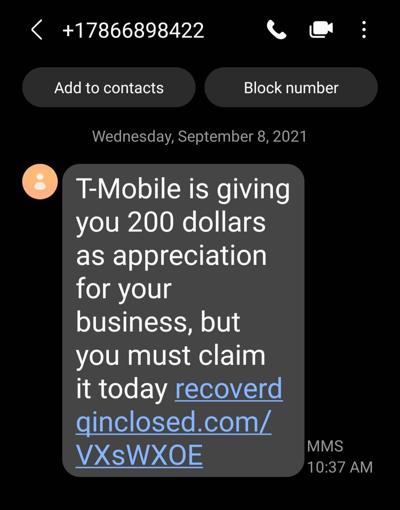
Never respond directly to these text messages. Don’t text “stop” or “no” as sometimes suggested. Doing so only alerts the identity thieves that they have a real and active cellphone number. Instead forward the text to 7726, which spells SPAM on your keyboard.
You can never be sure when you receive a text message asking for information if the sender is who he or she says he or she is and even if the message originates from a legitimate cellphone, you can’t be sure that the legitimate cellphone was not hacked into and the message you receive is from an identity thief. If you ever have the slightest thought that the text message may be a legitimate message from your cell phone service provider, your bank or any other entity with which you do business, you should contact the real entity directly at a number that you know is correct to inquire about the text message.
For those of you receiving the Scam of the day through an email, I just want to remind you that if you want to see the ever increasing list of Coronavirus scams go to the first page of the http://www.scamicide.com website and click on the tab at the top of the page that indicates “Coronavirus Scams.” Scamicide has been cited by the New York Times as one of three top sources for information about Coronavirus related scams.
If you are not a subscriber to Scamicide.com and would like to receive daily emails with the Scam of the day, all you need to do is sign up for free using this link. https://scamicide.com/scam-of-the-day/
Scam of the day – September 13, 2021 – Wells Fargo Phishing Email
A number of Scamicide readers have sent me copies of phishing emails that appear to come from Wells Fargo. One of them is reproduced below. It makes for compelling reading, but it is a scam. Phishing emails, by which scammers and identity thieves attempt to lure you into either clicking on links contained within the email which will download malware or providing personal information that will be used to make you a victim of identity theft, are nothing new. They are a staple of identity thieves and scammers and with good reason because they work. As always, they lure you by making it appear that there is an emergency that requires your immediate attention or else dire consequences will occur. Copied below is a new phishing email presently being sent to unsuspecting people that appears to come from Wells Fargo. This particular one comes with a Wells Fargo logo, but was sent from an email account that had no relation to Wells Fargo which is a clear indication that this is a scam. Most likely the email address from which it was sent was from an email account of an innocent person whose email accounts was hacked and made a part of a botnet used to send out phishing emails. I have disarmed the link which was found where the email indicates “sign on to your account at wellsfargo.com” and at the bottom of the email . If you had hovered your mouse over the link when it was active you would have seen that the link was from an address unrelated to Wells Fargo.
Here is a copy of the phishing email.
From: “Wells Fargo” <uta.klopfer@t-online.de>
 |
Please validate your email address nowFor your security, we need you to validate your email address to view your accounts and complete your security update in Wells Fargo Online. You have 1 day(s) to validate your email address or your online account access will be canceled.
How to validate your email address:
Simply sign on to your account at wellsfargo.com and follow the instructions to enter your 6 digit validation code. Entering the code below will validate this email address. Validation Code: 378532
If you have any questions, we’re available at 1-800-886-4442, 24 hours a day, 7 days a week.
|
TIPS
Legitimate emails from your bank would include the last four digits of your account and include your name. This email had neither. Obviously, if you are not a Wells Fargo customer, you will recognize immediately that this is a scam. As with most phishing emails, this one attempts to lure you into clicking on the link by threatening you with loss of access to your account if you do not provide the requested information.
As with all phishing emails, two things can happen if you click on the links provided. Either you will be sent to a legitimate looking, but phony webpage where you will be prompted to input personal information that will be used to make you a victim of identity theft or, even worse, merely by clicking on the link, you will download keystroke logging malware that will steal all of your personal information from your computer and use it to make you a victim of identity theft. If you receive an email like this and think it may possibly be legitimate, merely call your bank or other institution from which the email purports to originate at a telephone number that you know is accurate and you will be able to confirm that it is a scam.
For those of you receiving the Scam of the day through an email, I just want to remind you that if you want to see the ever increasing list of Coronavirus scams go to the first page of the http://www.scamicide.com website and click on the tab at the top of the page that indicates “Coronavirus Scams.” Scamicide was recently cited by the New York Times as one of three top sources for information about Coronavirus related scams.
If you are not a subscriber to Scamicide.com and would like to receive daily emails with the Scam of the day, all you need to do is to go to the bottom of the initial page of http://www.scamicide.com and insert your email address where it states “Sign up for this blog.”
Scam of the day – September 12, 2021 – SEC Sues BitConnect for Massive Fraud
Although cryptocurrencies, such as Bitcoin, may seem to be new. I have been writing in Scamicide.com about cryptocurrency scams since 2014. Cryptocurrencies are legitimate, but scammers are increasingly taking advantage of the public’s fascination with cryptocurrencies to take old forms of scams and update them with a cryptocurrency twist. The perception of many in the public that cryptocurrencies offer an easy path to riches coupled with many people violating the cardinal rule of investing by investing in schemes that they do not understand creates a perfect storm for cryptocurrency scams.
A good example of what a cryptocurrency scam looks like can be found by going to this website touting HoweyCoins. https://www.howeycoins.com/index.html
The bad news is that while HoweyCoins may appear to provide a lucrative investment opportunity, there is no such thing as HoweyCoins. It is a scam. Fortunately, it is a scam website that was set up by the Securities and Exchange Commission to serve as a warning to unwary investors about the dangers of cryptocurrency scams.
Recently the Securities and Exchange Commission (SEC) sued the company BitConnect and its founder, Satish Kumbhani alleging they operated a 2 billion dollar fraud scheme. According to the SEC, BitConnect said it had an automated program that made huge profits by trading bitcoins that would be provided to BitConnect by its customers. The company proclaimed that it never had a negative day of trading and its annualized return was 3,700%. Unfortunately, according to the SEC BitConnect was nothing more than a glorified Ponzi scheme in which new investors were paid from the contributions of later investors with most investors losing their entire investments. Already. Glenn Arcaro, an American promotor of BItConnect which itself is based overseas has pleaded guilty and will be sentenced in November.
TIPS
As I have mentioned many times previously, you should never invest in anything that you do not fully understand. You also should not invest in anything without investigating the people offering the investments. In addition, as always, if the investment sounds too good to be true, it usually is. Due to the fact that cryptocurrencies are totally unregulated by any government, they are a questionable investment. Add to that fact, their digital character and its susceptibility to hackers and fraud and you have a dangerous investment at best.
BitConnect and Kumhani are just the latest in a long line of Ponzi schemers who make promises that are too good to be true backed up by an incomprehensible formula for investment success. You should always remember the prime rule of investing which is to never invest in anything or any investment strategy that you do not totally understand. Some of the things to be on the lookout for in regard to cryptocurrency scams are promises of high, guaranteed returns on your investment, false claims of being SEC compliant, allowing you to invest using your credit card and pump and dump scams. For more information about pump and dump scams related to cryptocurrencies, check out the Scam of the day for April 11, 2018.
For those of you receiving the Scam of the day through an email, I just want to remind you that if you want to see the ever increasing list of Coronavirus scams go to the first page of the http://www.scamicide.com website and click on the tab at the top of the page that indicates “Coronavirus Scams.” Scamicide was recently cited by the New York Times as one of three top sources for information about Coronavirus related scams.
If you are not a subscriber to Scamicide.com and would like to receive daily emails with the Scam of the day, all you need to do is to go to the bottom of the initial page of http://www.scamicide.com and click on the tab that states “Sign up for this blog.”
Scam of the day – September 11, 2021 – MyChart Phishing Scam
This is a very convincing phishing email. It contained the first name of the Scamicide reader who forwarded it to me. I have blocked out the name to protect the reader’s privacy. I also have disarmed the links contained in the email which, if clicked on, would have taken you to an official appearing site where you would have been prompted to provide your username and password. Providing this information to a scammer would result in identity theft.
Here is a copy of the MyChart phishing email presently being circulated
Hello XXXX,
You have a new message in MyChart! Please sign in to read your message.
Thanks for using MyChart
Sign In to MyChart
MyChart is available on the go!
To change what notifications you receive and how you receive them,
log in to MyChart and choose Notifications from the Preferences menuTIPS
This is a particularly insidious phishing email because the email address from which it was sent could appear to be legitimate and is not one that is obviously an email address of someone whose email account was hacked and made a part of a botnet of computers used to send out such phishing emails. Also, the targeted victim’s name was included in the email.
As with all phishing emails, two things can happen if you click on the links provided. Either you will be sent to a legitimate looking, but phony website where you will be prompted to input personal information that will be used to make you a victim of identity theft or, even worse, merely by clicking on the link, you may download keystroke logging malware that will steal all of your personal information from your computer or smartphone and use it to make you a victim of identity theft.
If you receive an email like this and think it may possibly be legitimate, merely call your health care provider where you can confirm that it is a scam, but make sure that you dial the telephone number correctly because scammers have been known to buy phone numbers that are just a digit off of legitimate numbers to trap you if you make a mistake in dialing the real number.
For those of you receiving the Scam of the day through an email, I just want to remind you that if you want to see the ever increasing list of Coronavirus scams go to the first page of the http://www.scamicide.com website and click on the tab at the top of the page that indicates “Coronavirus Scams.” Scamicide has been cited by the New York Times as one of three top sources for information about Coronavirus related scams.
If you are not a subscriber to Scamicide.com and would like to receive daily emails with the Scam of the day, all you need to do is sign up for free using this link. https://scamicide.com/scam-of-the-day/




Scam of the day – September 10, 2021 – Zelle Scam Steals Money From Chicago Women
Peer to Peer Payment Payment Services (P2P) such as Zelle, Venmo, ApplePay, PayPal, Square Cash and PopMoney are popular ways to quickly and conveniently send money electronically from your credit card or bank account. These services also provide easy ways to be scammed and unlike scams targeting your credit cards directly, you may not have as much protection under the law to get your money back if you do get scammed.
Sadly Money Crashers did a survey of users of P2P services and found that 52% of users were not even concerned with the security of these payment apps, which is disconcerting considering many instances of fraud involving these services.
Recently, Nausheen Brooks and Darlene Chelsey were each scammed out of $3,500 when they received text messages that appeared to come from their bank, Bank of America asking them to verify purchases. Of course there were no purchases and it wasn’t Bank of America contacting them. After responding to the text messages, they were called by scammers posing as Bank of America employees. Through “spoofing” their Caller ID was able to be manipulated to make it appear as if the call actually came from Bank of America. The scammer told the women that withdrawals had been made from their Zelle accounts, but that all they needed to do to remedy the situation was use their mobile banking apps to transfer money back to themselves. While this does not seem particularly logical, the frightened women complied only to quickly find out that their Zelle accounts had been taken over by the scammers who promptly emptied the accounts.
While law enforcement does not know precisely how their accounts were taken over by the scammers, most likely they used the same password on multiple sites including some where data breaches enabled scammers to find out their Zelle passwords. They also failed to utilize dual factor authentication to protect themselves if their password was ever compromised.
TIPS
Before signing up for any P2P service, you should familiarize yourself with their fraud protection rules. In the fine print of many P2P services, you may find that you have little, if any, protection if you use the account to purchase something that ends up to be a scam. While PayPal offers significant protection from fraudulent transactions, Cash App, Zelle and Venmo, for example do not offer such protection, which is why these services should never be used for commercial transactions, but only to transfer small amounts of money to people you know. In order to protect your account from being hacked and being taken over by a scammer who could access your credit card or bank account, you should use a PIN or other dual factor authentication whenever your particular service provides for it. Linking your P2P service to a credit card is a good choice because if your account is tied to a credit card, you should be able to get the amount fraudulently taken refunded from your credit card company in accordance with federal law. If your account is tied to a bank account, you may be able to get the money refunded only if you report it immediately pursuant to the Electronic Transfer Act. However, any delay in reporting the fraud from your bank account could cost you dearly. In the cases of these two victims, Bank of America did cover their losses.
To avoid having your Zelle or other P2P accounts from being taken over by hackers, never provide your username, password or PIN in response to any email, text message or phone call unless you have absolutely confirmed that the request for this information is legitimate, which it never is. You can confirm this by contacting your bank or other company by calling them at a telephone number you know is accurate. Here is a link to use to activate dual factor authentication on your Zelle account. https://www.zellepay.com/pay-it-safe/resources-and-tips
For those of you receiving the Scam of the day through an email, I just want to remind you that if you want to see the ever increasing list of Coronavirus scams go to the first page of the http://www.scamicide.com website and click on the tab at the top of the page that indicates “Coronavirus Scams.” Scamicide was recently cited by the New York Times as one of three top sources for information about Coronavirus related scams.
If you are not a subscriber to Scamicide.com and would like to receive daily emails with the Scam of the day, all you need to do is to go to the bottom of the initial page of http://www.scamicide.com and type in your email address where it states “Sign up for this blog.”
Scam of the day – September 9, 2021 – Sophisticated Amazon Phishing Email
Shopping on Amazon, particularly during the continuing pandemic is extremely popular both with consumers and scammers seeking to exploit Amazon’s popularity. I have warned you many times over the years about scammers who send various types of phishing emails which purport to be from Amazon attempting to lure you into either clicking on links which can download malware, such as ransomware or providing personal information that can be used to make you a victim of identity theft.
I have heard recently from a number of Scamicide readers that they have lately been receiving many Amazon phishing emails. The email below is typical of those presently circulating. The latest Amazon phishing scam starts with an email that appears to come from Amazon informing you that someone has attempted to use your password to access your account. Anyone receiving such an email would certainly be concerned that their account is about to be hacked and may be lured into clicking on the link provided to deny access. Phishing emails often try to entice people into providing sensitive personal information that can be used for purposes of identity theft or to click on links that may either ask you for personal information or merely by clicking on the link you may download harmful malware.
This particular phishing email is very sophisticated. The grammar is correct and the logo used appears legitimate, but it is very simple to counterfeit a legitimate appearing logo. Often a telltale sign that the email is a part of a scam is that the email address of the sender has absolutely nothing to do with Amazon, however, in this case, the email addresses used appear to come from Amazon although they are not legitimate Amazon addresses. Many people are not aware that all legitimate Amazon email addresses have a dot before “amazon.com” so although the phony Amazon email addresses used in the phishing email appear to the untrained eye to be legitimate, they are not.
This phishing email also appears more legitimate because it actually uses the full name of the targeted victim. I have blocked out the surname of the targeted victim as well as the links and email addresses used in the phishing email for security and privacy purposes.
Here is a copy of the email presently being circulated.
|
|
||||||
| Anthony XXXXXX | |||||||
| Someone who knows your password is attempting to sign-in to your account. | |||||||
|
|||||||
|
Approve or Deny |
|||||||
Is it safe to follow this link?The link provided in this email starts with “https:xxxxxxxxx”. If you prefer, copy the following link and paste it into a browser to view. https:xxxxxxxxxxxxxx |
|||||||

TIPS
While this is a very legitimate appearing email that uses the Amazon logo and is written with proper grammar and punctuation as well as using the targeted victim’s name, the primary indication that this is a scam is that the email address does not use the protocol of Amazon because it did not have a dot prior to “amazon.com” in the email address. Trust me, you can’t trust anyone. Never click on a link in an email or text message or provide personal information unless you have confirmed that the email or text message is legitimate. The telephone number to call if you suspect Amazon related fraud is 866-216-1075 or you can call their customer service number 888-280-4331 Never call the numbers that appears in the phishing emails.
Also, because any of us can be scammed, it is a good idea to use dual factor authentication whenever possible to protect your various accounts so that even if someone actually had your password they would not be able to access your account. In order to set up dual factor authentication for your Amazon account use this link. https://www.amazon.com/gp/help/customer/display.html?nodeId=G3PWZPU52FKN7PW4
For those of you receiving the Scam of the day through an email, I just want to remind you that if you want to see the ever increasing list of Coronavirus scams go to the first page of the http://www.scamicide.com website and click on the tab at the top of the page that indicates “Coronavirus Scams.” Scamicide was recently cited by the New York Times as one of three top sources for information about Coronavirus related scams
If you are not a subscriber to Scamicide.com and would like to receive daily emails with the Scam of the day, all you need to do is sign up for free using this link. https://scamicide.com/scam-of-the-day/