
Scam of the Day
Scam of the day – October 31, 2021 – Fake IRS Emails About Economic Impact Payments
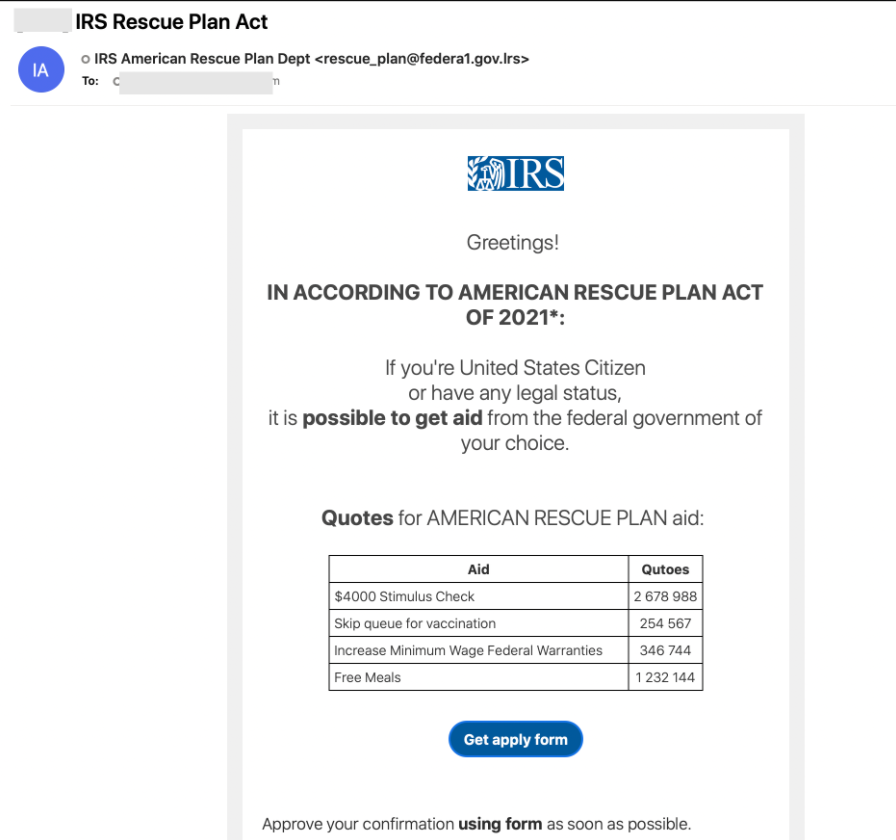
The third round of Economic Impact Payments authorized by the American Rescue Plan Act of 2021 was paid as an advance payment of the tax year 2021 Recovery Rebate Credit. The IRS began sending these payments on March 12, 2021 to eligible people, most of whom have already received their payment. However the IRS sent these payments based on information contained in their 2020 income tax returns and many people who filed later including those who just paid in October after getting an extension on the filing date for their 2020 income tax return will be now getting their payment when the IRS processes their 2020 income tax return (which they are doing very slowly). Scammers are not missing out on this opportunity to scam people or make them victims of identity theft and are capitalizing on interest in these payments by sending emails that appear to come from the IRS asking people to click on links to provide access to a form required in order to authorize the payment. Other forms of the email provide a link to click on to get help with your payment. In either case, only bad things can happen if you click on those links. In some instances, merely by clicking on the link you will download dangerous strains of malware that may include keystroke logging malware that will steal your personal information from your computer and use it to make you a victim of identity theft. In other other instances, you will be prompted to provide personal information directly that will be used to make you a victim of identity theft. Copied below is a similar bogus IRS email about which I told you in March. According to the cybersecurity company Proofpoint which issued a report about this scam, the scammers used email addresses that might appear at first blush to be from the federal government. Some of the email addresses used are us_irs@federa1.irs.c0m, resecue_plan@federa1.irs.c0m and american_rescure@federa1.irs.c0m. If you look closely at the email addresses of the sender, however, you will note that rather than the letter “l” in the word “federal,” the digit “1” appears. Also, each email address ends with .com, but the “o” is replaced with the digit “0.” If you look closely you will also see the word “quotes” is misspelled.
If you click on the tab marked “get apply form” you will end up downloading a type of malware called Dridex that will steal your personal banking information and other login credentials.
TIPS
The truth is that the federal government is not contacting anyone by email in regard to receiving benefits under the American Rescue Plan, which have been and continue to be sent to the bank accounts of eligible people. You do not apply for benefits under the American Rescue Plan. Your stimulus check will be sent to you based on your eligibility as determined from your most recently filed federal income tax return and your payment will be made either electronically to the bank account you indicated in your most recent federal income tax return or sent to you as a paper check or debit card. You do not need to do anything to apply for these benefits.
For detailed information upon which you can rely, you should go to the IRS’ website where it explains all you need to know about this program. https://www.irs.gov/coronavirus/third-economic-impact-payment
For information about the status of your specific stimulus payment, you should only go to this IRS interactive website. https://www.irs.gov/coronavirus/get-my-payment
For those of you receiving the Scam of the day through an email, I just want to remind you that if you want to see the ever increasing list of Coronavirus scams go to the first page of the http://www.scamicide.com website and click on the tab at the top of the page that indicates “Coronavirus Scams.” Scamicide has been cited by the New York Times as one of three top sources for information about Coronavirus related scams.
If you are not a subscriber to Scamicide.com and would like to receive daily emails with the Scam of the day, all you need to do is sign up for free using this link. https://scamicide.com/scam-of-the-day/
Scam of the day – October 30, 2021 – The Dangers of the Unsubscribe Link
I would say it is a pretty fair assumption that most of us get far more emails than we wish to receive. Much email contains solicitations and advertisements that clog up our inboxes and require constant attention to delete, which is why you may be tempted to take advantage of the opportunity presented in many of these emails to click on a link at the bottom of the email to unsubscribe.
Don’t do it.
While the unsubscribe link is probably safe when it comes in an email from a company that you are sure is legitimate, you could run into serious problems if the unsubscribe link is contained in an email from a scammer. The problem is that when you click on the unsubscribe link, you run the risk of being directed to a site that downloads malware on to your computer, laptop or cellphone. In addition, instead of reducing the amount of spam and undesired emails by clicking on the link to unsubscribe, you may end up getting more spam and malware infected emails because the scammers who include an unsubscribe link at the bottom of their emails compile lists of the email addresses of people who click on that link and sell those lists to other scammers as email addresses that they know are valid.
TIPS
In determining whether or not the email you get is truly from a legitimate company, you can check out the email address from which it is sent, but frankly you are better off just using your email provider’s option to block or mark the email as spam in order to prevent further such emails. Frankly, although it may seem like a waste of time, an effective and simple way to deal with the unsubscribe link is to ignore it and merely delete unwanted emails.
For those of you receiving the Scam of the day through an email, I just want to remind you that if you want to see the ever increasing list of Coronavirus scams go to the first page of the http://www.scamicide.com website and click on the tab at the top of the page that indicates “Coronavirus Scams.” Scamicide was recently cited by the New York Times as one of three top sources for information about Coronavirus related scams.
If you are not a subscriber to Scamicide.com and would like to receive daily emails with the Scam of the day, all you need to do is to go to the bottom of the initial page of http://www.scamicide.com and type your email address on the tab that states “Sign up for this blog.”
Scam of the day – October 29, 2021 – FTC Sues Company for Bogus Coronavirus Nasal Spray
While the Coronavirus pandemic has gotten considerably better in much of the United States and safe and effective vaccines are available, the pandemic still poses a significant health threat both here in the United States and around the world. However, even though the absolute best thing you can do to protect your self from COVID 19 is to get one of the FDA approved vaccines, many people are still falling prey to unscrupulous scammers who are peddling phony cures and treatments for the Coronavirus. The Federal Trade Commission (FTC) recently announced that it had sued Xlear, Inc. for violating the COVID-19 Consumer Protection Act alleging that Xlear represented that its saline nasal spray provided protection against infection from the coronavirus and was a “simple, safe, and cheap option that could be an effective solution to the pandemic.” Xlear made these claims on social media, podcasts and television commercials. The truth is that there is absolutely no clinical trial or scientific evidence to support these false and misleading claims, according to the FTC. Last July, the FTC sent a warning letter to Xlear demanding that they stop their misleading and deceptive advertising, but they failed to comply with the demand resulting in the FTC suing them to stop their misrepresenting their product.
TIPS
As for healthcare products in general, you should be skeptical about any company that promises miraculous cures to illnesses and medical conditions. The world is full of snake oil salesmen. You should also be wary of any healthcare product that is sold exclusively either over the Internet or through mail-order advertisements. The best course of action is to ask your physician about the effectiveness of a particular product or program before you buy it. As for the Coronavirus specifically, the best places to get reliable information are the World Health Organization https://www.who.int/health-topics/coronavirus, and the FDA https://www.fda.gov/patients/coronavirus-disease-2019-covid-19-resources-patients or the Centers for Disease Control https://www.cdc.gov/
Remember B.S. – Be skeptical. Whenever there will be breakthroughs to treat, prevent or cure any disease, particularly COVID 19 you are going to hear about it through legitimate news sources first rather than through ads in emails, text messages, podcasts, television commercials or posts on social media.
For those of you receiving the Scam of the day through an email, I just want to remind you that if you want to see the ever increasing list of Coronavirus scams go to the first page of the http://www.scamicide.com website and click on the tab at the top of the page that indicates “Coronavirus Scams.” Scamicide was recently cited by the New York Times as one of three top sources for information about Coronavirus related scams.
If you are not a subscriber to Scamicide.com and would like to receive daily emails with the Scam of the day, all you need to do is to go to the bottom of the initial page of http://www.scamicide.com and click on the tab that states “Sign up for this blog.”
Scam of the day – October 28, 2021 – Deed to Your Home Scam
Today’s Scam of the day is one that I have been warning you about since 2012, but lately there has been a resurgence of this scam as indicated by the number of Scamicide readers who have inquired about this scam after receiving a confusing notice. The scam begins with a call, email or snail mail letter informing you of the importance of having a copy of the deed to your home. Often these scammers will charge you $90 or more to obtain a copy of your deed for you. Having an actual copy of your deed is not very important once it has been recorded in the local Registry of Deeds, however it is still a good record to keep. However, obtaining a copy of your deed on your own from your local Registry of Deeds is both simple and rarely costs more than a few dollars at the most. The problem with this particular scam is that technically, it may be legal in the sense that they are offering to obtain a copy of your deed for you for a fee and there is nothing illegal about that. However, the emails and letters you receive offering this service are usually confusing and misleading which is why I consider them to be a scam. The state of Ohio in 2018 actually passed a law requiring specific disclosures to consumers be made when a fee is requested to obtain a copy of a deed on your behalf. The disclosure must include the actual cost charged by the Registry of Deeds for a deed copy as well as prohibiting charging a fee more than four times the cost charged by the Registry of Deeds.
TIP
This is an easy scam to avoid. If you get such a call, email or letter, merely ignore it. If you want a copy of your deed, merely contact your local Registry of Deeds where you can get one for a nominal cost.
For those of you receiving the Scam of the day through an email, I just want to remind you that if you want to see the ever increasing list of Coronavirus scams go to the first page of the http://www.scamicide.com website and click on the tab at the top of the page that indicates “Coronavirus Scams.” Scamicide has been cited by the New York Times as one of three top sources for information about Coronavirus related scams.
If you are not a subscriber to Scamicide.com and would like to receive daily emails with the Scam of the day, all you need to do is to go to the bottom of the initial page of http://www.scamicide.com and click on the tab that states “Sign up for this blog.”
Scam of the day – October 27, 2021 – Amazon Impersonation Scams Dramatically Increasing
I have warned you for years about impersonation scams in which scammers call you on the phone posing, for example, as the IRS, the Social Security Administration or companies with which you do business and try to lure you into either making an immediate payment to them under some pretense or providing personal information that will be used to make you a victim of identity theft. Recently the FTC issued a new report in which they indicated that between July 2020 and June 2021 one-third of all of the business impersonator complaints involved scammers posing as employees of Amazon. This represented a five hundred percent increase of Amazon impersonation scams from the previous pre-pandemic year. This should come as no surprise to anyone, particularly during the pandemic when so many of us did much more of our shopping on line and much of that on Amazon.
While these Amazon impersonation scams vary, common versions include calls warning you that there has been suspicious or unauthorized purchases made on your account. You are then told that to facilitate a refund, you need to give the “Amazon” employee remote access to your computer. People falling for this scam end up giving access to the personal and financial information on their computer and leads to tremendous losses and identity theft. In another Amazon impersonation scam, you are told that they are sending you a refund for unauthorized use of your account. When you receive the check, you are told that mistakenly you were sent too much money and that after you deposit the check you should wire the amount of the overpayment back to them. This is just another variation of the scam where for some reason you are given a check for more than what is owed you and you are convinced to send back the difference. The problem is that the check is counterfeit, but the money you wire to the scammers from your account is real and is lost forever.
TIPS
Whenever you get a phone call, you can never be sure who is actually calling you. Through a technique called “spoofing” your Caller ID can be manipulated to show the call is coming from whomever the scammer wishes to appear as. Never give personal information over the phone to someone you have not called unless you have absolutely confirmed that the call is legitimate. In the case of Amazon scam calls, if you think the call might be legitimate, hang up and call the Amazon customer service number 888-280-4331 for information you can trust.
Never deposit or accept a check for more than you are owed. This is always a scam and while when you deposit the check it may appear as if the bank has cleared the check, you only get temporary credit until the check has bounced at which time the money is withdrawn from your account.
Finally, never give anyone remote access to your computer unless you have absolutely confirmed that it is necessary. Facilitating the return of funds to you is not something that requires remote access.
For those of you receiving the Scam of the day through an email, I just want to remind you that if you want to see the ever increasing list of Coronavirus scams go to the first page of the http://www.scamicide.com website and click on the tab at the top of the page that indicates “Coronavirus Scams.” Scamicide was recently cited by the New York Times as one of three top sources for information about Coronavirus related scams.
If you are not a subscriber to Scamicide.com and would like to receive daily emails with the Scam of the day, all you need to do is to go to the bottom of the initial page of http://www.scamicide.com and type your email address on the tab that states “Sign up for this blog.”
Scam of the day – October 25, 2021 – UK Lottery Scam
Lottery scams are one of the most common types of scams. Scammers cheat people out of millions of dollars each year by tricking their victims into sending money to the scammers after being told that they have won a lottery, but are required to pay fees or taxes in order to collect their prize. It is hard to win any lottery. It is impossible to win one that you have not even entered and yet scam artists, the only criminals we refer to as artists have found that it is extremely lucrative to scam people by convincing them that they have won various lotteries.
Most lottery scams involve the victims being told that they need to pay taxes or administrative fees directly to the lottery sponsor; however no legitimate lottery requires you to do so. As with many effective scams, the pitch of the scammer seems legitimate. Income taxes are due on lottery winnings, but with legitimate lotteries they are either deducted from the lottery winnings before you receive your prize or you are responsible for paying the taxes directly to the IRS. No legitimate lottery collects taxes on behalf of the IRS from lottery winners. Other times, the scammer tell the “winners” that in order to collect their prizes, they need to pay administrative fees. Often, the victims are told to send the fees back to the scammer by prepaid gift cards or Green Dot MoneyPak cards. Prepaid cards are a favorite of scammers because they are the equivalent of sending cash. They are impossible to stop or trace. Again, no legitimate lottery requires you to pay administrative fees in order to claim your prize
Today’s impressive lottery scam starts with an email, a copy of which is reproduced below.
To:
Sent: Tue, Oct 12, 2021 2:24 pm
Subject: NOTIFICATION!!!
TIPS
As I have often told you, it is difficult to win a lottery you have entered. It is impossible to win one that you have not even entered. You should always be skeptical about being told that you have won a lottery you never entered. While it is true that income taxes are owed on lottery winnings, legitimate lotteries never collect tax money from winners. They either deduct the taxes from the winnings or leave it up to the winners to pay their taxes directly to the IRS. You also should never pay a fee to collect a legitimate lottery prize.
For those of you receiving the Scam of the day through an email, I just want to remind you that if you want to see the ever increasing list of Coronavirus scams go to the first page of the http://www.scamicide.com website and click on the tab at the top of the page that indicates “Coronavirus Scams.” Scamicide has been cited by the New York Times as one of three top sources for information about Coronavirus related scams.
If you are not a subscriber to Scamicide.com and would like to receive daily emails with the Scam of the day, all you need to do is to go to the bottom of the initial page of http://www.scamicide.com and type in your email address on the tab that states “Sign up for this blog.”
Scam of the day – October 24, 2021 – FTC Sending Refunds to Victims of Pain Relief Supplement Scam
Pursuant to a recent settlement, the Federal Trade Commission is sending checks to people who were scammed by Mile High Madison Group, Inc and four other related companies along with the principals of these companies Vittorio DiCriscio and Vito Proietti in regard to phony pain relief supplements sold under the names of Neurocet, Regenify and Resetigen-D primarily through direct mail campaigns. These supplements were marketed using false and deceptive statements that the supplements could stop pain and treat age-related ailments although there was no scientific evidence to support their claims.
TIPS
For more information about this refund program go to the tab in the middle of the Scamicide home page entitled “FTC Scam Refunds.” It is important to note that there is never a charge for obtaining a refund through the FTC or any of its refund administrators. Anyone who asks for such a payment is just another scammer.
As for health care products in general, the truth is that you should be wary of any health care product that is sold exclusively either over the Internet or through mail-order advertisements. The best course of action is to ask your physician about the effectiveness of a particular product or program before you consider buying it. Also, you should always be skeptical of the studies cited in their advertisements and their endorsements.
For those of you receiving the Scam of the day through an email, I just want to remind you that if you want to see the ever increasing list of Coronavirus scams go to the first page of the http://www.scamicide.com website and click on the tab at the top of the page that indicates “Coronavirus Scams.” Scamicide has been cited by the New York Times as one of three top sources for information about Coronavirus related scams.
If you are not a subscriber to Scamicide.com and would like to receive daily emails with the Scam of the day, all you need to do is sign up for free using this link. https://scamicide.com/scam-of-the-day/
Scam of the day – October 23, 2021 – Online Trading Academy Update
In March of 2020 I told you about the Federal Trade Commission (FTC) suing the investment training company Online Trading Academy (OTA) and its principals for fraud. In September the FTC settled its claims against OTA and its principals. As a part of the settlement, the defendants are paid millions of dollars to the FTC who refunded the money to victims of the scam. The Online Trading Academy lured people largely through seminars into purchasing its phony investment trading programs for as much as $50,000. The Online Trading Academy scammed victims out of more than 370 million dollars over six years. According to the FTC, OTA told people that it had a patented strategy that would enable people using the strategy to make substantial income trading stocks whether the stock market was “going up, down or sideways.” OTA also provided false testimonials from people OTA wrongfully misrepresented as successful traders who used its strategy. Finally, according to the FTC, customers requesting refunds were required to sign contracts preventing them from making negative comments about OTA or reporting them to law enforcement agencies.
Now Universal Guardian Acceptance, LLC (UGA) and Universal Account Servicing, LLC (UAS) the funder and servicer of the payments plans used by victims of this scam to pay for training from OTA has settled claims brought against it by the FTC. Under the terms of the settlement, UGA is required to forgive any debts incurred by the victims of OTA’s scam to pay for OTA’s faulty trading program. Victims of the scam who financed their payments to OTA through UGA will be receiving notices of the offer of debt forgiveness shortly and will have 45 days to request debt forgiveness.
TIPS
Never rush into any investment or other opportunity being sold through a seminar until you have carefully investigated the people selling their investment or system as well as the investment or system itself. Always be a bit skeptical as to testimonials which should also be carefully investigated before being relied upon. Before investing with anyone, you should investigate the person offering to sell you the investment with the Securities and Exchange Commission’s Central Registration Depository. This will tell you if the broker is licensed and if there have been disciplinary procedures against him or her. You can also check with your own state’s securities regulation office for similar information. Many investment advisers will not be required to register with the SEC, but are required to register with your individual state’s securities regulators. You can find your state’s agency by going to the website of the North American Securities Administrators Association. https://www.nasaa.org/investor-education/how-to-check-your-broker-or-investment-adviser/ Many investment advisers will not be required to register with the SEC, but are required to register with your individual state securities regulators. You should also check with the Financial Industry Regulatory Authority (FINRA) for information about the particular investment adviser. https://www.finra.org/investors/protect-your-money/ask-and-check
It is also important to remember that you should never invest in something that you do not completely understand. This was a mistake that many of Bernie Madoff’s victims made. You also may want to check out the SEC’s investor education website at www.investor.gov. Scammers can be very convincing and it may sound like there is a great opportunity for someone to make some money, but you must be careful that the person making money is not the scam artist taking yours.
Millions of dollars recovered by the FTC from Online Trading Academy and its principals through the settlement was refunded to victims of their scam in August of 2021 by the FTC.
For those of you receiving the Scam of the day through an email, I just want to remind you that if you want to see the ever increasing list of Coronavirus scams go to the first page of the http://www.scamicide.com website and click on the tab at the top of the page that indicates “Coronavirus Scams.” Scamicide was recently cited by the New York Times as one of three top sources for information about Coronavirus related scams.
If you are not a subscriber to Scamicide.com and would like to receive daily emails with the Scam of the day, all you need to do is to go to the bottom of the initial page of http://www.scamicide.com and type your email address on the tab that states “Sign up for this blog.”
Scam of the day – October 22, 2021 – Mailbox Identity Thief Sentenced to Prison
Identity theft can be high tech, low tech or no tech. Stealing mail from mailboxes for purposes of identity theft has been done by identity thieves for years. Numerous times over the last ten years I have warned you about the danger of having your mail, such as credit card bills or bank statements stolen from your personal mailbox. In addition, many people put themselves in great danger of identity theft by putting their outgoing mail in their mailbox and put up the red flag to alert the mail carrier that there is mail to be picked up. Unfortunately, that is also an alert to identity thieves cruising the neighborhood of mail to be easily stolen.
Recently, Dwayne Leroy Daan was convicted of mail theft and identity theft in Oregon and sentenced to 90 months in prison. Daan stole more than 800 pieces of mail both from private home mailboxes and USPS collection mailboxes.
TIPS
In order to avoid becoming a victim of identity theft through your mailbox, you should make sure that it is securely locked so that it is not easily accessed by your friendly neighborhood identity thief and when it comes to outgoing mail, don’t put it in your mailbox for your mail carrier to pick up regardless of how convenient it may be to do so. In fact, as was the case with Dwayne Leroy Daan, identity thieves also steal mail from the U.S. Postal Service mailboxes found on the corners of major streets so, in order to be safe, you should mail your outgoing mail at the post office. It may seem like this is being a bit excessive when it comes to protecting your mail, but remember, even paranoids have enemies.
Another thing you can do to reduce the danger of identity theft through mail theft is to use the Informed Delivery Program of the USPS. The Informed Delivery Program is a free service of the U.S. Postal Service that will send you an email each morning with images of the mail you will be receiving later that day. This service was first done on a pilot basis in 2014 in parts of California, Connecticut, Maryland, Virginia and Washington D.C. and became available to everyone three years later. Identity theft through the stealing of mail such as credit card statements and bank statements from your mailbox is a significant problem and this program both alerts you as to when to look for important mail, as well as let you know if such important mail has been stolen from your mailbox so you can respond more quickly. However, nothing is full proof. A few years ago I told you about the identity theft of more than thirty-five people living in the same Miramar, Florida neighborhood caused by criminals exploiting flaws in the program. These criminals signed up for the program in the names of their victims and were able to see when credit card statements and other mail containing personal information would be delivered so that they were alerted as to when to steal the mail from the mail boxes of their victims and gain access to their credit cards as well as sign her up for additional cards which they also exploited. While in order to set up an Informed Delivery account, you need to answer security questions, the information necessary to answer those questions can often be readily obtained online.
The best way to avoid the problem of someone using the Informed Delivery Program to learn about your upcoming mail deliveries is to sign up for the Informed Delivery Program yourself before an identity thief does so in your name. Here is the link to go to sign up.
https://informeddelivery.usps.com/box/pages/intro/start.action
It is also important to note that if you do sign up for the service, you should use a unique and complex password to prevent identity thieves from hacking your account to let them know when important mail that they can exploit for identity theft purposes will be arriving to your home.
For those of you receiving the Scam of the day through an email, I just want to remind you that if you want to see the ever increasing list of Coronavirus scams go to the first page of the http://www.scamicide.com website and click on the tab at the top of the page that indicates “Coronavirus Scams.” Scamicide has been cited by the New York Times as one of three top sources for information about Coronavirus related scams.
If you are not a subscriber to Scamicide.com and would like to receive daily emails with the Scam of the day, all you need to do is sign up for free using this link. https://scamicide.com/scam-of-the-day/