
Scam of the Day
Scam of the day – November 27, 2021 – Dangerous Netflix Phishing Email
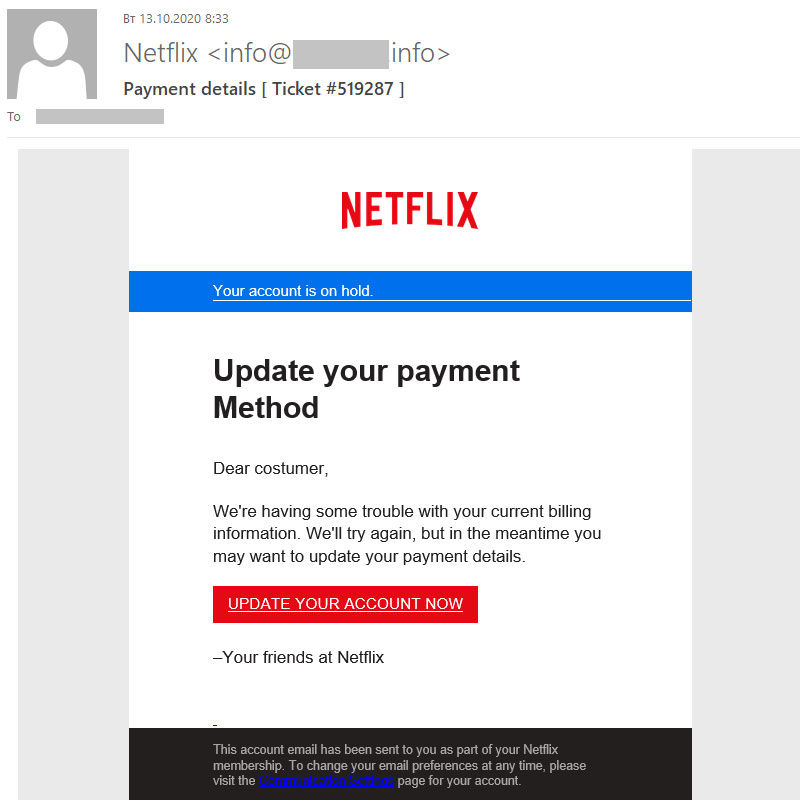
For a long time I have warned you that the popularity of Netflix makes it a preferred subject for phishing emails. Particularly since the start of the pandemic many of us, myself included, have been watching a lot of Netflix programming and this has increased the motivation of scammers to set up many phony Netflix websites to which they lure people through emails and text messages to go to under the guise of a variety of phony reasons, such as needing to update your information or confirm information as shown in the copy of a Netflix phishing email below. Of course, the real purpose of these phony Netflix websites and the phishing emails and text messages sent to you is to lure you into going to these phony Netflix websites to trick you into providing your credit card information or your username and password which can then be sold by cybercriminals on the Dark Web to people looking to use Netflix for free.
TIPS
As I always say, “trust me, you can’t trust anyone.” You can never be truly sure when you receive an email seeking personal information such as your credit card number whether or not the email is a scam. The risk of clicking on a link or providing the requested information is just too high. Instead, if you think that the email might be legitimate, you should contact the company at a telephone number that you know is legitimate and find out whether or not the email or text message was a scam. In this particular scam, a strong indication that this is a scam is the lack of your name in the email and the misspelling of “costumer” rather than “customer.”
It is also important to remember that Netflix will never ask in an email or text message for any of your personal information so anytime you get an email or text message purportedly from Netflix asking for your credit card number, Social Security number or any other personal information, it is a scam. Here is a link to Netflix’s security page for information about staying secure in regard to your Netflix account. https://help.netflix.com/en/node/13243
For those of you receiving the Scam of the day through an email, I just want to remind you that if you want to see the ever increasing list of Coronavirus scams go to the first page of the http://www.scamicide.com website and click on the tab at the top of the page that indicates “Coronavirus Scams.” Scamicide was recently cited by the New York Times as one of three top sources for information about Coronavirus related scams.
If you are not a subscriber to Scamicide.com and would like to receive daily emails with the Scam of the day, all you need to do is to go to the bottom of the initial page of http://www.scamicide.com and type in your email in the tab that states “Sign up for this blog.”
Scam of the day – November 26, 2021 – Annual Report of Federal Do-Not-Call List
Since it began in 2003, the National Do Not Call list has grown to include more than 244 million phone numbers. When you register your phone number with the Do Not Call list it becomes illegal for telemarketers to contact you by phone. The Do Not Call list does not apply to charities so you still may be contacted by charities even if you have registered for the Do Not Call list. However, when you receive a call from someone purporting to be representing a charity, you can never be sure who is really calling so you should never give your credit card number to someone who calls you allegedly from a charity. If you are interested in a particular charity, contact the charity directly to make your contribution.
If you are registered for the Do Not Call list and you do receive a call from a telemarketer, you can be confident that the call is a scam because no legitimate telemarketer would call you if you are enrolled in the Do Not Call list. It is also important to note that while telemarketing is not in and of itself illegal, telemarketing through robocalls is always illegal. Registering for the Do Not Call list will not stop robocalls. Illegal automated robocalls continue to be a major source of complaint for many people with the most common subjects of illegal robocalls being debt reduction, vacation and timeshares and warranty plans. Last year Congress passed a law intended to reduce robocalls, but the legislation does not by any means stop robocalls entirely.
Each year, the Federal Trade Commission issues an annual report for the Do Not Call List and this year’s report shows the greatest number of scam robocalls involve reducing debt scams, warranties and protection plan scams, computer and technical support scams, medical and prescription scams and impostor scams, such as calls in which the caller pretends to be an IRS employee.
A scam that uses the Do Not Call list as the basis of the scam starts when you receive an email informing you that your registration in the Do Not Call list is expiring and that you have to register your phone number again. You are then directed to a phony website that gathers information that can be used for purposes of identity theft. The important thing to know is that you never have to reregister your phone number with the Do Not Call list. Once you have registered a number it is permanently on the Do Not Call list until the number is disconnected or you ask for your number to be removed.
TIPS
Registering for the do not call list is easy and free. Merely go to http://www.donotcall.gov to register your phone number.
Verizon has implemented new services to help its customers avoid illegal robocalls. The new Call Filter service offers spam alerts and new protections from robocalls for its wireless customers. Customers will receive alerts when a call is most likely a scam. The new Call Filter service will also automatically block robocalls based of the customer’s preferred risk level. The Call Filter service is offered in a free version and an enhanced version that among other things will enable customers to create a personal robocall block list. For more information about the Call Filter Services and how to sign up go to https://www.verizonwireless.com/solutions-and-services/call-filter/
There are a number of other options for preventing robocalls including a number of apps that for free or a small fee will reduce and in some instances prevent robocalls.
Samsung’s SmartCall informs you if the call you are receiving is from a known robocaller. This feature is available with newer Samsung Galaxy phones. Here is a link to information about SmartCall and instructions as to how to activate this app.
http://www.samsung.com/levant/apps/smart-call/
Google also has a spam blocker that will warn you when you are receiving a robocall and your screen will turn red. Here is a link to information about the app and how to install it.
https://play.google.com/store/apps/details?id=com.google.android.dialer&hl=en
AT&T also offers free apps to block robocalls on iPhones and Android phones. Here is a link to information about these apps.
https://www.att.com/features/security-apps.html?partner=LinkShare&siteId=TnL5HPStwNw-yrUS1uDw9WGvN._xt67yew&source=ECay0000000CEL00O
Verizon’s CallerName ID is a free service for iPhones and Android phones that will alert you to suspected robocallers. Here is a link to Verizon’s app.
https://www.verizonwireless.com/solutions-and-services/caller-name-id/
T-Mobile offers a free scam blocker of known robocallers for Android phones which you can activate by merely dialing #662#
Sprint offers a paid service to protect your iPhone or Android phone from robocalls. For more information, use this link
http://explore.t-mobile.com/callprotection
For landlines as well as smartphones there are a number of apps such as Nomorobo, Truecaller, Hiya, RoboKiller and YouMail that offer robocall blocking for free or for small monthly charges. Here is a link to those apps. I have used Nomorobo for years and find it to be tremendously useful
https://www.nomorobo.com/
https://www.truecaller.com/
https://hiya.com/
https://www.robokiller.com/
https://play.google.com/store/apps/details?id=com.youmail.android.vvm&hl=en_US https://www.youmail.com/home/apps
Finally, you can just choose to ignore any calls that come from numbers you do not recognize. This is a good option. If they are legitimate calls, they will leave a message and you can call them back.
For those of you receiving the Scam of the day through an email, I just want to remind you that if you want to see the ever increasing list of Coronavirus scams go to the first page of the http://www.scamicide.com website and click on the tab at the top of the page that indicates “Coronavirus Scams.” Scamicide was cited by the New York Times as one of three top sources for information about Coronavirus related scams.
If you are not a subscriber to Scamicide.com and would like to receive daily emails with the Scam of the day, all you need to do is to go to the bottom of the initial page of http://www.scamicide.com and type in your email address on the tab that states “Sign up for this blog.”
Scam of the day – November 25, 2021 – Dangerous Thanksgiving E Greeting Cards
Happy Thanksgiving to everyone. I hope your day is a good one and is free of scams and identity theft. Electronic greeting cards have become very popular and with good reason. Even if you don’t remember a birthday or delay sending a holiday card until the last minute, you can send an electronic greeting card, often for free, and have it delivered immediately. Many electronic greeting cards are quite inventive with videos and music, as well. But, unfortunately, you can always count on scam artists and identity thieves to try to spoil anything and electronic greeting cards are no exception. The scam starts when you get a phony electronic greeting card that requires you to click on a link to read the card. If you click on one of these phony greeting cards, you will end up downloading a keystroke logging malware program that will steal all of the information from your computer and end up with you becoming a victim of identity theft.
TIPS
One of the first things to notice is who is indicated as the person sending the card. If it states that the card is being sent by “a friend” or “an admirer,” you can be pretty sure that it is a phony card. However, even if the card uses the name of someone you know, it still is risky to open the card without confirming with an email or a phone call that your friend actually did send you the card. Remember, even paranoids have enemies. It is also important to keep your security software including anti-virus software and anti-malware software installed and up to date at all times.
For those of you receiving the Scam of the day through an email, I just want to remind you that if you want to see the ever increasing list of Coronavirus scams go to the first page of the http://www.scamicide.com website and click on the tab at the top of the page that indicates “Coronavirus Scams.” Scamicide was cited by the New York Times as one of three top sources for information about Coronavirus related scams.
If you are not a subscriber to Scamicide.com and would like to receive daily emails with the Scam of the day, all you need to do is to go to the bottom of the initial page of http://www.scamicide.com and type in your email address on the tab that states “Sign up for this blog.”
Scam of the day – November 24, 2021 – Holiday Shopping Scams
Tomorrow is Thanksgiving and I want to be the first to wish all Scamicide readers a happy Thanksgiving. Even in these difficult times, we all have much for which we should be thankful. Friday is the official start of the holiday shopping season although I have been seeing holiday shopping displays since Halloween. The day after Thanksgiving is often referred to as Black Friday, which traditionally is one of the biggest shopping days of the year. This fact is not lost on scammers who will be as pervasive as ever. Over the next few weeks, I will be focusing the Scams of the day on the many holiday season scams about which we should all be aware. If you are shopping in a brick and mortar store Friday or any other day throughout the year, you should use a credit card rather than a debit card because of the possibility of skimmers which are small devices being used by criminals working as sales clerks that will capture your credit card number which will then be used to make fraudulent purchases. Whenever possible you should use your chip credit card because it is not susceptible to skimmers, however, some retailers have not switched to chip technology so your credit card’s vulnerable magnetic strip will be used to process the purchase which makes it more susceptible to being hacked by a criminal. As for using your credit card rather than your debit card, it is important to remember that while your liability for fraudulent use of your credit card is limited by federal law to no more than $50, your liability for fraudulent use of your debit card which is tied to your bank account is unlimited if you do not promptly discover and report the fraud which is why you should always use your credit card for shopping rather than your debit card.
I will be discussing safe practices for online shopping in a future Scam of the day, but in the last couple of years the problem of what the FBI calls E-skimming has become more serious. E-skimming occurs when criminals infect the websites of numerous retailers in a manner that they are able to capture your credit card or debit card information when you enter it into the website. It is important to note that while your chip card will protect you if you make purchases using it at a brick and mortar store that has updated its credit card processing equipment to handle chip credit cards, you cannot use your chip for online purchases. However, as I indicated in the previous paragraph, the most you are responsible for if your credit card is used fraudulently is $50 and quite frankly I have never seen a credit card company even charge its customers that amount.
TIPS
For the reasons discussed above, try to use your credit card as a chip card whenever possible and always watch your credit card when it is being processed at a brick and mortar store. Don’t let it out of your sight because that is when you run the risk of a rogue clerk running it through a skimmer, which will steal the number of your card. Refrain from using your debit card except as an ATM card. Finally, in regard to the E-skimming threat, you should regularly monitor your credit card statement online rather than waiting for a monthly paper bill to be delivered to you so that if your credit card was compromised and your data stolen, you will be able to discover and report the problem to your credit card issuer quickly and avoid more problems.
For those of you receiving the Scam of the day through an email, I just want to remind you that if you want to see the ever increasing list of Coronavirus scams go to the first page of the http://www.scamicide.com website and click on the tab at the top of the page that indicates “Coronavirus Scams.” Scamicide was cited by the New York Times as one of three top sources for information about Coronavirus related scams.
If you are not a subscriber to Scamicide.com and would like to receive daily emails with the Scam of the day, all you need to do is to go to the bottom of the initial page of http://www.scamicide.com and type in your email address on the tab that states “Sign up for this blog.”
Scam of the day – November 23, 2021 – Phony Letter from State Attorney General
The New Hampshire Attorney General is warning New Hampshire residents about a letter being received by many people that appears to come from the New Hampshire Attorney General. The phony letter comes on what appears to be stationary of the Attorney General and informs the person receiving it that their identity has been stolen and that the Attorney General is investigating what they oddly refer to as “unsanctioned transactions” being done in the name of the identity theft victim. The letter goes on to say that accounts linked to the recipient of the letter’s Social Security number will be closed unless the recipient sends gift cards to the Attorney General. It certainly can be expected that similar letters will be sent by scammers around the country posing as their state’s Attorney General.
Gift cards are a favorite method of payment for scammers because all the scammer needs is the numbers on the card to steal money that cannot be traced to them.
TIPS
There are many indications that this is a scam. If a company with which you do business suspects you are a victim of identity theft, they will contact you directly. They will not contact you through the Attorney General of your state. Additionally, and most importantly, you are never charged to correct identity theft on an account of yours. Finally, whenever you are asked to make a payment for anything by way of a gift card, it is a scam. Plain and simple. Scammers request payments through gift cards because they are impossible to trace to the scammer, but no legitimate company or government agency ever demands payment through a gift card. The IRS even issued a warning to people that they never ask for payment by way of a gift card.
If you get such a letter, the best thing you can do is to merely ignore it.
For those of you receiving the Scam of the day through an email, I just want to remind you that if you want to see the ever increasing list of Coronavirus scams go to the first page of the http://www.scamicide.com website and click on the tab at the top of the page that indicates “Coronavirus Scams.” Scamicide was cited by the New York Times as one of three top sources for information about Coronavirus related scams.
If you are not a subscriber to Scamicide.com and would like to receive daily emails with the Scam of the day, all you need to do is to go to the bottom of the initial page of http://www.scamicide.com and type in your email address on the tab that states “Sign up for this blog.”
Scam of the day – November 22, 2021 – A New Version of an Old Scam Updated to Cryptocurrencies
Sophisticated scammers are adept at adapting the latest technologies and using them for purposes of scams. A wide variety of scams involve the scammer convincing the victim to send money to the scammer under a wide variety of pretenses including romance scams and scams where the scammer poses as a legitimate company or financial institution with which you do business. Often scammers will require the funds be sent to them by a wire transfer or in the form of gift cards because with both of these methods of payment, it is impossible to stop the payment or determine the true identity of the person receiving the payment. Now there is a new way that scammers are requiring payments be made – through cryptocurrency ATMs. The victim of the scam is told to put cash into a cryptocurrency ATM and send the cryptocurrency coins exchanged for the cash to the the criminal using an address stored in a QR code. The victim scans the QR code into the cryptocurrency ATM which will then send the cryptocurrencies to the criminal. It is easy to see why criminals would prefer this method of payment even over wiring funds or gift cards because many banks and other institutions that wire funds or sell gift cards now inquire when a wiring is being done or gift cards purchased as to the reason for the wiring of funds or the purchase of the gift cards and are often trained to recognize scams.
TIPS
Regular readers of Scamicide will recognize many scams, but the smartest person can be scammed. No one is immune from being scammed. Among the red flags of a scam are when for whatever reason you are asked to make a payment by wiring funds or gift cards and now we can add whenever you are asked to pay by cryptocurrencies. Whenever you are asked to make a payment through one of these methods, you should first carefully consider how the particular transaction could be a scam. Scammers often try to trick people into acting quickly before their victims have the time to consider whether the transaction is a scam by making them think that there is an emergency that requires immediate action. You can avoid many scams by being more deliberate whenever you are asked to send a payment to anyone.
For those of you receiving the Scam of the day through an email, I just want to remind you that if you want to see the ever increasing list of Coronavirus scams go to the first page of the http://www.scamicide.com website and click on the tab at the top of the page that indicates “Coronavirus Scams.” Scamicide was cited by the New York Times as one of three top sources for information about Coronavirus related scams.
If you are not a subscriber to Scamicide.com and would like to receive daily emails with the Scam of the day, all you need to do is to go to the bottom of the initial page of http://www.scamicide.com and type in your email address on the tab that states “Sign up for this blog.”
Scam of the day – November 21, 2021 – Stealing Cars by Hacking Key Fobs
In 2015 I first warned you of the dangers of cars being able to be stolen by hacking remote fobs when I wrote about the story of the theft of a Jaguar automobile valued at more than $123,000 right from a Jaguar dealership in Auckland, New Zealand. The thief apparently walked right into the dealership and drove the car off the lot although no key was in the car and the car was locked. The reason the thief was able to do this was that this Jaguar, like many cars, uses a wireless key fob to both lock and unlock the car as well as start the engine. The device used by the thief to accomplish this is readily available for purchase online. Although this story may seem unusual, in fact, thousands of cars are stolen each year using this technology. in fact as long ago as 2006, David Beckham’s BMW X5 was stolen using this technology.
Cyber car thieves manage to steal cars by using a power amplifier which they can buy for as little as $17 which can pick up the signal from your key fob from as far away as three hundred feet. They then capture the information and use it to unlock your car and start the engine.
This security problem should have come as no surprise to automobile manufacturers, as researchers Roel Verdult, Baris Ege and Flavio D. Garcia published a paper entitled, “Dismantling Megamos Crypto: Wirelessly Lockpicking a Vehicle Immobilizer” and responsibly notified manufacturers of this problem in 2012. The Megamos Crypto system is a commonly used key fob security system.
TIPS
So how safe is your car if you use a wireless key fob? Since there are actually a number of different ways by which your key fob may be vulnerable it is hard to tell. For such a high tech crime, one of the best solutions, which is decidedly low tech, is to wrap your key fob in aluminum foil which will block the signal from your key fob from being picked up by a cyber car thief. Then unwrap the key fob when you use it to open your car. People who want something a bit more stylish and durable can buy any of the many small key fob holders specifically designed to block attempts to hack the key fob.
For those of you receiving the Scam of the day through an email, I just want to remind you that if you want to see the ever increasing list of Coronavirus scams go to the first page of the http://www.scamicide.com website and click on the tab at the top of the page that indicates “Coronavirus Scams.” Scamicide was cited by the New York Times as one of three top sources for information about Coronavirus related scams.
If you are not a subscriber to Scamicide.com and would like to receive daily emails with the Scam of the day, all you need to do is to go to the bottom of the initial page of http://www.scamicide.com and type in your email address on the tab that states “Sign up for this blog.”ca
Scam of the day – November 20, 2021 – Child Tax Credit Scams Increasing.
The intricate and complex American Rescue Plan Act (ARPA) passed by Congress which provided for a 1.9 trillion dollar economic stimulus package including direct payments to many Americans also provides for qualifying Americans to receive an advance Child Tax Credit payment. These payments began on July 15th and are continuing monthly until December of 2021. These payments are an advance on the families’ child tax credit. Eligible people will get up to half of their child tax credit in these monthly payments and the other half when they file their 2021 federal income tax returns. Payments total up to $3,000 for each qualifying child between the ages of 6 and 17 and payments of $3,600 for each qualifying child under the age of 6. The best place to go for detailed information about this program and determining if you qualify is the IRS’ website through this link. https://www.irs.gov/credits-deductions/advance-child-tax-credit-payments-in-2021.
The good news is that if you do qualify for these payments, you do not have to do anything to get them. You do not have to specifically apply for them. The bad news is that the FTC just issued a new warning that just like we found with the federal government’s stimulus payments to individuals, scammers are contacting people posing as government officials promising to help people get these payments. The scammers, however ask for personal information they use for purposes of identity theft or ask for payments in order to process a person’s eligibility for this benefit. The truth is that neither the IRS, which administers the program, nor any other federal agency is contacting people on the phone, email, text message or through social media to help you get your child tax credit and there is no fee to be eligible for the program.
TIPS
If you are eligible the amount of your payment will be based on information in your 2020 federal income tax return so if you got an extension for filing of your 2020 federal income tax return, you should file it as soon as possible to avoid problems. Filing electronically with a direct deposit into your bank account of any refund will speed up getting your refund as well as any of the child tax credit payments.
If you are contacted by phone, email, text message or through social media by anyone purporting to be from the federal government offering to help you get your child tax credit payments, you can be sure that they are a scammer and you should not respond to them. Do not provide personal information to anyone contacting you in these ways offering to assist you in your claim and certainly do not pay them anything to enroll in the program. No payment is required to be eligible.
For those of you receiving the Scam of the day through an email, I just want to remind you that if you want to see the ever increasing list of Coronavirus scams go to the first page of the http://www.scamicide.com website and click on the tab at the top of the page that indicates “Coronavirus Scams.” Scamicide was cited by the New York Times as one of three top sources for information about Coronavirus related scams.
If you are not a subscriber to Scamicide.com and would like to receive daily emails with the Scam of the day, all you need to do is to go to the bottom of the initial page of http://www.scamicide.com and click on the tab that states “Sign up for this blog.”
Scam of the day – November 19, 2021 – Go Fund Me Scams
Crowdfunding is the name for the process by which people raise funds on websites such as GoFundMe for various projects from movies and books to the development of new businesses. Unfortunately, as I have been warning you about since 2012, the potential for crowdfunding scams is tremendous. Recently in Texas, a five year old boy, Raymond Johnson died after a three year battle with cancer. Incredibly vile criminals promptly set up a GoFundMe account to steal money from sympathetic donors seeking to help out Raymond Johnson’s family. This illustrates the danger you face when donating funds through GoFundMe although by taking some precautions you can do so safely.
TIPS
One of the good aspects of GoFundMe is its guarantee that if scams like this are discovered, GoFundMe will refund all donations made to the scammers. Here is a link to GoFundMe’s guarantee. https://support.gofundme.com/hc/en-us/articles/203604704-The-GoFundMe-Guarantee
In addition, GoFundMe also provides tips for people trying to distinguish scams from legitimate requests for donation, which describe things you should consider before making a donation such as whether or not the intended beneficiary of the donations is in control of the withdrawals and if not, if there is a clear path for the funds to reach him or her. For a full list of the things you should consider before making a GoFundMe donation, click on this link. https://support.gofundme.com/hc/en-us/articles/115015913668-How-to-Determine-if-a-GoFundMe-is-Safe-to-Donate-To
GoFundMe does a good job of trying to keep its site free of scams, but of course, they will never be perfect. Fortunately, due to their guarantee policy, no one making a donation should feel there is a danger of losing their money to a discovered scam.
For those of you receiving the Scam of the day through an email, I just want to remind you that if you want to see the ever increasing list of Coronavirus scams go to the first page of the http://www.scamicide.com website and click on the tab at the top of the page that indicates “Coronavirus Scams.” Scamicide was cited by the New York Times as one of three top sources for information about Coronavirus related scams.
If you are not a subscriber to Scamicide.com and would like to receive daily emails with the Scam of the day, all you need to do is to go to the bottom of the initial page of http://www.scamicide.com and type in your email address on the tab that states “Sign up for this blog.”
Scam of the day – November 18, 2021 – Wells Fargo Phishing Email
Today’s Scam of the day comes from a loyal Scamicide reader who received the following phishing email that appears to come from Wells Fargo. It makes for compelling reading, but it is a scam. Phishing emails, by which scammers and identity thieves attempt to lure you into either clicking on links contained within the email which will download malware or providing personal information that will be used to make you a victim of identity theft, are nothing new. They are a staple of identity thieves and scammers and with good reason because they work. As always, they lure you by making it appear that there is an emergency that requires your immediate attention or else dire consequences will occur. Copied below is a new phishing email presently being sent to unsuspecting people that appears to come from Wells Fargo. This particular one comes with a Wells Fargo logo, but was sent from an email account that had no relation to Wells Fargo which is a clear indication that this is a scam. Most likely the email address from which it was sent was from an email account of an innocent person whose email accounts was hacked and made a part of a botnet used to send out phishing emails. I have disarmed the link which was found where the email indicates “Access Account Documents Now.” If you had hovered your mouse over the link when it was active you would have seen that the link was from an address unrelated to Wells Fargo.
Here is a copy of the phishing email.
|
|
|||||||||
|
|||||||||
|
|||||||||
|
|
|||||||||
|

TIPS
Legitimate emails from your bank would include the last four digits of your account and include your name. This email had neither. Obviously, if you are not a Wells Fargo customer, you will recognize immediately that this is a scam.
As with all phishing emails, two things can happen if you click on the links provided. Either you will be sent to a legitimate looking, but phony webpage where you will be prompted to input personal information that will be used to make you a victim of identity theft or, even worse, merely by clicking on the link, you will download keystroke logging malware that will steal all of your personal information from your computer and use it to make you a victim of identity theft. If you receive an email like this and think it may possibly be legitimate, merely call your bank or other institution from which the email purports to originate at a telephone number that you know is accurate and you will be able to confirm that it is a scam.
For those of you receiving the Scam of the day through an email, I just want to remind you that if you want to see the ever increasing list of Coronavirus scams go to the first page of the http://www.scamicide.com website and click on the tab at the top of the page that indicates “Coronavirus Scams.” Scamicide was cited by the New York Times as one of three top sources for information about Coronavirus related scams.
If you are not a subscriber to Scamicide.com and would like to receive daily emails with the Scam of the day, all you need to do is to go to the bottom of the initial page of http://www.scamicide.com and insert your email address where it states “Sign up for this blog.”