
Scam of the Day
Scam of the day – December 6, 2021 – Hacked Email Account Scams
“I’m sorry for any inconvenience this will cost you. I got bad news this morning that I lost a childhood friend to the deadly COVID-19. I want to support the struggling family with a small donation .So I was going to ask if you could kindly help me send out a donation to them anytime you can today, I’m having issue with my bank I contacted my bank and they told me it would take a couple of days to get it sorted I would refund you when I get it sorted soon. Kindly let me know if that will be possible.
For those of you receiving the Scam of the day through an email, I just want to remind you that if you want to see the ever increasing list of Coronavirus scams go to the first page of the http://www.scamicide.com website and click on the tab at the top of the page that indicates “Coronavirus Scams.” Scamicide was cited by the New York Times as one of three top sources for information about Coronavirus related scams.
If you are not a subscriber to Scamicide.com and would like to receive daily emails with the Scam of the day, all you need to do is to go to the bottom of the initial page of http://www.scamicide.com and type in your email address on the tab that states “Sign up for this blog.”
Scam of the day – December 5, 2021 – FTC Refunding 1.8 Million Dollars to Consumers Defrauded by Lifewatch
Scams involving medical services have been a staple of scam artists since the earliest days of time and seniors are frequently targets of scams so when you put the two together, you have the perfect storm for scams. Although there are many companies that offer medical alert systems for seniors, there are many scammers that sell these services to unwary seniors. So how do you tell the sales pitch for a scam medical alert company from the sales pitch for a legitimate medical alert company? One way to tell is if the sales pitch comes via an illegal prerecorded robocall. Since commercial robocalls are illegal, obviously a company selling you their services through this type of call has little regard for the law and you should have little regard for that company. Six years ago I told you about one such company, Lifewatch which in 2015 was sued by both the Federal Trade Commission (FTC) and the Attorney General of Florida who alleged that the company violated the law not only through illegal robocalls, but also by alleging that the medical alert system they offered was free and already been paid for by a friend or family member when that was untrue. They also were accused of misrepresenting that their product has been endorsed by AARP, which it was not. Finally, they were accused of telling prospective customers that they would not be charged anything (in regard to the product that they already had been told had been prepaid) until they activated the device. The truth, according to the FTC, is that Lifewatch charged people immediately.
Now six years later, the lawsuit has been settled with Lifewatch providing 1.8 million dollars to the Federal Trade Commission (FTC) which is returning the funds to victims of the scam. The checks being sent by the FTC must be cashed within 90 days of the date of the check. For more specific information about these refunds go the “FTC Scam Refunds” tab in the middle of the initial page of Scamicide.com.
TIPS
Since commercial robocalls are illegal, if a product is being pitched to you in a robocall, you can’t trust the company so why should you buy the product? As for medical alert services, if you are considering buying one, you should first check with your physician and then check out the company with the FTC, the Better Business Bureau, your state attorney general and even by just putting the name of the company into a Google search with the word “scam” and see what come up.
Last year the FTC refunded more than 483 million dollars to scam victims, however the U.S. Supreme Court unfortunately ruled this year that the FTC does not have the authority to make such refunds from money collected by the FTC from scammers. The FTC has asked Congress to restore the FTC’s ability to get money from scammers and return it to scam victims. Fortunately, there is pending legislation, H.R. 2668 which would return that authority to the FTC. I urge you to contact your representatives in Congress and the Senate and tell them to vote in favor of this legislation. Here is a link you can use to contact your representative in Congress. https://www.house.gov/representatives/find-your-representative And here is a link you can use to contact your senator. https://www.senate.gov/senators/senators-contact.htm
For those of you receiving the Scam of the day through an email, I just want to remind you that if you want to see the ever increasing list of Coronavirus scams go to the first page of the http://www.scamicide.com website and click on the tab at the top of the page that indicates “Coronavirus Scams.” Scamicide was cited by the New York Times as one of three top sources for information about Coronavirus related scams.
If you are not a subscriber to Scamicide.com and would like to receive daily emails with the Scam of the day, all you need to do is to go to the bottom of the initial page of http://www.scamicide.com and type in your email address on the tab that states “Sign up for this blog.”
Scam of the day – December 4, 2021 – TSA PreCheck Scam Increasing
Scams related to the Transportation Security Administration’s (TSA) PreCheck program have recently substantially increased. I first warned you about this last August when the scams began. For those people unfamiliar with the PreCheck program, the TSA has a long standing program called TSA PreCheck which enables you to go through an expedited screening at the airport in special lines without having to remove your shoes, belts or jackets.
In order to obtain PreCheck status you need to both apply online and then schedule an appointment at one of 380 enrollment centers. The in-person appointment which includes fingerprinting and a background check is generally completed in ten minutes.
Unfortunately, scammers, of course, have been taking advantage of people trying to sign up for the TSA PreCheck program and are setting up phony websites that appear to be official websites of the TSA. They then lure you into providing personal information they use to make you a victim of identity theft as well as steal the money they charge you online for a phony TSA PreCheck enrollment. Recently we have seen the scammers charging $140 for their worthless services. The actual enrollment price is $70.
TIPS
Part of the problem is that some sophisticated scammers are adept at manipulating the algorithms used by Google Chrome and other search engines so that the phony websites appear high on a search. Merely because a website appears high on a search does not mean that it is legitimate. The only legitimate sites where you can apply for the TSA PreCheck program are https://www.tsa.gov/precheck and https://universalenroll.dhs.gov/
Also, it is important to note that when you first apply for the TSA PreCheck program, you cannot pay online. You can register for the program, but you pay when you have your in-person appointment. Therefore any site that asks you to pay online for your initial TSA PreCheck status is a scam. TSA PreCheck status is good for five years, but it can be renewed. When you renew, you can do the entire process including payment online. The renewal process also has been exploited by scammers sending you emails posing as the TSA encouraging you to click on links to renew your status. This is problematic since when you actually need to renew your status, you will get an email from the real TSA, however, it can be difficult to distinguish the phony TSA email from that of the real TSA so you are best checking directly with the TSA to see about renewing your status. You can use this link to find about your present status, whether you need to renew and how to do so properly. https://www.tsa.gov/travel/frequently-asked-questions/how-do-i-renew-my-membership-when-it-expires
For those of you receiving the Scam of the day through an email, I just want to remind you that if you want to see the ever increasing list of Coronavirus scams go to the first page of the http://www.scamicide.com website and click on the tab at the top of the page that indicates “Coronavirus Scams.” Scamicide has been cited by the New York Times as one of three top sources for information about Coronavirus related scams.
If you are not a subscriber to Scamicide.com and would like to receive daily emails with the Scam of the day, all you need to do is sign up for free using this link. https://scamicide.com/scam-of-the-day/
Scam of the day – December 3, 2021 – Lucifer Star Warns Fans of Phony Social Media Accounts
Posing as a famous person on social media such as Facebook, Twitter and Instagram is quite simple to do and has proven to be quite lucrative for many scammers who are able to convince unsuspecting victims to rely on the phony accounts. Some of the celebrities whose names have been used to scam their fans are Duane Johnson, soccer player Neymar and Selena Gomez. Now Tom Ellis, the star of Netflix’s show “Lucifer” is warning fans of a phony Instagram account where someone is posing as him and attempting to lure his fans into sending money to the phony Tom Ellis for various bogus charity purposes. Setting up a social media account is easy to do for a scammer requiring merely a name, a photo and an email address, all of which can be done to make it appear that the account is that of the real celebrity when, in truth it is that of the scammer. Sometimes the scammer will add a middle initial or a slight misspelling of the name of the celebrity to avoid detection. There are even companies that for a few dollars will set up phony celebrity social media accounts for scammers. Despite the efforts of the various social media companies to try to stop this practice, it continues in great numbers. Facebook estimates that there are as many as 60 million phony Facebook accounts including hundreds of its founder Mark Zuckerberg. Facebook tries to remove the accounts when it becomes aware of them, but they spring up soon again like a game of whack-a-mole.
Two years ago a fan of country singer Chris Stapleton was scammed out of $500 when she sent him a message on what she thought was his Facebook account after seeing him in concert. In response to her message a running communication began on Facebook between the fan and the person she thought was Chris Stapleton. In the course of the online conversations, she confided that she was having health issues that were financially costly and she asked if he could help her. The phony Stapleton indicated he would be willing to help, but that first she had to send him gift card numbers for him to make a donation to an orphanage. She complied with his directions and ended up being scammed out of $500 before realizing the Facebook account was a scam and she had not been communicating with the real Chris Stapleton.
TIPS
Facebook has a blue verification badge program that helps people know that a celebrity Facebook page is authentic. The real Chris Stapleton’s Facebook account carried the blue check verification badge which is used by public figures and media organizations to indicate that Facebook has verified the account as legitimate. Many of the Facebook and other social media scams involve, as did the Dwayne Johnson Facebook scam, getting something for nothing. Whenever you see one of these free giveaways appear in social media be a little skeptical and don’t provide any personal information. Certainly don’t give away any credit card information and don’t click on unverified links. You should never trust a social media account of a celebrity or anyone for that matter that promises to give you something for nothing. No celebrity is giving gifts to total strangers, not even Oprah Winfrey, whose generosity is well known and whose name was used to perpetrate these scams, as well. Trust me, you can’t trust anyone.
As for Facebook accounts of celebrities always look for the blue check verification.
For those of you receiving the Scam of the day through an email, I just want to remind you that if you want to see the ever increasing list of Coronavirus scams go to the first page of the http://www.scamicide.com website and click on the tab at the top of the page that indicates “Coronavirus Scams.” Scamicide was cited by the New York Times as one of three top sources for information about Coronavirus related scams.
If you are not a subscriber to Scamicide.com and would like to receive daily emails with the Scam of the day, all you need to do is to go to the bottom of the initial page of http://www.scamicide.com and type in your email address on the tab that states “Sign up for this blog.”
Scam of the day – December 2, 2021 – Return of the Secret Sister Gift Exchange Scam
Fans of the old horror movie Poltergeist 2 remember the classic line “They’re back” and so it is with the classic Secret Sister scam which returns each holiday season. I first reported to you about this scam in 2015. It seems harmless enough when you see it come up in your email or on social media, such as Facebook or Twitter where it has increasingly been found lately. It is often titled the “Secret Sister Gift Exchange.” Commonly it provides you with a list of six people and you are told to send a gift worth at least ten dollars to the first person on the list, remove that person’s name from the list, move the second person on the list to the first position, add your name to the end of the list and then send the list to six of your friends. In theory, you will receive thirty-six gifts for your small contribution of ten dollars.
So where is the harm?
First of all, it is a blatantly illegal chain letter and violates Title 18 of the United States Code, Section 1302. In addition, like all chain letters, ultimately, it is destined to fail because it is a pyramid scheme where ultimately we run out of people on the planet. In one particular version of this illegal chain letter, you are required to provide personal information that can lead you to become more vulnerable to scams and identity theft schemes.
Holiday pyramid schemes come in a wide variety of disguises including exchanging bottles of wine and the Secret Santa Dog scam where you are lured into sending a gift to your “secret dog,” but they all are just scams that entice you into sending gift or money to scammers while participating in an illegal pyramid scheme.
TIPS
Avoid all chain letters regardless of the guise under which you receive them. They are illegal. In addition, although in some instances these chain letters are turning up on Facebook pages, it is a violation of your Facebook terms of agreement, so you potentially face the loss of your Facebook account if you participate in the scheme.
Scam of the day – December 1, 2021 – Watch Out for Holiday Gift Card Scams
Buying a gift card as a gift is both an easy way to purchase a gift for someone and a good way to make sure that the gift is something that the receiver of the gift can actually use and enjoy. However, scammers are always ready to take any good thing and turn it into a scam. The most common gift card scam involves scammers going to racks of gift cards in stores and using handheld scanners that are easy to obtain, read the code on the strip of the card and the number on the front. They then put the card back in the display and periodically check with the retailer by calling its 800 number to find out whether the card has been activated and what the balance is on the card. Once they have this information they either create a counterfeit card using the information they have stolen or order material online without having the actual card in hand.
In some instances, the scammers don’t even bother to scan the barcode, but rather use what is called a brute force attack by using software that will try out huge numbers of possible bar code numbers and PINs to see if any of them match legitimately issued gift cards. They strike gold when they find one or more that match legitimate cards.
Another gift card scam occurs when scammers place a sticker with the barcode of a a gift card that the scammers possess over the actual barcode of the gift card in the rack. Thus when the card is taken by the gift card purchaser to the checkout counter to have the card activated, the funds used to purchase the gift card are credited to the card of the scammer. It is not until the gift card purchaser tries to use his or her card that it is discovered that there are no funds credited to the card.
Some retailers, in an effort to reduce gift card fraud put a PIN on the gift card so that if the card is used online, the user must have access to the PIN which is generally covered and must have the covering material scratched off in order to be visible. Unfortunately, many purchasers of gift cards are not aware of this so they don’t even notice that the PIN on the card that they are purchasing has already had the covering material scratched off by the scammer who has recorded the PIN.
Finally, you may be tempted to buy a gift card at a discounted rate at one of many online sites that enable people to sell their unwanted gift cards from particular retailers. While there are many legitimate sites that will allow you to do this, it is not a good idea to buy a card from these sites because the card you buy may have been stolen or the value of the card may already have been used.
TIPS
When buying a gift card, only purchase cards from behind the customer service desk and if the card is preloaded, always ask for the card to be scanned to show that it is still fully valued. This avoids all of the problems of tampering with the card before it is sold.
Always inspect the card carefully to make sure that the barcode has not been tampered with in any fashion and that the PIN is still covered.
For those of you receiving the Scam of the day through an email, I just want to remind you that if you want to see the ever increasing list of Coronavirus scams go to the first page of the http://www.scamicide.com website and click on the tab at the top of the page that indicates “Coronavirus Scams.” Scamicide has been cited by the New York Times as one of three top sources for information about Coronavirus related scams.
If you are not a subscriber to Scamicide.com and would like to receive daily emails with the Scam of the day, all you need to do is sign up for free using this link. https://scamicide.com/scam-of-the-day/
Scam of the day – November 30, 2021 – New Danger Discovered in Online Shopping
Britain’s National Cyber Security Centre recently identified more than 4,000 online retailers who had their payment systems hacked in a manner that enabled the hackers to steal credit card and debit card information used by unwary online shoppers. Most of the hacked retailers were small and medium sized businesses and all of them had not updated their card processing software with already issued security patches. The particular software that was hacked was an e-commerce platform called Magento which is used not only in the United Kingdom, but also extensively in the United States as well as Germany, the Netherlands, Brazil and Italy. With online shopping expected to be extensive during the holiday season it is critical that online merchants make sure that they install security updates as soon as they become available.
But what should we as shoppers do?
TIP
As a consumer, you can never be sure as to whether the site where you are doing your online shopping is using software that is vulnerable to being hacked so the most important thing you can do to protect yourself is to use your credit card rather than your debit card for online shopping. The holder of a credit card used for fraudulent purposes cannot be assessed more than $50 for such use and most credit card companies charge nothing. However, the potential liability of a person whose debit card has been compromised can reach his or her entire bank account tied to the card if the card owner does not report the crime promptly and even if the card owner does report the theft promptly, the debit card owner’s access to his or her own bank account is frozen while the bank investigates the crime. While using your chip credit card in a brick and mortar store will provide you with protection even if the store’s card processing equipment is hacked, the chip cannot be used for online purchases so it is critical that you use your credit card for purchases rather than your debit card.
For those of you receiving the Scam of the day through an email, I just want to remind you that if you want to see the ever increasing list of Coronavirus scams go to the first page of the http://www.scamicide.com website and click on the tab at the top of the page that indicates “Coronavirus Scams.” Scamicide was recently cited by the New York Times as one of three top sources for information about Coronavirus related scams.
If you are not a subscriber to Scamicide.com and would like to receive daily emails with the Scam of the day, all you need to do is to go to the bottom of the initial page of http://www.scamicide.com and click on the tab that states “Sign up for this blog.”
Scam of the day – November 29, 2021 – Auto Loan Refinancing Scams
People who are having difficulty paying their car loans often turn to companies that promise that they can get their payments lowered. While some refinancing companies are legitimate, many unfortunately are scammers who make big promises and take your money, but provide no services in return.
These scammers lure people by representing that they have strong relationships with the lenders when the truth is that they have no relationships with the lenders. Their ads often feature testimonials from “satisfied’ customers, but these testimonials are bogus. They often appear to offer a money back guarantee, but the guarantee is worthless. Once someone is lured into doing business with one of these scam auto loan refinancers, the soon-to-be scam victim is told that they have to pay a few hundred dollars as an “enrollment fee.” Often the scammers tell you that you should stop making your car payments while the company negotiates on your behalf or, even worse, some of the scammers tell you to make your payment to the scammer who promises to pay your lender on your behalf.
The truth is that these scammers aren’t negotiating with anyone. They money you pay as an enrollment fee gets you nothing, but a reduced bank account and money you pay to the scammer that the scammer represents will be paid on your behalf to the lender is pocketed by the scammer.
TIPS
It can be difficult to initially determine if a company offering auto loan relief is a scammer, however an easy way to tell if it is a scam is through the requirement of an advance fee before services have been rendered. Regardless of whether this advance fee is called an “enrollment fee” or something else, it is a violation of federal law for any company to charge you any kind of advance fee for an auto loan renegotiation before providing any results.
When considering whether to use a particular company for debt relief services, you should do a search engine search and see if there have been complaints or allegations of fraud against them. You also can check with the Federal Trade Commission or your state’s Attorney General to find out if any legal action has been taken against them.
Finally, if you do have trouble making your car payments, the best thing you can do is to contact your lender directly to see what options they may provide. Some will add payments to the end of the loan or extend the term of the loan. Unfortunately, despite what scammers will tell you, lenders rarely reduce the interest rate on their loans.
For those of you receiving the Scam of the day through an email, I just want to remind you that if you want to see the ever increasing list of Coronavirus scams go to the first page of the http://www.scamicide.com website and click on the tab at the top of the page that indicates “Coronavirus Scams.” Scamicide was cited by the New York Times as one of three top sources for information about Coronavirus related scams.
If you are not a subscriber to Scamicide.com and would like to receive daily emails with the Scam of the day, all you need to do is to go to the bottom of the initial page of http://www.scamicide.com and type in your email address on the tab that states “Sign up for this blog.”
Scam of the day – November 28, 2021 – Beware of Phony Police and Firefighter Charities
The holiday season is a time when many people give to charities. In particular, you will most likely be contacted by numerous people soliciting charitable contributions on behalf of organizations purporting to support the brave men and women who make up our police and fire departments. Unfortunately, many of those solicitations will be from scammers merely looking to steal money under false pretenses. Whenever you are solicited by phone, you can never be sure who is really contacting you. Even if your Caller ID indicates that the call is coming from a legitimate source, as I have mentioned many times scammers use a simple technique called “spoofing” to manipulate your Caller ID to make their calls appear to come from a legitimate source when the truth is that the call is coming from a scammer. In addition, even if you are on the Federal Do No Call List, the law permits charities to call you, however, unfortunately you can never be sure when you receive a call that purports to be from a charity whether the call is legitimate or not. Similarly when you receive a text message or email solicitation for a charity, you have no way of knowing if the solicitation is from a scammer or a legitimate charity.
TIPS
Phony charities often have names that sound legitimate and it is difficult to know merely from a solicitation whether or not the charity is a fake. Other times, scammers will use the name of a legitimate charity when they solicit you by phone, email or text message and you can never be sure when you are contacted by email or text message whether or not the solicitation is legitimate. Prior to giving to any charity, I suggest you first look into whether indeed the charity is legitimate or not and the best way I know to do that is to go to http://www.charitynavigator.org where not only can you find out whether the charity is a scam, but also whether or not your donation will be tax deductible, how much of your donation goes toward the charitable purposes of a legitimate charity and how much goes toward salaries, administrative costs and fund raising. Charitynavigator.org will also give you access to the websites and phone numbers of legitimate charities you may wish to consider giving to so you can feel confident when you make a gift that it is going to the right place.
For those of you receiving the Scam of the day through an email, I just want to remind you that if you want to see the ever increasing list of Coronavirus scams go to the first page of the http://www.scamicide.com website and click on the tab at the top of the page that indicates “Coronavirus Scams.” Scamicide has been cited by the New York Times as one of three top sources for information about Coronavirus related scams.
If you are not a subscriber to Scamicide.com and would like to receive daily emails with the Scam of the day, all you need to do is sign up for free using this link. https://scamicide.com/scam-of-the-day/
Scam of the day – November 27, 2021 – Dangerous Netflix Phishing Email
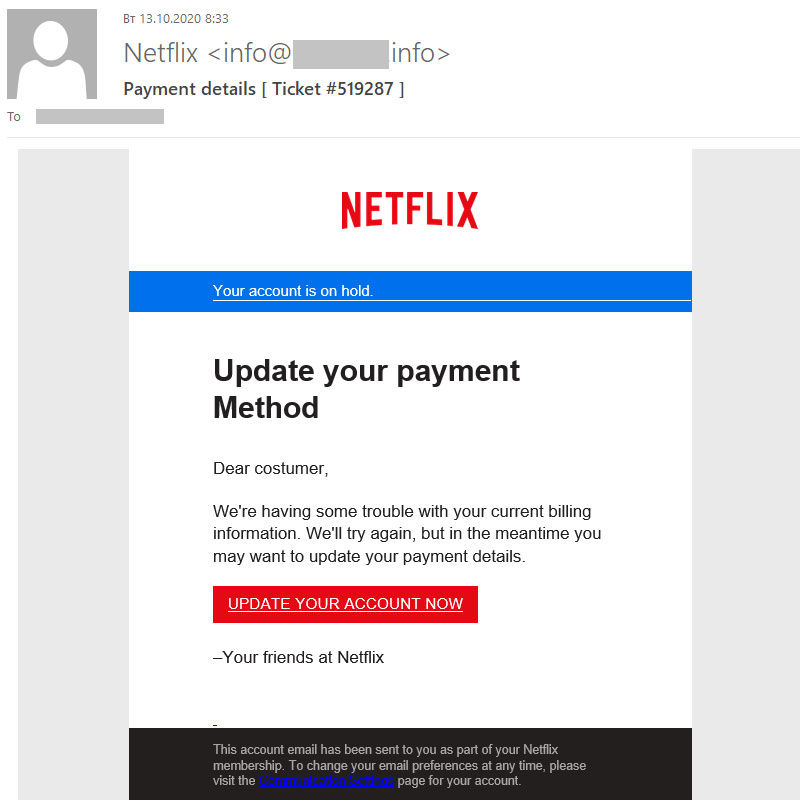
For a long time I have warned you that the popularity of Netflix makes it a preferred subject for phishing emails. Particularly since the start of the pandemic many of us, myself included, have been watching a lot of Netflix programming and this has increased the motivation of scammers to set up many phony Netflix websites to which they lure people through emails and text messages to go to under the guise of a variety of phony reasons, such as needing to update your information or confirm information as shown in the copy of a Netflix phishing email below. Of course, the real purpose of these phony Netflix websites and the phishing emails and text messages sent to you is to lure you into going to these phony Netflix websites to trick you into providing your credit card information or your username and password which can then be sold by cybercriminals on the Dark Web to people looking to use Netflix for free.
TIPS
As I always say, “trust me, you can’t trust anyone.” You can never be truly sure when you receive an email seeking personal information such as your credit card number whether or not the email is a scam. The risk of clicking on a link or providing the requested information is just too high. Instead, if you think that the email might be legitimate, you should contact the company at a telephone number that you know is legitimate and find out whether or not the email or text message was a scam. In this particular scam, a strong indication that this is a scam is the lack of your name in the email and the misspelling of “costumer” rather than “customer.”
It is also important to remember that Netflix will never ask in an email or text message for any of your personal information so anytime you get an email or text message purportedly from Netflix asking for your credit card number, Social Security number or any other personal information, it is a scam. Here is a link to Netflix’s security page for information about staying secure in regard to your Netflix account. https://help.netflix.com/en/node/13243
For those of you receiving the Scam of the day through an email, I just want to remind you that if you want to see the ever increasing list of Coronavirus scams go to the first page of the http://www.scamicide.com website and click on the tab at the top of the page that indicates “Coronavirus Scams.” Scamicide was recently cited by the New York Times as one of three top sources for information about Coronavirus related scams.
If you are not a subscriber to Scamicide.com and would like to receive daily emails with the Scam of the day, all you need to do is to go to the bottom of the initial page of http://www.scamicide.com and type in your email in the tab that states “Sign up for this blog.”