
Scam of the Day
Scam of the day – December 13, 2021 – Used Car Scams
Due to computer chip shortage, automobile manufacturers are producing fewer new cards and many consumers are turning to buying a used car. A problem about which people often are unaware involves the sale of used cars that were damaged in a storm or hurricane. In the past, the Massachusetts Registry of Motor Vehicles and other state RMVs have issued warnings to consumers to be on the lookout for used cars with phony title papers that indicate that the particular used car in which you are interested is from a state such as Oregon when in fact, these cars are cars that were from hurricane ravaged areas with many of them containing hidden water damage that could present serious safety problems.
In one instance, a report for a car purported to be from Oregon showed a damage report filed previously that showed the car listed as a total loss vehicle with a salvage title listed in New York and a new title later issued in Oregon. This practice of transporting a car to another state and re-registering it is called “title washing.” In order to protect yourself when you are buying a used car you should always have a mechanic whom you trust check out any used car that you are considering buying.
TIPS
Prior to buying a used car you should always get a full report on its history. The United States Department of Justice operates The National Motor Vehicle Title Information System which provides much information about used cars. The NVMTIS provides a list of various companies such as Carfax that have been approved to provide reliable reports. These companies charge between $2.95 and $12.99 for a report that will provide detailed information including the car’s accident and repair history on any used car you are considering purchasing. You also can get some information about a particular car’s title, most recent odometer reading and condition from the National Motor Vehicle Title Information System for free. https://www.nicb.org/
Also, the National Insurance Crime Bureau has a free database that will indicate whether a particular car was flood-damaged, stole but not recovered or otherwise declared as salvaged if the car was insured at the time it was damaged. https://www.nicb.org/
For those of you receiving the Scam of the day through an email, I just want to remind you that if you want to see the ever increasing list of Coronavirus scams go to the first page of the http://www.scamicide.com website and click on the tab at the top of the page that indicates “Coronavirus Scams.” Scamicide has been cited by the New York Times as one of three top sources for information about Coronavirus related scams.
If you are not a subscriber to Scamicide.com and would like to receive daily emails with the Scam of the day, all you need to do is to go to the bottom of the initial page of http://www.scamicide.com and type in your email address on the tab that states “Sign up for this blog.”
Scam of the day – December 12, 2021 – FTC Sending 3rd Round of Checks to Victims of Business Coaching Scam
Business coaches are people who advise and guide business owners in the operating and growing their businesses. They can be quite helpful, particularly to entrepreneurs. However, scammers posing as business coaches take advantage of trusting business owners by selling worthless services to their unwary victims. I have reported on this scam numerous times in the past, but it is timely again with the FTC’s settlement of charges against the operators of Coaching Department and Apply Knowledge who scammed millions of dollars from consumers by falsely promising their victims that they could easily earn thousands of dollars each month if they bought the business coaching services offered. The truth is that the people who bought the business coaching services from Coaching Department and Apply Knowledge lost thousands of dollars. The Federal Trade Commission (FTC) has previously sent two rounds of refunds to victims of the scam in October of 2019 and June of 2020 at which times I informed you of the refunds here in Scamicide. Now the FTC is sending out another round of refunds bringing the amount being returned to victims to 48% of their losses.
If you were a victim of this scam, you may be eligible for a refund. For more information about this refund program, click on the FTC Scam Refunds tab in the middle of the first page of http://www.scamicide.com. There are no fees involved with receiving a refund through this program. Anyone contacting you about this refund program who demands a fee or payment of any kind is a scammer.
TIPS
Before hiring the services of a business coach, you may want to find out what helpful advice you can get for free through government agencies such as the Small Business Administration. http://www.sba.gov/starting-managing-business
If you do decide to hire a business coach, you should find out if there are any complaints filed against him or her. An easy way to do this is to just do a search engine search in which you look up the person’s name with the words “scam” or “complaint” and see what comes up. Also, be wary of paying up front for the services of business coaches before they provide any services.
Last year the FTC refunded more than 483 million dollars to scam victims, however the U.S. Supreme Court unfortunately ruled this year that the FTC does not have the authority to make such refunds from money collected by the FTC from scammers. The FTC has asked Congress to restore the FTC’s ability to get money from scammers and return it to scam victims. Fortunately, there is pending legislation, H.R. 2668 which would return that authority to the FTC. I urge you to contact your representatives in Congress and the Senate and tell them to vote in favor of this legislation. Here is a link you can use to contact your representative in Congress. https://www.house.gov/representatives/find-your-representative And here is a link you can use to contact your senator. https://www.senate.gov/senators/senators-contact.htm
For those of you receiving the Scam of the day through an email, I just want to remind you that if you want to see the ever increasing list of Coronavirus scams go to the first page of the http://www.scamicide.com website and click on the tab at the top of the page that indicates “Coronavirus Scams.” Scamicide was cited by the New York Times as one of three top sources for information about Coronavirus related scams.
If you are not a subscriber to Scamicide.com and would like to receive daily emails with the Scam of the day, all you need to do is to go to the bottom of the initial page of http://www.scamicide.com and type in your email address in the tab that states “Sign up for this blog.”
Scam of the day – December 11, 2021 – Mavis Wanczyk Lottery Scam Strikes Again
I have been writing about scams related to Mavis Wanczyk for four years but recently I have received many emails from Scamicide readers telling me about various new incarnations of a variety of scams that share the same hook which is that Mavis Wanczyk is giving money away to lucky people. Many of you may not remember the name of Mavis Wanczyk, but she was the lucky winner of a 758 million dollar Powerball drawing in 2017. Not long after she claimed her prize, a scam started appearing in which many people received emails with the message line referring to the Mavis Wanczyk Cash Grant. The email indicated that you were chosen to receive a large cash grant from Mavis Wanczyk. All the lucky strangers receiving the emails had to do was provide personal information in order to qualify for the grant. In addition, phony social media accounts on Twitter, Facebook and Instagram were also set up in Ms. Wanczyk’s name through which people were contacted with the same phony offer of free money informing them that in order to qualify for the grant they merely needed to provide personal information.
Here is a post from the Instagram account of a recent scammer pretending to be Mavis Wanczyk.

Another version of the Mavis Wanczyk lottery scam that victimized a Scamicide reader started with a text message purportedly from Mavis Wanczyk informing the targeted victim that she would give $15,000 to the targeted victim. All the victim had to do was pay some fees. After paying $3,786.68 through untraceable Bitcoin cryptocurrency, the victim still had not received anything who was then prompted to send an additional $300 for expedited delivery of his check. After paying that amount, the scammers still had not sent anything, but did demand access to the victim’s Facebook account. Finally, the greedy scammers even threatened to turn in the victim to the FBI unless they were paid $500. It does take quite a bit of gall for criminals to threaten victims with reporting them to law enforcement, but gall does not appear to be in short supply when it comes to scammers.
TIPS
It is difficult to win a lottery you have entered. It is impossible to win one that you have never entered and neither lottery winners, nor anyone else is sending out messages through the Internet offering free money to anyone who responds with personal information. Never give out personal information that can make you vulnerable to identity theft unless you have absolutely verified that the party requesting the personal information is legitimate and has a legitimate need for the information. Also never pay anything to a lottery claiming you owe fees in order to claim your prize. This is a telltale sign of a scam. No legitimate lottery requires the payment of a fee to collect your winnings or requires you to pay the lottery income taxes on the prize. While income taxes are due on lottery winnings, those taxes are either deducted by the lottery sponsor before giving you your prize or the prize is given to you in full and you are responsible for the payment of any taxes. No lottery collects taxes on behalf of the IRS.
You should never give anyone access to your social media accounts because scammers use your account to scam others who trust you and fall for scams that appear to come from you.
Finally and most importantly, remember neither Mavis Wanczyk nor any other lottery winner is giving away money to strangers.
For those of you receiving the Scam of the day through an email, I just want to remind you that if you want to see the ever increasing list of Coronavirus scams go to the first page of the http://www.scamicide.com website and click on the tab at the top of the page that indicates “Coronavirus Scams.” Scamicide was cited by the New York Times as one of three top sources for information about Coronavirus related scams.
If you are not a subscriber to Scamicide.com and would like to receive daily emails with the Scam of the day, all you need to do is to go to the bottom of the initial page of http://www.scamicide.com and insert your email address where it indicates “Sign up for this blog.”
Scam of the day – December 10, 2021 – Watch Out For Phony Coupons – They Can Cost You Dearly
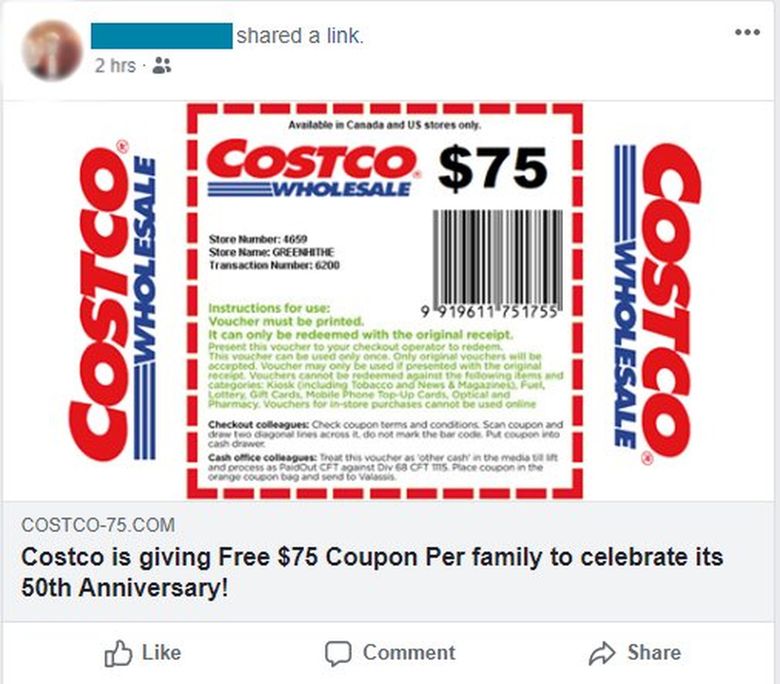
The holiday shopping season is well underway and, many people are looking for coupons to cut the cost. Everyone loves coupons and like many things in our lives, coupons which used to be found commonly in newspapers and magazines have migrated online. Last year the Better Business Bureau issued a warning about phony coupons appearing on social media. Among the companies affected by these phony coupons were Bath and Body Works, Costco, Aldi, Starbucks and Trader Joe’s. As I have warned you many times in the past, Facebook has become a hotbed for phony online coupons. The phony coupons looks quite legitimate which means nothing because it is very easy to copy the company logos and make the coupons appear to be genuine. The way that many phony coupon scams work is that in order to qualify for the coupon, you must complete a survey in which you are required to provide much personal information that is used to make you a victim of identity theft. In other versions of the scam, the scammer actually asks for your credit card numbers. In yet another version of the scam you are required to buy many costly items in order to claim your “free” coupon. Many of the coupon scams also require you to forward the coupon to friends which make the phony coupons look more legitimate when they are received by your friends. Ultimately, in all of these scams, the coupons are worthless and you get nothing, but the opportunity to become a victim of identity theft. Here is a copy of a phony coupon appearing online. It was provided by the Identity Theft Resource Center.
TIPS
If the coupon appears too good to be true, it usually is a scam. No company could cover the cost of giving away vast numbers of $75 coupons although sometimes, participants in legitimate surveys are promised a chance to win a prize in a drawing. Facebook is a favorite venue for scammers perpetrating this type of scam because often unwary victims will unwittingly share the scam with their friends. One way to determine if a coupon is legitimate is to look for the expiration date found on most coupons. The phony Costco coupon shown above like most phony coupons does not carry an expiration date. The best place to go to find out if a coupon is legitimate is to go to the company’s website to see what real coupons are being offered.
For those of you receiving the Scam of the day through an email, I just want to remind you that if you want to see the ever increasing list of Coronavirus scams go to the first page of the http://www.scamicide.com website and click on the tab at the top of the page that indicates “Coronavirus Scams.” Scamicide was cited by the New York Times as one of three top sources for information about Coronavirus related scams.
If you are not a subscriber to Scamicide.com and would like to receive daily emails with the Scam of the day, all you need to do is to go to the bottom of the initial page of http://www.scamicide.com and type in your email address on the tab that states “Sign up for this blog.”
Scam of the day – December 9, 2021 – Identity Thief Who Stole From Mailboxes Sentenced
Identity theft can be high tech, low tech or no tech. Stealing mail from mailboxes for purposes of identity theft has been done by identity thieves for years. Numerous times over the last ten years I have warned you about the danger of having your mail, such as credit card bills or bank statements stolen from your personal mailbox. In addition, many people put themselves in great danger of identity theft by putting their outgoing mail in their mailbox and put up the red flag to alert the mail carrier that there is mail to be picked up. Unfortunately, that is also an alert to identity thieves cruising the neighborhood of mail to be easily stolen.
Recently in Tennessee, Shamari Johnson was convicted of mail fraud and identity theft charges and sentenced to 75 months in prison. Johnson cruised through neighborhoods stealing both outgoing and delivered mail from the mailboxes of residents. From the stolen mail that included checks, he was able to create counterfeit checks. He also used personal information contained in the mail for purposes of identity theft.
TIPS
In order to avoid becoming a victim of identity theft through your mailbox, you should make sure that it is securely locked so that it is not easily accessed by your friendly neighborhood identity thief and when it comes to outgoing mail, don’t put it in your mailbox for your mail carrier to pick up regardless of how convenient it may be to do so. In fact, identity thieves also steal mail from the U.S. Postal Service mailboxes found on the corners of major streets so, in order to be safe, you should mail your outgoing mail at the post office. It may seem like this is being a bit excessive when it comes to protecting your mail, but remember, even paranoids have enemies.
Another thing you can do to reduce the danger of identity theft through mail theft is to use the Informed Delivery Program of the USPS. The Informed Delivery Program is a free service of the U.S. Postal Service that will send you an email each morning with images of the mail you will be receiving later that day. This service was first done on a pilot basis in 2014 in parts of California, Connecticut, Maryland, Virginia and Washington D.C. and became available to everyone three years later. Identity theft through the stealing of mail such as credit card statements and bank statements from your mailbox is a significant problem and this program both alerts you as to when to look for important mail, as well as let you know if such important mail has been stolen from your mailbox so you can respond more quickly. However, nothing is full proof. A few years ago I told you about the identity theft of more than thirty-five people living in the same Miramar, Florida neighborhood caused by criminals exploiting flaws in the program. These criminals signed up for the program in the names of their victims and were able to see when credit card statements and other mail containing personal information would be delivered so that they were alerted as to when to steal the mail from the mail boxes of their victims and gain access to their credit cards as well as sign her up for additional cards which they also exploited. While in order to set up an Informed Delivery account, you need to answer security questions, the information necessary to answer those questions can often be readily obtained online.
The best way to avoid the problem of someone using the Informed Delivery Program to learn about your upcoming mail deliveries is to sign up for the Informed Delivery Program yourself before an identity thief does so in your name. Here is the link to go to sign up.
https://informeddelivery.usps.com/box/pages/intro/start.action
It is also important to note that if you do sign up for the service, you should use a unique and complex password to prevent identity thieves from hacking your account to let them know when important mail that they can exploit for identity theft purposes will be arriving to your home.
For those of you receiving the Scam of the day through an email, I just want to remind you that if you want to see the ever increasing list of Coronavirus scams go to the first page of the http://www.scamicide.com website and click on the tab at the top of the page that indicates “Coronavirus Scams.” Scamicide has been cited by the New York Times as one of three top sources for information about Coronavirus related scams.
If you are not a subscriber to Scamicide.com and would like to receive daily emails with the Scam of the day, all you need to do is sign up for free using this link. https://scamicide.com/scam-of-the-day/
Scam of the day – December 8, 2021 – Jury Duty Scams Increasing
I have been warning you about the jury duty scam for nine years, but it continues to snare many unwary victims. This scam has been used effectively for years by scammers to con people out of their money. The scam starts with a telephone call that you receive purportedly from a law enforcement officer informing you that you have failed to appear for jury duty and that a warrant has been issued for your arrest. You are told, however, that you can avoid arrest and greater fines by paying a fine through a credit card or or prepaid cash card. Of course, the phone call is a scam. Even if you have missed jury duty, you will never be called by legitimate court officers and shaken down for a payment. The FBI warning noted that often now the scammers will use a technique called “spoofing” to make the call appear on your Caller ID as if it is coming from a legitimate law enforcement agency or court. In some instances of the scam you are asked to confirm your identity by providing your Social Security number which will then be used to make you a victim of identity theft. Recently the scam has evolved to where people are also being contacted by text messages or emails from scammers posing as a representative of the local court system. Earlier this week the Oregon Judicial Department warned Oregonians about an increase in these scams, however, these scams are by no means limited to Oregon. They are turning up everywhere.
TIPS
Initial contacts from courts regarding jury duty are always in writing through the mail although some systems will permit you to receive future notices through email. Under no circumstances will you receive telephone calls or text messages indicating that you have failed to report for jury duty. No court will demand payment over the phone for failing to appear for jury duty. If you do receive such a call and you think that there is even the possibility that you might have forgotten to report for jury duty, merely call the local clerk of courts in order to get accurate information. Of course anyone calling you and telling you that you can pay your fine to them over the phone using your credit card or a gift card is a scammer.
For those of you receiving the Scam of the day through an email, I just want to remind you that if you want to see the ever increasing list of Coronavirus scams go to the first page of the http://www.scamicide.com website and click on the tab at the top of the page that indicates “Coronavirus Scams.” Scamicide has been cited by the New York Times as one of three top sources for information about Coronavirus related scams.
If you are not a subscriber to Scamicide.com and would like to receive daily emails with the Scam of the day, all you need to do is to go to the bottom of the initial page of http://www.scamicide.com and type in your email address where it states “Sign up for this blog.”
Scam of the day – December 7, 2021 – Hacker Sentenced for Stealing Millions of Dollars Worth of Cryptocurrencies.
Garrett Endicott recently was sentenced to prison for his role in a hacking conspiracy perpetrated by a criminal group known as “The Community” that stole millions of dollars worth of cryptocurrencies from their victims through SIM card swapping which gave Endicott and the other five members of “The Community” access to the cryptocurrency accounts of their victims. SIM card swapping is a major problem. A Subscriber Identity Module, more commonly known as a SIM card, is an integrated circuit that stores information used to authenticate subscribers on mobile devices, such as a cell phone. The SIM card is able to be transferred between different devices, and often is, when people update into a newer cell phone. However, as more and more financial transactions, such as online banking, are now done through cell phones, identity thieves with access to their victims’ SIM cards are also increasingly becoming able to intercept security codes sent by text messages for online banking as part of dual factor authentication and thereby providing the identity thief with the opportunity to empty their victims’ bank accounts and cause other financial havoc.
SIM card swapping or porting as it is sometimes referred to is the name for the crime where someone convinces your phone carrier to transfer your SIM card to a phone controlled by the criminal. By SIM swaps, criminals can reset passwords on online accounts and request dual factor authentication codes be sent to their phones which will render dual factor authentication useless as a security measure. Sometimes criminals contact the mobile service providers of their victims posing as the victims and trick the mobile service provider employees to swap the SIM cards to phones controlled by the criminals Other times criminals bribe employees at their victims’ mobile service providers to achieve the SIM swap.
SIM card swapping has resulted in huge losses including one instance in which a victim had 23.8 million dollars worth of cryptocurrencies stolen from his account by someone who accessed the account through SIM swapping that thwarted the dual factor authentication used by the victim to protect the security of the account.
In a new development the Federal Communications Commission (FCC) is proposing new regulations that will require phone carriers to better authenticate customers before redirecting a customer’s phone number to a new device or carrier. In addition, the new proposals would require phone carriers to immediately notify its customers whenever a SIM card change is requested for their phone number.
TIPS
The best protection for your phone starts with a strong password, facial recognition or fingerprint scanner. Also, set your phone so that it locks when you are not using it. Make sure that you back up everything in your phone regularly. Install the Find My iPhone app if you have an iPhone or the Find My Device app if you have an Android phone. These will enable you to locate your cellphone if it is lost or stolen and also allow you to send a command to erase everything in your cellphone even if the phone has been turned off. If your phone is lost or stolen, you should immediately contact your wireless provider to have them disable the SIM card in your phone so that your phone cannot be used by someone else. As for protecting your phone from cyberattacks, it is important to both download and continually update security software.
Perhaps the best thing you can do to protect your SIM card from SIM card swapping is to set up a PIN or password to be used for access to your mobile service provider account. This will help prevent a criminal from calling your carrier posing as you and convincing your mobile carrier to swap your SIM card to the criminal’s phone merely by providing personal identifying information or answering a security question.
AT&T will allow you to set up a passcode for your account that is different from the password that you use to log into your account online. Without this passcode, AT&T will not swap your SIM card. Here is a link with instructions as to how to set up the passcode. https://www.att.com/esupport/article.html#!/wireless/KM1051397?gsi=9bi24i
Verizon enables customers to set up a PIN or password to be used for purposes of authentication when they contact a call center. Here is a link with information and instructions for setting up a PIN with Verizon. https://www.verizonwireless.com/support/account-pin-faqs/
T-Mobile will allow you to set up a passcode that is different from the one you use to access your account online. This new passcode is used when changes to your account are attempted to be made such as swapping a SIM card. This code will not only protect you from criminals attempting to call T-Mobile and swap your SIM card, but will also prevent someone with a fake ID from making changes to your account at a T-Mobile store. Here is a link to information and instructions for adding a new passcode to your account. https://www.t-mobile.com/customers/secure
Sprint customers can establish a PIN that must be provided when doing a SIM swap, in addition to merely answering a security question, the answer to which may be able to be learned by a clever identity thief. Here is a link to information about adding a PIN to your Sprint account. https://www.sprint.com/en/support/solutions/account-and-billing/update-your-pin-and-security-questions-on-sprint-com.html
For those of you receiving the Scam of the day through an email, I just want to remind you that if you want to see the ever increasing list of Coronavirus scams go to the first page of the http://www.scamicide.com website and click on the tab at the top of the page that indicates “Coronavirus Scams.” Scamicide has been cited by the New York Times as one of three top sources for information about Coronavirus related scams.
If you are not a subscriber to Scamicide.com and would like to receive daily emails with the Scam of the day, all you need to do is sign up for free by going to the bottom of the first page of Scamicide.com and typing in your email address where it indicates “Sign up for our blog.”
Scam of the day – December 6, 2021 – Hacked Email Account Scams
“I’m sorry for any inconvenience this will cost you. I got bad news this morning that I lost a childhood friend to the deadly COVID-19. I want to support the struggling family with a small donation .So I was going to ask if you could kindly help me send out a donation to them anytime you can today, I’m having issue with my bank I contacted my bank and they told me it would take a couple of days to get it sorted I would refund you when I get it sorted soon. Kindly let me know if that will be possible.
For those of you receiving the Scam of the day through an email, I just want to remind you that if you want to see the ever increasing list of Coronavirus scams go to the first page of the http://www.scamicide.com website and click on the tab at the top of the page that indicates “Coronavirus Scams.” Scamicide was cited by the New York Times as one of three top sources for information about Coronavirus related scams.
If you are not a subscriber to Scamicide.com and would like to receive daily emails with the Scam of the day, all you need to do is to go to the bottom of the initial page of http://www.scamicide.com and type in your email address on the tab that states “Sign up for this blog.”
Scam of the day – December 5, 2021 – FTC Refunding 1.8 Million Dollars to Consumers Defrauded by Lifewatch
Scams involving medical services have been a staple of scam artists since the earliest days of time and seniors are frequently targets of scams so when you put the two together, you have the perfect storm for scams. Although there are many companies that offer medical alert systems for seniors, there are many scammers that sell these services to unwary seniors. So how do you tell the sales pitch for a scam medical alert company from the sales pitch for a legitimate medical alert company? One way to tell is if the sales pitch comes via an illegal prerecorded robocall. Since commercial robocalls are illegal, obviously a company selling you their services through this type of call has little regard for the law and you should have little regard for that company. Six years ago I told you about one such company, Lifewatch which in 2015 was sued by both the Federal Trade Commission (FTC) and the Attorney General of Florida who alleged that the company violated the law not only through illegal robocalls, but also by alleging that the medical alert system they offered was free and already been paid for by a friend or family member when that was untrue. They also were accused of misrepresenting that their product has been endorsed by AARP, which it was not. Finally, they were accused of telling prospective customers that they would not be charged anything (in regard to the product that they already had been told had been prepaid) until they activated the device. The truth, according to the FTC, is that Lifewatch charged people immediately.
Now six years later, the lawsuit has been settled with Lifewatch providing 1.8 million dollars to the Federal Trade Commission (FTC) which is returning the funds to victims of the scam. The checks being sent by the FTC must be cashed within 90 days of the date of the check. For more specific information about these refunds go the “FTC Scam Refunds” tab in the middle of the initial page of Scamicide.com.
TIPS
Since commercial robocalls are illegal, if a product is being pitched to you in a robocall, you can’t trust the company so why should you buy the product? As for medical alert services, if you are considering buying one, you should first check with your physician and then check out the company with the FTC, the Better Business Bureau, your state attorney general and even by just putting the name of the company into a Google search with the word “scam” and see what come up.
Last year the FTC refunded more than 483 million dollars to scam victims, however the U.S. Supreme Court unfortunately ruled this year that the FTC does not have the authority to make such refunds from money collected by the FTC from scammers. The FTC has asked Congress to restore the FTC’s ability to get money from scammers and return it to scam victims. Fortunately, there is pending legislation, H.R. 2668 which would return that authority to the FTC. I urge you to contact your representatives in Congress and the Senate and tell them to vote in favor of this legislation. Here is a link you can use to contact your representative in Congress. https://www.house.gov/representatives/find-your-representative And here is a link you can use to contact your senator. https://www.senate.gov/senators/senators-contact.htm
For those of you receiving the Scam of the day through an email, I just want to remind you that if you want to see the ever increasing list of Coronavirus scams go to the first page of the http://www.scamicide.com website and click on the tab at the top of the page that indicates “Coronavirus Scams.” Scamicide was cited by the New York Times as one of three top sources for information about Coronavirus related scams.
If you are not a subscriber to Scamicide.com and would like to receive daily emails with the Scam of the day, all you need to do is to go to the bottom of the initial page of http://www.scamicide.com and type in your email address on the tab that states “Sign up for this blog.”
Scam of the day – December 4, 2021 – TSA PreCheck Scam Increasing
Scams related to the Transportation Security Administration’s (TSA) PreCheck program have recently substantially increased. I first warned you about this last August when the scams began. For those people unfamiliar with the PreCheck program, the TSA has a long standing program called TSA PreCheck which enables you to go through an expedited screening at the airport in special lines without having to remove your shoes, belts or jackets.
In order to obtain PreCheck status you need to both apply online and then schedule an appointment at one of 380 enrollment centers. The in-person appointment which includes fingerprinting and a background check is generally completed in ten minutes.
Unfortunately, scammers, of course, have been taking advantage of people trying to sign up for the TSA PreCheck program and are setting up phony websites that appear to be official websites of the TSA. They then lure you into providing personal information they use to make you a victim of identity theft as well as steal the money they charge you online for a phony TSA PreCheck enrollment. Recently we have seen the scammers charging $140 for their worthless services. The actual enrollment price is $70.
TIPS
Part of the problem is that some sophisticated scammers are adept at manipulating the algorithms used by Google Chrome and other search engines so that the phony websites appear high on a search. Merely because a website appears high on a search does not mean that it is legitimate. The only legitimate sites where you can apply for the TSA PreCheck program are https://www.tsa.gov/precheck and https://universalenroll.dhs.gov/
Also, it is important to note that when you first apply for the TSA PreCheck program, you cannot pay online. You can register for the program, but you pay when you have your in-person appointment. Therefore any site that asks you to pay online for your initial TSA PreCheck status is a scam. TSA PreCheck status is good for five years, but it can be renewed. When you renew, you can do the entire process including payment online. The renewal process also has been exploited by scammers sending you emails posing as the TSA encouraging you to click on links to renew your status. This is problematic since when you actually need to renew your status, you will get an email from the real TSA, however, it can be difficult to distinguish the phony TSA email from that of the real TSA so you are best checking directly with the TSA to see about renewing your status. You can use this link to find about your present status, whether you need to renew and how to do so properly. https://www.tsa.gov/travel/frequently-asked-questions/how-do-i-renew-my-membership-when-it-expires
For those of you receiving the Scam of the day through an email, I just want to remind you that if you want to see the ever increasing list of Coronavirus scams go to the first page of the http://www.scamicide.com website and click on the tab at the top of the page that indicates “Coronavirus Scams.” Scamicide has been cited by the New York Times as one of three top sources for information about Coronavirus related scams.
If you are not a subscriber to Scamicide.com and would like to receive daily emails with the Scam of the day, all you need to do is sign up for free using this link. https://scamicide.com/scam-of-the-day/