
Scam of the Day
Scam of the day – November 30, 2025 – Holiday Charity Scams: How to Spot Fake Police and Fire Department Solicitations
The holiday season is now in full swing. This is a time when many people give to charities. In particular, you will most likely be contacted by numerous people soliciting charitable contributions on behalf of organizations purporting to support the brave men and women who make up our police and fire departments. Unfortunately, many of those solicitations will be from scammers merely looking to steal money under false pretenses. Whenever you are solicited by email or phone, you can never be sure who is really contacting you. In addition, even if you are on the Federal Do No Call List, the law permits charities to call you, however, unfortunately you can never be sure when you receive a call that purports to be from a charity whether the call is legitimate or not. Similarly when you receive a text message or email solicitation for a charity, you have no way of knowing if the solicitation is from a scammer or a legitimate charity.
TIPS
Whenever you get an email, call or a text message, you can’t be sure as to who is really contacting you. Even if the call appears to come from your local police department, scammers can manipulate your Caller ID through a technique called “spoofing” to make it appear that the call is legitimate when it is not and email addresses used by scammers can also appear legitimate. If you think the email, call or text message may be legitimate, merely contact your local police department at a telephone number you know is legitimate to determine whether or not the email, call or text message was a scam.
Phony charities often have names that sound legitimate and it is difficult to know merely from a solicitation whether or not the charity is a fake. Other times, scammers will use the name of a legitimate charity when they solicit you by phone, email or text message and you can never be sure when you are contacted by email or text message whether or not the solicitation is legitimate. Prior to giving to any charity, I suggest you first look into whether indeed the charity is legitimate or not and the best way I know to do that is to go to http://www.charitynavigator.org where not only can you find out whether the charity is a scam, but also whether or not your donation will be tax deductible, how much of your donation goes toward the charitable purposes of a legitimate charity and how much goes toward salaries, administrative costs and fund raising. Charitynavigator.org will also give you access to the websites and phone numbers of legitimate charities you may wish to consider giving to so you can feel confident when you make a gift that it is going to the right place.
If you are not a subscriber to Scamicide.com and would like to receive daily emails with the Scam of the day, all you need to do is sign up for free using this link. https://scamicide.com/scam-of-the-day/
Scam of the day – November 29, 2025 – Beware Holiday Delivery Scam Emails: How to Spot Fake Refund Offers
The holiday shopping season is in full swing and many people are doing their shopping online which means that their packages will be delivered by the United States Postal Service, Federal Express, UPS or Amazon. With so many packages being delivered at this time of year, it is inevitable that some packages will be delayed. In this case, scammers, posing as the United States Postal Service, Federal Express and UPS and Amazon are contacting people apologizing for the delay in receiving their orders and offering a refund of their money. The emails contain a link for you to click on to process your claim for a refund, but unfortunately, if you click on the link either you will automatically download harmful malware or you will be prompted to provide information that will be used to make you a victim of identity theft.
TIPS
As always, the first thing you should look at when you get such an email is the address from which it was sent. In many instances the email address of the sender has no relation to the United States Postal Service, Federal Express, UPS or Amazon. Often the email is that of someone whose email account has been hijacked by the scammer and made a part of a botnet of zombie computers used to send out such phishing emails. However, in other instances, the email address may appear legitimate. But remember my motto, “trust me, you can’t trust anyone.” Even if the email address of the sender looks legitimate, you should never click on a link unless you have absolutely confirmed that the email is legitimate. In this case it is important to remember that none of these companies are contacting people by email or text messages offering refunds.
For information about refunds for late deliveries of UPS use this link https://www.ups.com/no/en/support/shipping-support/legal-terms-conditions/ups-service-guarantee.page
For information about refunds for late deliveries of Federal Express use this link https://www.fedex.com/en-us/service-guide/money-back-guarantee.html
For information about refunds for late deliveries of Amazon use this link https://www.amazon.com/gp/help/customer/display.html?nodeId=GZ5R2Y8QHENSLW75
If you are not a subscriber to Scamicide.com and would like to receive daily emails with the Scam of the day, all you need to do is sign up for free using this link. https://scamicide.com/scam-of-the-day/
Scam of the day – November 28, 2025 – How to Protect Your Cryptocurrency Wallet from Scams: Essential Security Tips
I have been writing about cryptocurrency scams for years. There a variety of scams that attempt to steal your cryptocurrencies from you. One of the most important decisions anyone should make when deciding whether to invest in cryptocurrencies is what kind of a wallet they will hold their investment in. Many cryptocurrency scams involve people being tricked into turning over access to their cryptocurrency wallets and losing all of their funds.
Your digital wallet is where the key that allows you to access your cryptocurrency account is found. If your key falls into the hands of a hacker, you can easily lose all of your cryptocurrency account so it is of paramount importance to secure your digital wallet. Digital wallets can either be hot wallets or cold wallets. Hot wallets are connected to the Internet which makes them more susceptible to being hacked which is why a cold wallet which is not connected to the Internet, but rather is is kept in a portable hard drive is your best bet.
TIPS
When doing cryptocurrency transactions online, use a Virtual Private Network (VPN) to provide encryption for your communications which will make the transactions more secure and refrain from using public WIFI for cryptocurrency transactions. Use a strong, complex password for your account and consider using a password manager or store your password on a portable hard drive that you keep in a secure spot.
Use dual factor authentication for your account for additional security, however, it is important to note that many cryptocurrency thefts have occurred when hackers were able to defeat dual factor authentication through SIM swapping whereby they contact the cell phone service provider of their victim, answer a security question and manage to get the cell phone service provider to switch the phone number of the victim to a phone controlled by the criminal thus defeating the dual factor authentication.
The best thing you can do to protect your SIM card from being swapped is to set up a PIN or password to be used for access to your mobile service provider account. This will help prevent a criminal from calling your carrier posing as you and convincing your mobile carrier to swap your SIM card to the criminal’s phone merely by providing personal identifying information or answering a security question.
Finally, I strongly urge anyone considering investing in cryptocurrencies as well as any investment to research the investment thoroughly before investing. No one should ever invest in anything they do not fully understand.
If you are not a subscriber to Scamicide.com and would like to receive daily emails with the Scam of the day, all you need to do is sign up for free using this link. https://scamicide.com/scam-of-the-day/
Scam of the day – November 27, 2025 – Does the Social Security Administration Suspend Your SSN? The Truth About SSA Scams
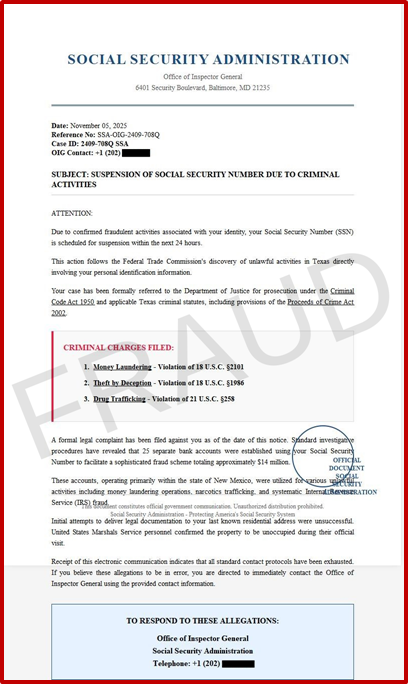
The Social Security Administration has issued a warning about an imposter scam presently circulating in which scammers receive an email with the subject line of “Alert: Social Security Account Issues Detected” with an attachment such as the one appearing below which purports to inform the targeted victim that his or her Social Security number will be suspended within 24 hours and their case referred for criminal prosecution. The letter provides a phone number to call to remedy the situation. If you call the number, a scammer posing as a Social Security representative will answer and require you to provide personal information and make a payment to resolve the situation.
Unfortunately, using AI it is a simple matter for a scammer to create an official appearing letter such as the one reproduced below.
TIPS
The first thing to note is that the Social Security Administration never suspends a Social Security number so immediately you can recognize this email as a scam. The Social Security Administration will never call, email or text you to threaten suspension of your Social Security number and they do not demand immediate payment for purported offenses. Nor, unlike scammers, do they demand payment by gift cards, wire transfers or cryptocurrencies. Only scammers demand payment by these methods.
If you are not a subscriber to Scamicide.com and would like to receive daily emails with the Scam of the day, all you need to do is to go to the bottom of the initial page of http://www.scamicide.com and type in your email address on the tab that states “Sign up for this blog.”
Scam of the day – November 26, 2025 – Online Shopping Safety Tips: How to Avoid Scams and Protect Your Data
Every year, the number of people shopping online and the money spent through online shopping grows significantly. And why not? The convenience alone of being able to shop from the comfort and privacy of your home is reason enough for many of us to shop online. But how safe is it? According to the FTC, online shopping scams were the second most common scams following imposter scams. However, following some basic precautions can go a long way in protecting you from being scammed when shopping online.
TIPS
Here is a list of some online shopping tips:
1. Make sure that the computer, laptop, tablet or phone you use is equipped with the anti-virus and anti-malware software and that you have updated the software with the latest security patches.
2. As with shopping at brick and mortar stores, don’t use a debit card for online purchases, as well. In the event of a data breach, the consumer protection laws in regard to fraudulent use of your debit card are not as protective as those that apply when your credit card is fraudulently used.
3. Don’t supply your credit card number unless the address of the website is preceded by the letters “https.” That additional letter “s” indicates that the transmission of your data is encrypted and secure.
4. Don’t leave your credit card number on record with the online retailers you use for the sake of convenience. Doing so only makes you more likely to become a victim of identity theft if the company suffers a data breach (and many of them will).
5. Don’t click on coupons or ads that you may receive by way of an email or text message regardless of how good they appear. They may be loaded with malware that will be downloaded on to your computer, tablet or phone if you click on the link. That malware can steal all of your personal information and lead to your becoming a victim of identity theft. Any legitimate coupon you might receive through an email or a text message will also be available on the website of the company where you want to shop.
6. Limit your online shopping to companies that you know and trust. Merely because a company comes up high on a Google search does not mean that the company is legitimate. Any company offering a price that appears too good to be true, should be particularly suspect. You can use the site whois.com to see who actually owns an online shopping site you are considering using. Scammers create phony shopping sites and often make them appear to be sites of legitimate retailers with which you are familiar. If using whois.com you find that the Walmart site you are considering using was only created a month ago and it was created by someone in Nigeria, you can be confident that it is a scam. You also can use sites such as trustpilot.com and resellerratings.com to check and see if a site you are considering is phony.
7. Use distinct and complex passwords for each online company with which you shop and use dual factor authentication whenever possible.
If you are not a subscriber to Scamicide.com and would like to receive daily emails with the Scam of the day, all you need to do is to go to the bottom of the initial page of http://www.scamicide.com and type in your email address on the tab that states “Sign up for this blog.”
Scam of the day – November 25, 2025 – Holiday Coupon Scams: How Fake Deals on Social Media Steal Your Data
Everyone loves coupons, particularly during the holiday shopping season. Like many things in our lives, coupons which used to be found commonly in newspapers and magazines have migrated online. In recent years scammers have been perpetrating phony coupon scams on social media. Among the companies affected by these phony coupons were Bath and Body Works, Costco, Aldi, Starbucks and Trader Joe’s. As I have warned you many times in the past, Facebook has become a hotbed for phony online coupons. The phony coupons looks quite legitimate which means nothing because it is very easy to copy the company logos and make the coupons appear to be genuine.
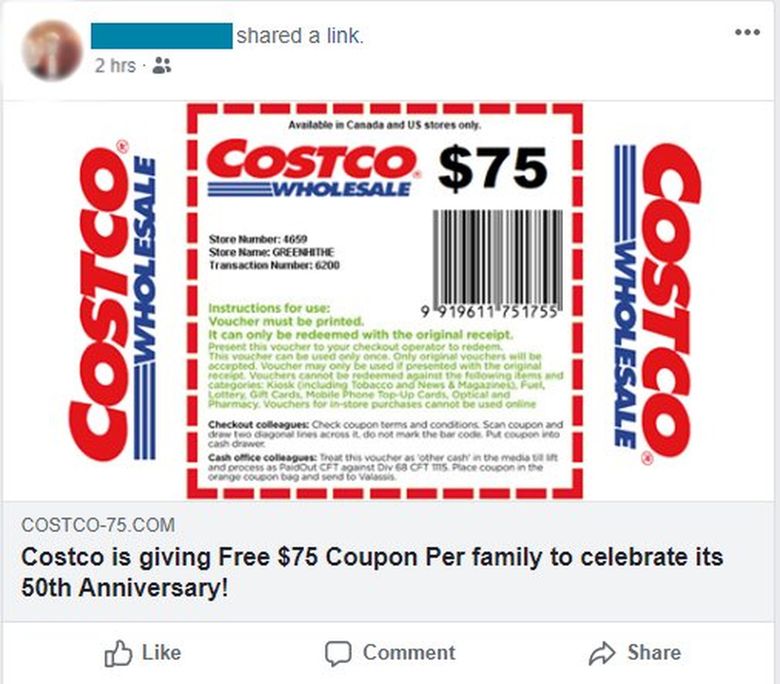
The way that many phony coupon scams work is that in order to qualify for the coupon, you must complete a survey in which you are required to provide much personal information that is used to make you a victim of identity theft. In other versions of the scam, the scammer actually asks for your credit card numbers. In yet another version of the scam you are required to buy many costly items in order to claim your “free” coupon. Many of the coupon scams also require you to forward the coupon to friends which make the phony coupons appear more trustworthy when they are received by your friends. Ultimately, in all of these scams, the coupons are worthless and you get nothing but the opportunity to become a victim of identity theft. Here is a copy of a phony coupon appearing online. It was provided by the Identity Theft Resource Center.
TIPS
If the coupon appears too good to be true, it usually is a scam. No company could cover the cost of giving away vast numbers of $75 coupons although sometimes, participants in legitimate surveys are promised a chance to win a prize in a drawing. Facebook is a favorite venue for scammers perpetrating this type of scam because often unwary victims will unwittingly share the scam with their friends. One way to determine if a coupon is legitimate is to look for the expiration date found on most coupons. The phony Costco coupon shown above like most phony coupons does not carry an expiration date. The best place to go to find out if a coupon is legitimate is to go to the company’s website to see what real coupons are being offered.
If you are not a subscriber to Scamicide.com and would like to receive free daily emails with the Scam of the day, all you need to do is to go to the bottom of the initial page of http://www.scamicide.com and type in your email address on the tab that states “Sign up for this blog.”
Scam of the day – November 24, 2025 – Black Friday Scams: How to Shop Safely and Avoid Skimmers
This coming Friday is Black Friday, the unofficial start of the holiday shopping season although I have been seeing holiday shopping displays since Halloween. The fact that Black Friday is such a huge shopping day is not lost on scammers who will be as pervasive as ever. Over the next few weeks, I will be focusing the Scams of the day on the many holiday season scams about which we should all be aware.
If you are shopping in a brick and mortar store Friday or any other day throughout the year, you should use a credit card rather than a debit card because of the possibility of skimmers which are small devices being used by criminals working as sales clerks that will capture your credit card number which will then be used to make fraudulent purchases. As for using your credit card rather than your debit card, it is important to remember that while your liability for fraudulent use of your credit card is limited by federal law to no more than $50, your liability for fraudulent use of your debit card which is tied to your bank account is unlimited if you do not promptly discover and report the fraud which is why you should always use your credit card for shopping rather than your debit card.
I will be discussing safe practices for online shopping in a future Scam of the day, but in the last couple of years the problem of what the FBI calls E-skimming has become more serious. E-skimming occurs when criminals infect the websites of numerous retailers in a manner that they are able to capture your credit card or debit card information when you enter it into the website. It is important to note that while your chip card will protect you if you use your chip card to make purchases at a brick and mortar store that has updated its credit card processing equipment to handle chip credit cards, you cannot use your chip for online purchases. However, as I indicated in the previous paragraph, the most you are responsible for if your credit card is used fraudulently is $50 and quite frankly I have never seen a credit card company even charge its customers that amount.
TIPS
For the reasons discussed above, try to use your credit card as a chip card whenever possible and always watch your credit card when it is being processed at a brick and mortar store. Don’t let it out of your sight because that is when you run the risk of a rogue clerk running it through a portable skimmer, which will steal the number of your card. Refrain from using your debit card except as an ATM card. Finally, in regard to the E-skimming threat, you should regularly monitor your credit card statement online rather than waiting for a monthly paper bill to be delivered to you so that if your credit card was compromised and your data stolen, you will be able to discover and report the problem to your credit card issuer quickly and avoid more problems.
If you are not a subscriber to Scamicide.com and would like to receive daily emails with the Scam of the day, all you need to do is to go to the bottom of the initial page of http://www.scamicide.com and type in your email address on the tab that states “Sign up for this blog.”
Scam of the day – November 23, 2025 – Gift Card Scams: How Hackers Trick You Through Fake Emails
Scammers are big fans of gift cards because they are easy to purchase, easy to send to the scammer and impossible to trace to the scammer. It is not even necessary for the scammer to be in possession of the actual gift card to use it. Sending the gift card numbers or taking a picture on your phone and transmitting it to the scammer is sufficient for the scammer to use the gift card to quickly buy things that can then be sold and converted into cash. In a current gift card related scam, people are reporting receiving emails from friends who for one reason or another need you to send them gift cards to cover some necessary expenses. Unfortunately, the email is sent to people on the contact list of a person whose email account was hacked so even though the email is coming from your friend’s email address, it was not sent by your friend, but by a scammer. Anyone providing the gift card numbers to the scammer, as requested, soon becomes aware that he or she has been scammed and lost the gift card funds forever.
Here is an email I received this week that appeared to come from someone I know.
“I need you to get an Apple E-gift card for a friend who is down with Liver Cancer, it’s her birthday today. I tried purchasing them myself but my card got declined. I contacted my bank and they told me it would take a couple of days to get it sorted and the stores around here are all out of stock, Could you get them on Amazon or Walmart and have them sent to her email address for delivery today? I ‘ll reimburse you once my bank sorts the issue out. I am just trying to put a smile on her face in this trying times. Let me know so I can provide you with her email address and the amount needed on them.”
TIPS
The key to protecting yourself from this scam is to be skeptical whenever you get a request to wire money or make a payment through gift cards because once money has been wired, it is gone forever which is why it is a favorite method of payment for scammers. As for gift cards, once you provide the numbers from the gift cards, the scammers utilize the gift cards to quickly make purchases that they then sell in order to get cash. Always confirm with a phone call the legitimacy of any request for you to send funds before you send anything. Finally, anytime anyone approaches you with a business transaction in which you are asked to pay through gift cards, you can be confident that it is a scam. The IRS has even had to post on its website that it does not accept gift cards as payments.
If you are not a subscriber to Scamicide.com and would like to receive daily emails with the Scam of the day, all you need to do is to go to the bottom of the initial page of http://www.scamicide.com and click on the tab that states “Sign up for this blog.”
Scam of the day – November 22, 2025 – Thanksgiving Scam Alert: Beware of Fake E-Greeting Cards and Malware
Thanksgiving is just a few days away and I want to wish everyone a happy and scam-free Thanksgiving..
Electronic greeting cards have become very popular and with good reason. Even if you don’t remember a birthday or delay sending a holiday card until the last minute, you can send an electronic greeting card, often for free, and have it delivered immediately. Many electronic greeting cards are quite creative with videos and music Unfortunately, you can always count on scam artists and identity thieves to try to spoil anything and electronic greeting cards are no exception. The scam starts when you get a phony electronic greeting card that requires you to click on a link to read the card. If you click on one of these phony greeting cards, you may end up downloading a keystroke logging malware program that will steal all of the information from your computer and end up with you becoming a victim of identity theft or alternatively you may download dangerous malware such as ransomware.
TIPS
One of the first things to notice when you receive an e greeting card is who is indicated as the person sending the card. If it states that the card is being sent by “a friend” or “an admirer,” you can be pretty sure that it is a phony card. However, even if the card uses the name of someone you know, it still is risky to open the card without confirming with an email or a phone call that your friend actually did send you the card. Remember, even paranoids have enemies. Scammers may pick a common name to use as the sender or may even have researched who your friends and family are and use their names..
It is also important to keep your security software including anti-virus software and anti-malware software installed and up to date at all times which can help if you unwittingly download malware. However, it is important to remember that even the most up to date security software is always at least thirty days behind the latest strains of malware often referred to as those that exploit “zero day defects.”
If you are not a subscriber to Scamicide.com and would like to receive daily emails with the Scam of the day, all you need to do is to go to the bottom of the initial page of http://www.scamicide.com and type in your email address on the tab that states “Sign up for this blog.”
Scam of the day – November 21, 2025 – Most Dangerous Celebrities Online: How Hackers Exploit Taylor Swift and Others
Each year, computer security company, McAfee releases a list of the most dangerous celebrities on the Internet. These are people whose popularity is exploited by identity thieves and hackers who lure unsuspecting people through links in emails, social media, deepfakes and text messages relating to these celebrities to malware filled websites where their victims unknowingly download ransomware or keystroke logging malware that enables the identity thieves to steal all of the personal information from the victim’s computer, laptop, smartphone or other electronic device and use that information to make the person a victim of identity theft. This year’s list not surprisingly is led by Taylor Swift followed by Scarlett Johansson, Jenna Ortega, Sydney Sweeney, Tom Cruise, Alexandra Ocasio-Cortez, Sabrina Carpenter, Lebron James, Kim Kardashian and Zendaya.
TIPS
It is important to remember that merely because a celebrity website turns up high on a Google search does not mean that it is legitimate. Google doesn’t check out websites for legitimacy in ranking sites. The ranking is done by secret algorithms that some identity thieves are adept at manipulating. A good practice is to check out the actual URL of any celebrity website with which you are unfamiliar with whois.com which will let you know who actually owns the particular website. This can help identify one that may have been set up by cybercriminals.
Also, as I constantly warn you, never click on links or download attachments unless you are absolutely sure that they are legitimate. It is also important to remember with some types of malware, merely going to an infected website will download dangerous malware so you need to be very careful. Merely because it appears that a friend is passing them on to you does not make them legitimate. As for celebrity videos and photos, you should have a healthy mistrust of websites with which you are not entirely familiar. For gossip, http://www.tmz.com is a good place to go. They always have the latest gossip and they are legitimate. Finally make sure that you keep all of your electronic devices secure with anti-malware and anti-virus software and keep your security software current with the latest security patches.
Don’t trust celebrity social media posts as they are often cloned by scammers. Always confirm any offers you see on social media purporting to be from celebrities with their official websites.
If you are not a subscriber to Scamicide.com and would like to receive daily emails with the Scam of the day, all you need to do is to go to the bottom of the initial page of http://www.scamicide.com and click on the tab that states “Sign up for this blog.”