
Scam of the Day
Scam of the day – August 1, 2023 – What to do if Your Email is Hacked
If you are not a subscriber to Scamicide.com and would like to receive free daily emails with the Scam of the day, all you need to do is to go to the bottom of the initial page of http://www.scamicide.com and insert your email address where it indicates “Sign up for this blog.”
Scam of the day – July 31, 2023 – OneDrive Phishing Scam
OneDrive is a popular cloud storage system of Microsoft that allows you to sync and save documents, pictures and files. Scammers send emails purporting to be from OneDrive, such as the one copied below that I received recently. If you click on the View File, you will either be lured into providing personal information that can lead to your becoming a victim of identity theft or download malware such as ransomware or keystroke logging malware that leads to your becoming a victim of identity theft.
|
|||||||||

|
TIPS
I was not expecting an email from the lawyer whose name appears in the email and so I contacted her office to confirm whether or not she had sent me documents through OneDrive. She had not. The lesson here is to never click on any links in any email unless you have absolutely confirmed that the email is legitimate. It is also important to remember that even if you have the most up to date security software, it will not protect you from the latest forms of malware which exploit what are called zero day defects. It generally takes the security software companies about a month to provide a security update for the particular malware which is why you should always install the latest security updates as soon as they become available.
If you are not a subscriber to Scamicide.com and would like to receive daily emails with the Scam of the day, all you need to do is to go to the bottom of the initial page of http://www.scamicide.com and type in your email address where it states “Sign up for this blog.”
Scam of the day – July 30, 2023 – Gift Card Scams Getting Worse
Scammers are big fans of gift cards because they are easy to purchase, easy to send to the scammer and impossible to trace to the scammer. According to the FTC, consumers lost 233 million dollars to gift card scams last year. It is not even necessary for the scammer to be in possession of the actual gift card to use it. Sending the gift card numbers or taking a picture on your phone and transmitting it to the scammer is sufficient for the scammer to use the gift card to buy things that can then be sold and converted into cash.
In many instances the scams involved scammers posing as large companies or government agencies such as the IRS demanding payments. It is important to remember that no legitimate company and no government agencies asks for or accepts gift cards as a payment method so anytime you are asked for a payment by gift card, you can be confident it is a scam.
In an interesting development, the FTC noted that Target gift cards were the most popular choice for scammers with scammers asking specifically for Target gift cards in twice as many instances as the next most popular gift card and even when the gift card requested by the scammers was not a Target gift card, the scammers asked their victims to purchase the particular gift cards at a Target store.
TIPS
Although it is impossible to stop payment on a gift card or trace the user after the scammer has used it, if you recognize immediately that you have provided a gift card to a scammer, you can report it to the issuer to cancel the card. Here is contact information for some popular gift cards.
Amazon
- Call 1 (888) 280-4331.
- Keep the Amazon card itself and your receipt for the Amazon card.
- Learn about Amazon gift card scams and how to report them. Click on “Contact us.”
Google Play
- Report the gift card scam to Google.
- Keep the Google Play card itself and your receipt for the Google Play card.
- Learn about Google Play gift card scams and how to report them.
iTunes
- Call Apple Support right away at 1 (800) 275-2273. Say “gift card” to connect with a live representative.
- Ask if the money is still on the iTunes card. If so, Apple can put a freeze on it. You might be able to get your money back from them.
- Keep the iTunes card itself and your receipt for the iTunes card.
- Learn about iTunes gift card scams and how to report them.
Target
- Call Target GiftCard Services at 1 (800) 544-2943
MoneyPak
- Report gift card scams to MoneyPak.
- Keep the MoneyPak card itself and your receipt for the MoneyPak card.
- Learn about MoneyPak gift card scams.
If you are not a subscriber to Scamicide.com and would like to receive free daily emails with the Scam of the day, all you need to do is to go to the bottom of the initial page of http://www.scamicide.com and type in your email address on the tab that states “Sign up for this blog.”
Scam of the day – July 29, 2023 – Hotel Food Delivery and Room Service Scam
Some scams are just so simple and effective that they remind us why scam artists are indeed the only criminals we refer to as artists. An old scam that is still being used effectively by scammers involves a flyer under your door in your hotel or motel room that purportedly is an advertisement for a local pizza parlor or in a case last year of one family that lost $6,000 taken from their debit card, a phony room service menu slid under the door. The flyer gives a telephone number for the pizza parlor which conveniently delivers to your room or, again in this particular case the phone number for the hotel’s room service.
All you need to do is call the number, give them a credit card and they will promptly send you your fresh pizza or other food. Unfortunately, it is a scam. There is no pizza parlor and this is not the real room service telephone number The scammers have merely gone through the hotel and put their flyers under the doors. They then just wait for the telephone calls, steal your credit card number and use it to make charges to your card.
TIPS
A good rule to follow is not to order any food from a restaurant that puts flyers under the door of your hotel or motel room and don’t trust a room service menu that has been slid under your door. In regard to the pizza parlor or other restaurant you can confirm online or even with a quick call to the clerk at the front desk as to whether the particular restaurant described in the flyer is legitimate and whether indeed the telephone number is their actual number. Sometimes the scammers will use the name of a real restaurant, but substitute their phony telephone number. Never order or provide your credit card unless you have independently confirmed both that the restaurant is real and the telephone number is accurate.
As for room service, you can easily access them through the appropriate button on the room landline or through the number indicated in the booklet found in the room containing information about the hotel.
Finally, as I have often warned you, the protection you get from fraud when using your debit card is far less than what you get when using your credit card so you should never use your debit card for anything other than an ATM card.
If you are not a subscriber to Scamicide.com and would like to receive free daily emails with the Scam of the day, all you need to do is to go to the bottom of the initial page of http://www.scamicide.com and type in your email address in the tab that states “Sign up for this blog.”
Scam of the day – July 28, 2023 – Phony Coupon Scams
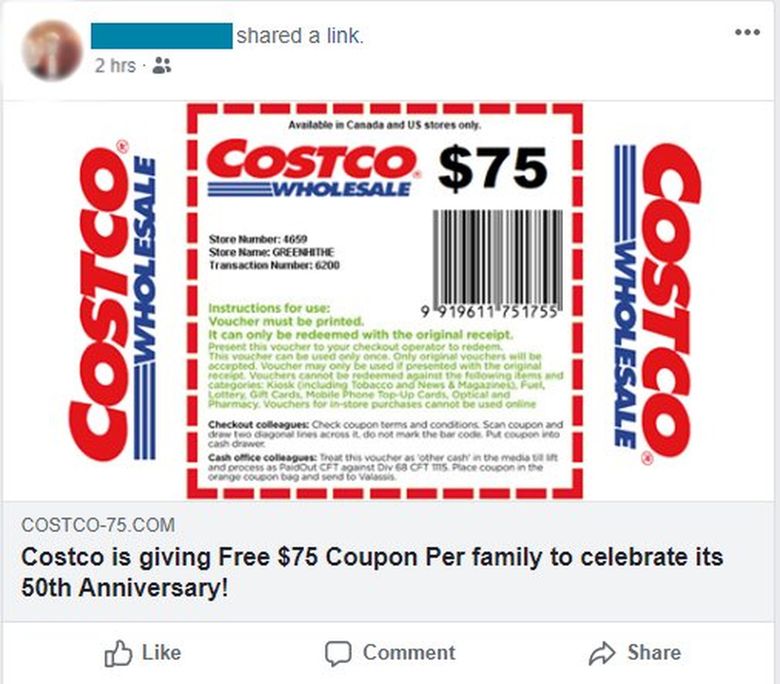
Everyone loves coupons and like many things in our lives, coupons which used to be found commonly in newspapers and magazines have migrated online. In recent years scammers have been perpetrating phony coupon scams on social media. Among the companies affected by these phony coupons were Bath and Body Works, Costco, Aldi, Starbucks and Trader Joe’s. As I have warned you many times in the past, Facebook has become a hotbed for phony online coupons. The phony coupons looks quite legitimate which means nothing because it is very easy to copy the company logos and make the coupons appear to be genuine.
The way that many phony coupon scams work is that in order to qualify for the coupon, you must complete a survey in which you are required to provide much personal information that is used to make you a victim of identity theft. In other versions of the scam, the scammer actually asks for your credit card numbers. In yet another version of the scam you are required to buy many costly items in order to claim your “free” coupon. Many of the coupon scams also require you to forward the coupon to friends which make the phony coupons appear more trustworthy when they are received by your friends. Ultimately, in all of these scams, the coupons are worthless and you get nothing but the opportunity to become a victim of identity theft. Here is a copy of a phony coupon appearing online. It was provided by the Identity Theft Resource Center.
TIPS
If the coupon appears too good to be true, it usually is a scam. No company could cover the cost of giving away vast numbers of $75 coupons although sometimes, participants in legitimate surveys are promised a chance to win a prize in a drawing. Facebook is a favorite venue for scammers perpetrating this type of scam because often unwary victims will unwittingly share the scam with their friends. One way to determine if a coupon is legitimate is to look for the expiration date found on most coupons. The phony Costco coupon shown above like most phony coupons does not carry an expiration date. The best place to go to find out if a coupon is legitimate is to go to the company’s website to see what real coupons are being offered.
If you are not a subscriber to Scamicide.com and would like to receive free daily emails with the Scam of the day, all you need to do is to go to the bottom of the initial page of http://www.scamicide.com and type in your email address on the tab that states “Sign up for this blog.”
Scam of the day – July 27, 2023 – PACT Act Scams
Since the passage of the PACT Act in 2022 which expanded VA benefits and health care for veterans who were exposed to burn pits and other toxic substances, there have been numerous companies and lawyers offering assistance in filing for benefits for conditions related to such toxic exposures in return for a percentage of your benefit award. However, you don’t need to pay to file a claim. The VA can assist you or help you identify a VA-recognized organization or VA-accredited individual to help you with your claim. You can submit your application securely online via VA.gov. There is no cost for the forms and no fee to apply. VA will never charge you to apply for benefits. In addition, Veterans Service Organizations (VSOs) and representatives are available to assist in filing claims. To help guard against fraud and scams, validate the credentials of anyone offering to help you with a VA claim by using the Office of General Counsel’s Accreditation Search tool or by contacting your local representative or VA Regional Office
TIPS
There is no deadline for filing for benefits under the PACT Act, however, if you are eligible for benefits and file prior to August 9, 2023 you may receive benefits retroactive to August 10, 2022.
For more information about the PACT Act and how to apply for benefits go to https://www.va.gov/resources/the-pact-act-and-your-va-benefits/
If you are not a subscriber to Scamicide.com and would like to receive daily emails with the Scam of the day, all you need to do is to go to the bottom of the initial page of http://www.scamicide.com and type in your email address on the tab that states “Sign up for our Blog.”
Scam of the day – July 25, 2023 – Fitness App Scams
Popular fitness trackers such as Fitbit, Garmin, Oura and Apple watches provide an easy way to measure your sleep quality, heart rate and other biological metrics and can be quite helpful. However, as I often tell you, anything popular with the public is also popular with scammers who seek to leverage that popularity into being a tool to scam you and so it is with fitness trackers.
Scammers are creating their own fitness apps or counterfeit versions of popular fitness apps so it is very important when downloading a fitness app to get it from legitimate app stores such as the Microsoft Store, Google Play or the App Store and make sure that you read all of the reviews. It is also important to remember that although all of these legitimate app stores investigate apps before offering them to the public, bogus apps do appear at all of these legitimate stores.
The most common way fitness apps are used for scams is when you make friends with people in your fitness network. Over time, scammers build trust in their communications with you through your fitness network until, after they have built a high level of trust they hit you with a scam such as an opportunity to invest in cryptocurrencies or ask you for money needed for an emergency.
TIPS
The first thing to do is to secure your account with a strong, unique password and also use dual factor authentication which you should do with any app or account that you have. You also should limit the amount of personal information that you provide and read the privacy rules for your particular app and set the privacy settings to limit the sharing of your information. Also, when setting up an account, do not use a photo of yourself, but rather use an avatar. You would be surprised how scammers can take information provided by your photograph to add to other information that they gather about you to create specifically targeted scams.
As always, never click on links or download attachments unless you have absolutely confirmed that they are legitimate.
For more information about fitness app scams, check out this video of a television interview I did recently about these scams. https://www.wwlp.com/video/mass-appeal-is-your-fitness-app-putting-you-at-risk/8791788/
If you are not a subscriber to Scamicide.com and would like to receive free daily emails with the Scam of the day, all you need to do is sign up for free using this link. https://scamicide.com/scam-of-the-day/
Scam of the day – July 24, 2023 – Storm Damaged Used Car Scams
The recent storms that ravaged parts of the country particularly in the Northeast have opened the door to a scam that often follows storm damage through extensive rain or hurricanes, namely the sale of storm damaged cars. In the past, the Massachusetts Registry of Motor Vehicles and other state RMVs have issued warnings to consumers to be on the lookout for used cars with phony title papers that indicate that the particular used car in which you are interested is from a state such as Oregon when in fact, these cars are cars that were from rain ravaged areas with many of them containing hidden water damage that could present serious safety problems.
In one instance, a report for a car purported to be from Oregon showed a damage report filed previously that showed the car listed as a total loss vehicle with a salvage title listed in New York and a new title later issued in Oregon. This practice of transporting a car to another state and re-registering it is called “title washing.”
TIPS
Whenever you buy a used car, you should always have a mechanic whom you trust check out any used car that you are considering buying. You also should always get a full report on its history. The United States Department of Justice operates The National Motor Vehicle Title Information System which provides much information about used cars. The NVMTIS provides a list of various companies such as Carfax that have been approved to provide reliable reports. These companies charge between $2.95 and $12.99 for a report that will provide detailed information on any used car you are considering purchasing.
If you are not a subscriber to Scamicide.com and would like to receive daily emails with the Scam of the day, all you need to do is to go to the bottom of the initial page of http://www.scamicide.com and type in your email address on the tab that states “Sign up for this blog.”