
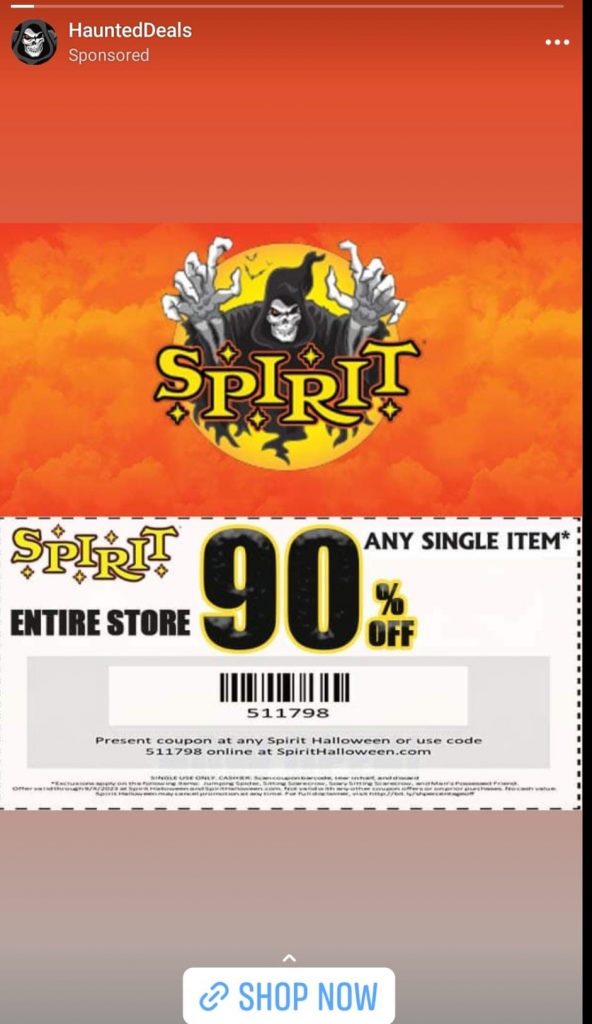
Celebrating Halloween has become a major event in recent years with many adults searching for elaborate costumes and of course whenever many people are interested in something, scammers appear ready to take advantage of that interest. Scammers have set up phony Halloween costume websites, often posing as legitimate costume websites. Often the ads for their phony websites are posted on social media as well as appearing high in search engine searches because the scammers either purchase an advertisement in order to get a high position in a search engine search or because they are skilled enough to manipulate the algorithms the search engines use to obtain a high ranking. Pictured below is one of the phony ads that has appeared in social media. Anyone ordering online from one of these phony websites will end up providing their credit card to a scammer.
TIPS
The 90% discount in the advertisement pictured above should give you pause because generally anytime the price is too good to be true, it is a scam. Also, whenever you order anything online you should use your credit card rather than your debit card because the protection you get from fraud when using your credit card is much greater than the protection you get when using your debit card.